When AI Learns to Listen; Using Imentiv's Text Emotion AI in Thought Record Therapy
Every clinician knows the moment: a client describes a stressful week in careful, measured sentences, yet something in the room feels heavier than the words suggest. Emotion lives between the lines, in the adjectives someone reaches for at 2 a.m., in the passive voice they use when recounting an argument, in the conspicuous absence of any feeling word when describing something genuinely frightening.
Cognitive Behavioural Therapy has long tried to bridge this gap through the thought record, a structured journal in which clients log situations, automatic thoughts, emotional responses, and cognitive distortions. It is one of our most powerful tools. Yet it relies on self-report, and self-report is shaped by awareness, vocabulary, and the ever-present human tendency to soften or intellectualize pain.
What if a layer of objective, sentence-by-sentence emotion analysis could sit alongside a client's own words, not to replace their voice, but to amplify what it is already quietly saying?
" Imentiv AI' s text emotion tool doesn't interpret your client for you. It hands you a lantern to walk into the text together."
That is precisely the promise of Imentiv AI's Text Emotion Analysis, and in the sections that follow, I want to explore both its remarkable capabilities and the thoughtful, ethics-first way psychologists should integrate it into clinical practice.
What Imentiv AI's Text Emotion feature actually does
Imentiv AI is a multimodal emotion recognition platform, it can analyze facial expressions from video, vocal tone from audio, and emotional content from written text. For psychologists, the text analysis arm is the most immediately relevant: it processes written passages and returns a rich, sentence-level emotional breakdown.
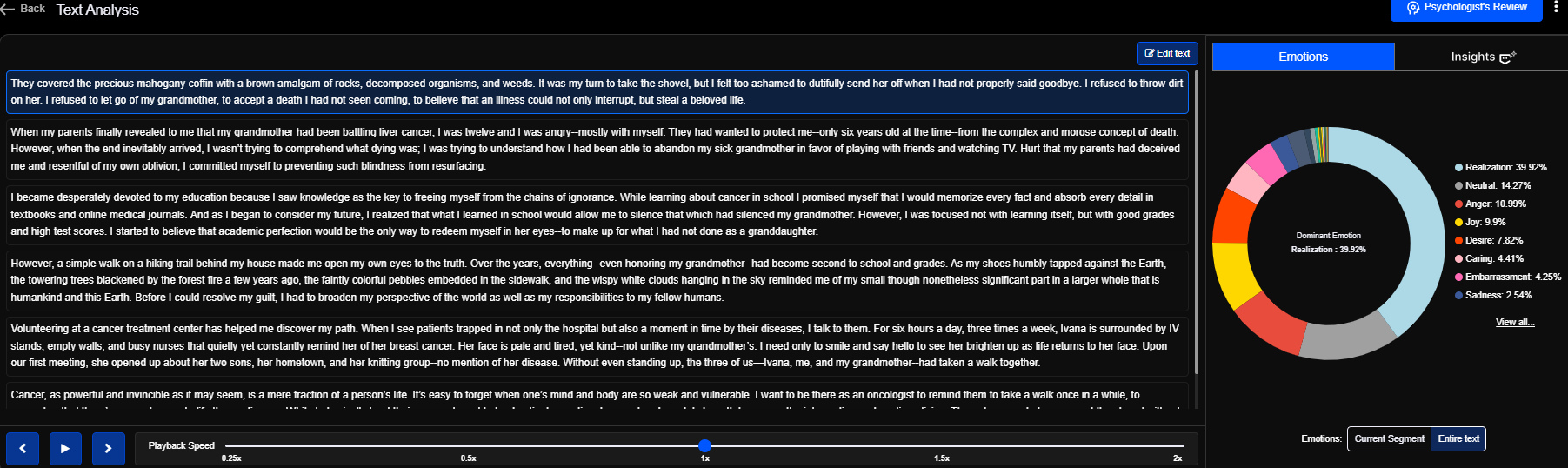
Rather than reducing language to a simple positive / negative / neutral score, Imentiv's deep learning model identifies 28 distinct emotions within a single body of text. This is not superficial sentiment analysis, it is a psychological-grade palette spanning the full range of human feeling:
Positive & Approach emotions: Admiration, Amusement, Approval, Caring, Curiosity, Desire, Excitement, Gratitude, Joy, Love, Optimism, Pride, Relief
Difficult & Withdrawal emotions: Anger, Annoyance, Disappointment, Disapproval, Disgust, Embarrassment, Fear, Grief, Nervousness, Remorse, Sadness
Transitional & Neutral states: Confusion, Realization, Surprise, Neutral
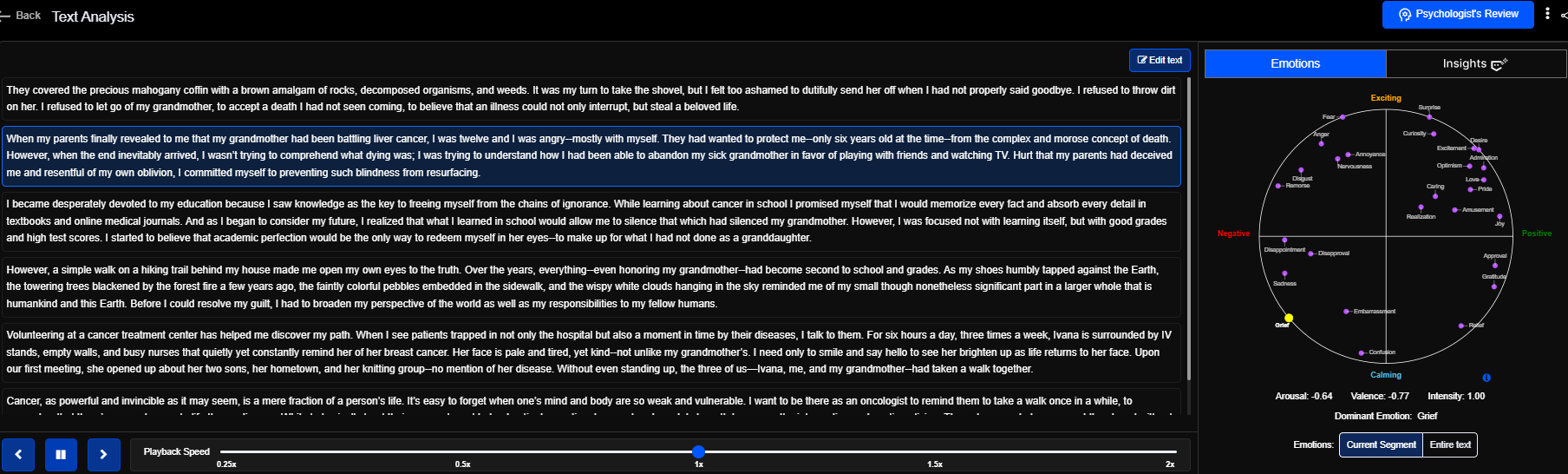
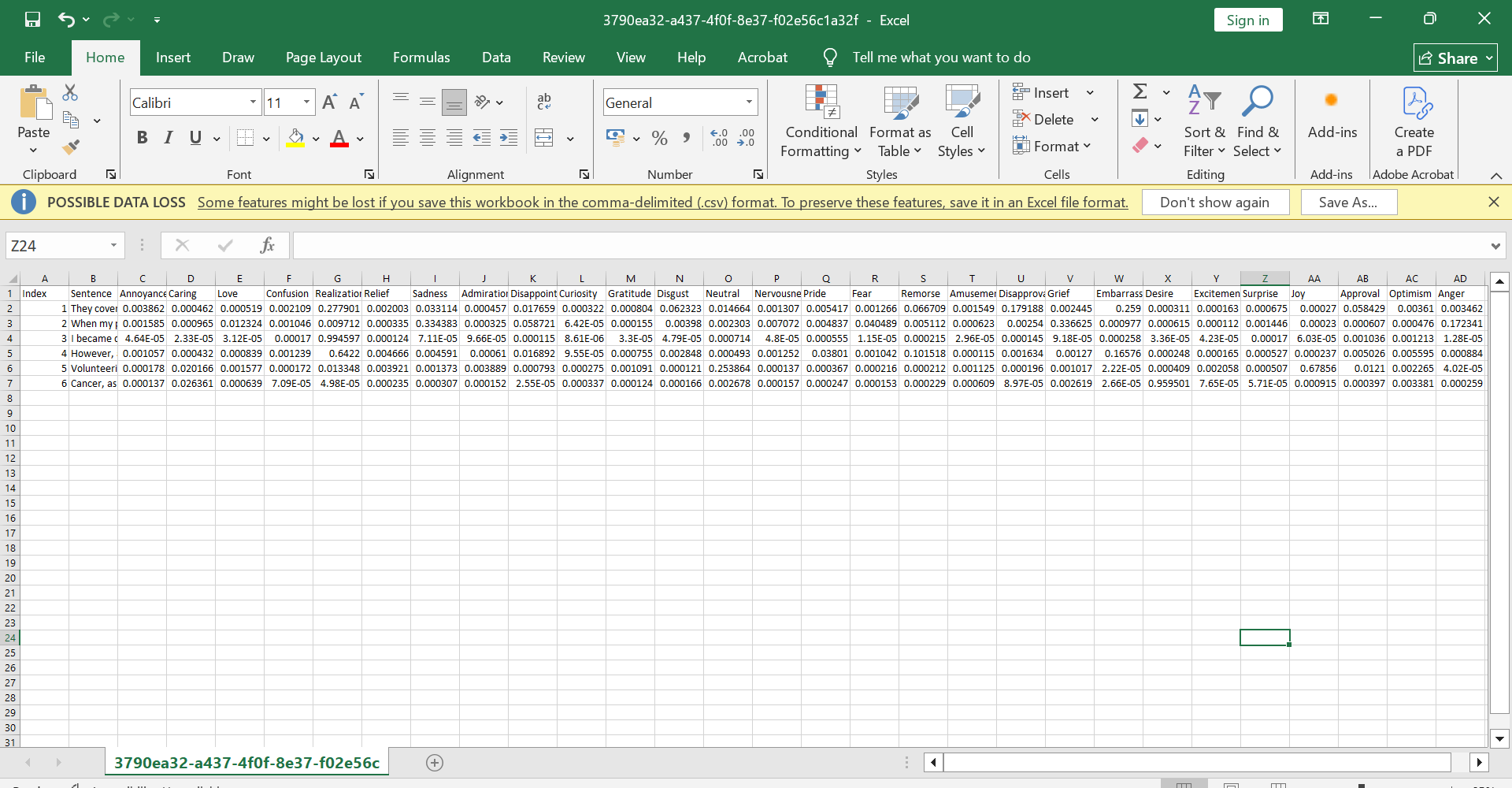
Beyond labelling individual emotions, the platform identifies the dominant emotional tone across the whole text, flags emotional transitions between sentences, and can export results as a visual graph, a CSV, or a PDF, all formats a busy clinician can actually use.
Key features at a glance
Sentence-level granularity — Each sentence receives its own emotion score, so you can trace exactly where a mood shift occurs in a client's writing.
Emotional journey graph — A timeline view showing how emotional intensity rises and falls through the passage, invaluable for spotting escalation patterns.
CSV & PDF export — Results can be saved and appended to clinical notes, providing a longitudinal record of emotional patterns across sessions.
The thought record reimagined with AI-detected emotion
The classic CBT thought record asks clients to fill in five to seven columns: Situation → Automatic Thought → Emotion → Evidence For → Evidence Against → Balanced Thought → Outcome . It is elegant, and when clients engage with it honestly, transformative.
Here is where Imentiv AI creates a meaningful addition. When a client submits their completed thought record, either typed during the week or transcribed from a handwritten sheet, the text can be passed through the emotion analyzer before the next session. The result: a granular emotion profile of their own words that neither the client nor the psychologist has to infer.
Below is an annotated example showing how a single thought record entry might look when enriched with Imentiv AI's emotion output.
Thought Record — Session 7 | Client A (Imentiv AI Enhanced)
SITUATION — What happened?
I sent an email to my manager about the project delay, and she replied with a one-line response. She didn't say anything bad, but she used my full name in the greeting, which she never does.
AUTOMATIC THOUGHT — What went through your mind?
She's disappointed in me. I always ruin things just when they start going well. I'll probably lose this job too.
Imentiv AI insight: Dominant emotions detected — Nervousness · Shame · Sadness . Sentence 2 ("I always ruin things") carries the highest intensity spike — a potential target for cognitive restructuring.
EMOTIONS FELT — Self-reported ratings
Anxiety (80%), Shame (65%), Sadness (50%)
Imentiv AI insight: AI-detected profile aligns closely with self-report. Additionally, flags Disappointment (not self-reported) — a useful discussion point: "Who are you disappointed in?"
EVIDENCE FOR — Supporting the thought
She did use my full name. She usually says "hi" and signs off with a joke. This response had neither.
EVIDENCE AGAINST — Challenging the thought
She could have been in a rush. She approved my last three project proposals without comment. My team actually said the delay wasn't my fault.
Imentiv AI insight: Emotional tone shifts here — Optimism and Curiosity emerge. The client's language becomes slightly more expansive, suggesting genuine engagement with the counter-evidence.
BALANCED THOUGHT — Reframed perspective
My manager was brief, and I'm not sure why. It's possible she's busy. My record at this job is actually solid. I don't need to spiral before I even know what she thinks.
Imentiv AI insight: Dominant shift to Relief and Optimism . Anxiety score drops significantly, measurable evidence that the reframe is being internalised, not just performed.
Notice what the AI layer adds: it doesn't override Client A's self-report, it corroborates and extends it . The unexplored "Disappointment" (column 3) becomes an opening for the next session. The measurable emotional shift between the automatic thought and the balanced thought gives both therapist and client tangible evidence that the reframe is working.
Six ways psychologists can use text emotion AI in practice
1. Between-session journaling analysis
Clients submit weekly journal entries via a secure portal. Before each session, the psychologist reviews the Imentiv AI emotion graph to identify which days carried the highest emotional intensity, and starts the session there. This keeps the hour focused on what actually matters to the client that week, rather than what they think they should bring up.
2. Measuring therapeutic progress over time
Run a client's thought records from Month 1 and Month 4 through the analyzer. The shift in dominant emotions, or the shortening of high-anxiety sequences, provides objective evidence of progress that resonates with clients who struggle to feel their own improvement. Seeing "your nervousness intensity has halved since we started" can be more convincing than any reassurance a therapist can offer verbally.
3. Crisis monitoring through written check-ins
For high-risk clients, brief daily written check-ins analyzed by Imentiv AI can flag spikes in fear, grief, or despair, prompting a timely call between scheduled sessions rather than waiting for things to escalate. The tool becomes an early warning layer that supports, but never replaces, clinical risk assessment.
4. Surfacing emotions clients cannot name
Alexithymia, difficulty identifying and describing feelings, affects a significant proportion of clients with depression and PTSD. The AI's 28-emotion breakdown can offer vocabulary to someone who writes "I just felt weird" and discovers it maps to Realization and Nervousness . Having a name for an emotion is often the first step toward regulating it.
5. Supervision and training
Trainee therapists can submit anonymized session transcripts for emotion analysis, developing their attunement to emotional subtext by comparing their own clinical impressions to the AI's sentence-level breakdown. It is a powerful mirror for developing emotional intelligence in the consulting room.
6. Schema pattern identification
Across multiple thought records, recurring emotion clusters, shame appearing alongside any situation involving authority figures, for example, can illuminate deep maladaptive schemas that might take months to surface through conversation alone. The AI becomes a pattern-recognition partner across a client's entire written history.
Holding the technology responsibly
As clinicians, our first obligation is to our clients' well-being, and any technology that touches therapeutic material must be held to an exacting standard. I want to name several considerations clearly.
Informed consent is non-negotiable
Clients must know, in plain language, that their written material may be processed by an AI tool, what data is stored, and how results will be used. Consent must be specific, written, and freely given. "I agreed to therapy" is not consent to AI analysis.
The AI is a clinical aid, not a clinician
Imentiv AI's emotion outputs are probabilistic labels derived from patterns in training data. They can be wrong, culturally inflected, or simply miss the idiosyncratic way a particular client uses language. The psychologist's contextual knowledge, the therapeutic relationship, and clinical judgment remain primary. The AI adds a lane to the road; it does not drive the car.
Data security and jurisdiction
Thought records contain some of the most sensitive personal disclosures a human being can make. Before using any cloud-based tool with clinical material, verify that it meets the data protection requirements of your jurisdiction — GDPR in the European Union, HIPAA in the United States, and the DPDP Act in India, among others. Work with your institution's data protection officer and, where in doubt, use fully anonymized or fictional data for demonstration purposes.
Protecting the therapeutic relationship
Technology can feel cold. Some clients will find it empowering and validating to see their internal world mapped; others may feel scrutinized or reduced to data. Introduce the tool collaboratively, frame it as a shared exploration, and remain responsive to any discomfort. The relationship is always more important than the analysis.
"The measure of a good clinical tool is not what it can detect, it is what it enables the therapist and client to explore together."
Emotion AI as a scaffold for deeper human understanding
The thought record is already one of the most evidence-based interventions we have. Layering Imentiv AI's text emotion analysis on top of it does not make it more technological, it makes it more human . It gives us a way to honour the full complexity of what a client is expressing, to notice the emotions that do not make it into their self-ratings, and to measure with some objectivity whether the interior weather is truly shifting.
We are at an early and genuinely exciting moment in the integration of emotion-aware AI into mental health care. The tools are imperfect, the ethical frameworks are still being written, and the research base is growing. But the direction is clear: AI that can read emotional nuance will increasingly sit alongside clinicians, not to replace our empathy, but to extend our perception.
Used thoughtfully, Imentiv AI's text emotion feature is not surveillance. It is a more sensitive listening post, and in a discipline where listening is everything, that matters enormously.
Curiosity is the beginning of healing.
Note: AI-generated emotional interpretations are probabilistic and may not fully capture individual, cultural, contextual, or nuanced human experiences. Any use of Emotion AI within therapeutic or research settings should be conducted ethically, with informed consent, appropriate data protection measures, and professional oversight. Clinicians remain solely responsible for all clinical decisions, interpretations, and interventions.