Disapproval
Disapproval is the emotional and social signal that someone rejects, disagrees with, or is dissatisfied with what another person has said, done, or expressed. It functions as a form of negative feedback that communicates misalignment in values, expectations, or behavior, and it can appear in facial expressions, body language, and written text.
Signals of disapproval in communication
Disapproval is often more layered than approval. People frequently soften or mask it, especially in professional settings, which makes it harder to detect without careful attention to emotional cues.
Facial cues
Furrowed brows, pursed lips, downturned mouth corners, and averted eye contact are universal markers of disapproval.
Verbal signals
Phrases like "I don't think that's right," "this isn't what I expected," or silence where agreement is anticipated.
Negative sentiment in text
Criticism, hedged language, complaint framing, and passive disagreement markers show up clearly in written communication.
Body language
Crossed arms, leaning back, reduced responsiveness, and physical distancing are behavioral signs of disapproval.
The psychology behind disapproval
Disapproval is an active emotional state with its own physiological and social consequences. When a person receives disapproval, the brain registers it as a social threat, triggering responses similar to physical pain. Research in social neuroscience has found that social rejection and disapproval activate overlapping brain regions with physical discomfort.
This reaction is rooted in human evolutionary history. For most of human development, being excluded or disapproved of by a group carried real survival risks. That wiring remains active today, which is why disapproval, even in low-stakes professional contexts, can feel disproportionately intense.
Disapproval also functions as a mechanism of social correction. In group dynamics, it signals that a behavior or idea falls outside accepted norms, prompting recalibration. This makes it a powerful driver of behavioral change, both constructive and destructive, depending on how it is expressed. Understanding disapproval is central to fields like behavioral emotion analysis and organizational psychology.
In written communication, disapproval is particularly easy to misread. Tone is absent, so a measured critique can land as a harsh rejection, or a genuine concern can be buried in polite language and missed entirely.
Disapproval vs. Approval: Key Differences
The two emotions sit at opposite ends of the same social signal spectrum, but they are not simple mirror images. Disapproval tends to carry more emotional complexity and is more often concealed or softened than approval.
- Positive sentiment markers
- Agreement and affirmation words
- Open body language and eye contact
- Encourages continued behavior
- Usually expressed directly
Disapproval
- Negative or hedged sentiment
- Criticism, doubt, or complaint language
- Closed posture, avoidance cues
- Signals a need for correction
- Often expressed indirectly
Because disapproval is frequently softened or implied, detecting it accurately in text requires understanding more than keyword sentiment. Context, phrasing patterns, and emotional subtext all matter, which is where nuanced emotion classification tools outperform basic positive/negative scoring.
Example — Customer Feedback
A customer writes: "The product arrived three days late, and when I finally opened it, the setup instructions made no sense. Not what I paid for." This text carries clear disapproval signals: unmet expectations ("not what I paid for"), frustration markers ("finally"), and direct criticism of the product experience. A text emotion analysis platform would classify this as disapproval with high confidence, distinct from mild dissatisfaction or a neutral complaint.
How Emotion AI Detects Disapproval?
Disapproval is often subtle in text and rarely expressed through strong negative words. Humans can miss these signals, especially in large-scale or digital communication. Emotion AI is needed to detect these hidden cues by analyzing multiple layers of communication beyond basic sentiment.
Traditional analytics systems may struggle to detect nuanced signals because they rely on explicit keywords or sentiment polarity. Platforms such as Imentiv AI uses advanced text emotion analysis to detect disapproval by evaluating patterns such as negative or uncertain sentiment, disagreement language, hesitation cues, and contextual shifts in tone. Instead of focusing only on direct expressions, it analyzes how disapproval emerges across the flow of communication.
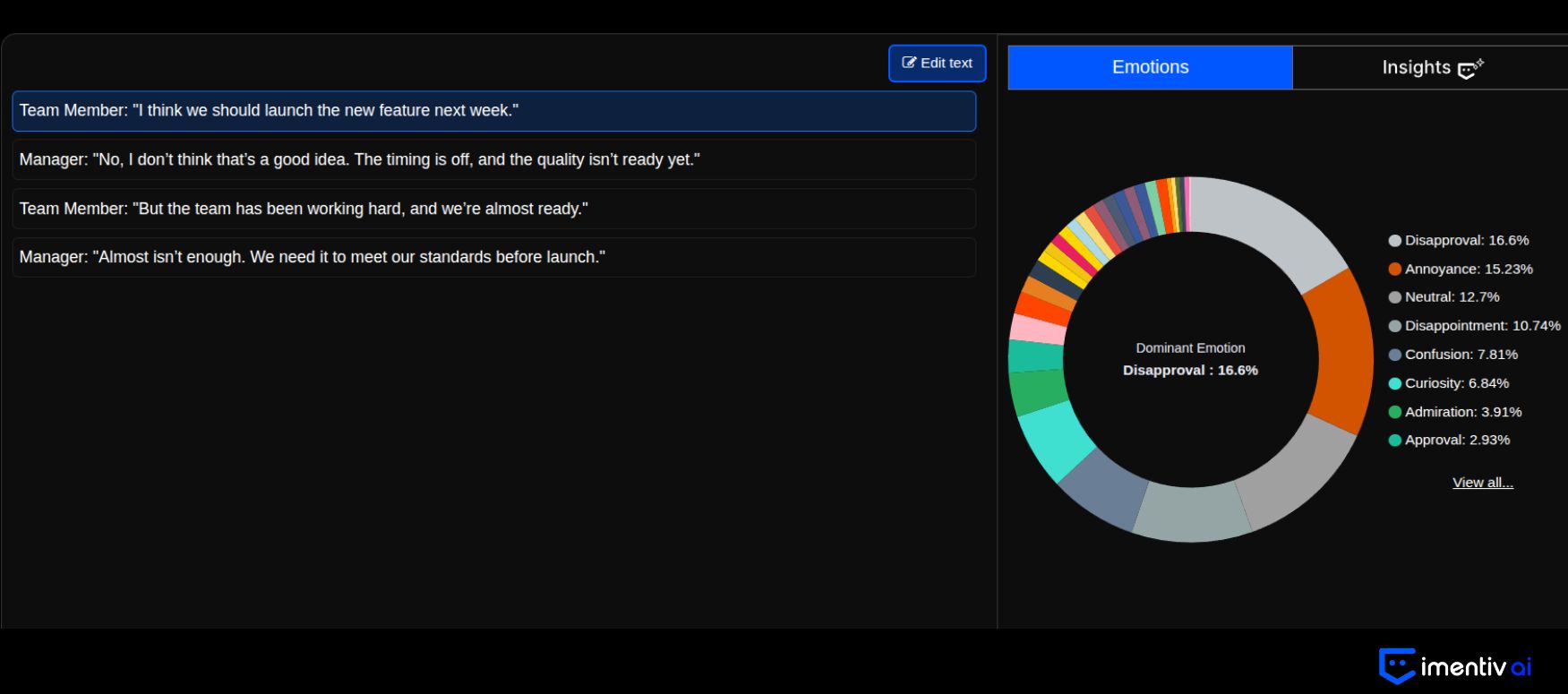
This enables organizations to identify friction in customer feedback, detect concerns in interviews, understand audience resistance in campaigns, and address issues before they escalate. By capturing subtle disapproval signals, Imentiv AI provides a deeper understanding of how people truly respond.