Approval
Approval is the emotional and social signal that someone accepts, agrees with, or supports what another person has said, done, or expressed. In human communication, it acts as positive reinforcement that confirms shared values, encourages behavior, and builds social bonds.
Signals of approval in communication
Approval rarely arrives as a single clear message. It comes through a combination of verbal cues, body language, and emotional tone. Understanding these signals is important for anyone studying human behavior, customer experience, or emotion detection in conversation.
Facial expressions
Genuine smiles, raised eyebrows, and open eye contact are the most immediate visual cues of approval.
Verbal affirmation
Words like "yes," "exactly," "good point," or "I agree" communicate approval explicitly in speech and text.
Positive sentiment
Text with low negativity, high agreement markers, and encouraging phrasing signals an approving emotional state.
Nodding and posture
In live interaction, head nods and open body posture serve as non-verbal approval that reinforces spoken words.
Want to see how approval shows up across real conversations? Imentiv AI detects signals of agreement, validation, and support within text, helping you understand where approval is driving engagement, decisions, and behavior. Explore Imentiv AI.
The psychology behind approval
Approval is one of the most fundamental human social needs. Psychologist Abraham Maslow identified belonging and esteem, which include receiving approval from others, as core layers of human motivation in his widely cited Hierarchy of Needs.
Approval activates the brain's reward pathways. When we receive it, the brain releases dopamine, reinforcing the behavior that earned that response. This is why approval shapes repeated actions in both personal relationships and professional environments. In workplaces, teams that communicate approval more often through positive feedback tend to show higher engagement and psychological safety.
Approval also plays a key role in social emotion recognition. Humans are remarkably sensitive to detecting the absence of approval. A neutral or ambiguous response in a context where approval is expected can trigger anxiety, self-doubt, or withdrawal.
In written communication, this becomes especially complex. Without vocal tone or facial cues, readers rely entirely on word choice, sentence structure, and emotional framing to infer whether approval is being expressed. A short reply of "okay" in a text conversation carries entirely different emotional weight depending on context.
Example — Workplace Context
A manager responds to a team member's proposal with: "This is exactly what we needed. You addressed every concern I had, and the timeline is realistic." That response is rich with approval signals: affirmation ("exactly what we needed"), validation of effort ("you addressed every concern"), and confidence in the plan. An AI emotion analysis tool would flag this as highly positive sentiment with strong agreement markers.
Example — Customer Feedback
A customer writes: "The support team was patient and actually solved my problem the first time. I'll definitely be back." This text signals approval through satisfaction markers ("solved my problem"), reliability language ("first time"), and intent to return. Detecting these signals at scale helps businesses measure service quality more accurately than star ratings alone. This is a direct application of text-based sentiment and emotion analysis.
How Emotion AI detects approval
Approval is not always explicitly stated. Many approval signals are subtle, especially in text and digital communication. This is where emotion AI becomes valuable.
Traditional sentiment analysis tools classify text as positive, negative, or neutral. That is useful, but it misses nuance. Approval is a specific emotion within the positive range, and it carries different implications than excitement, relief, or happiness. Imentiv AI is built to distinguish these emotional states through granular emotion classification in text.
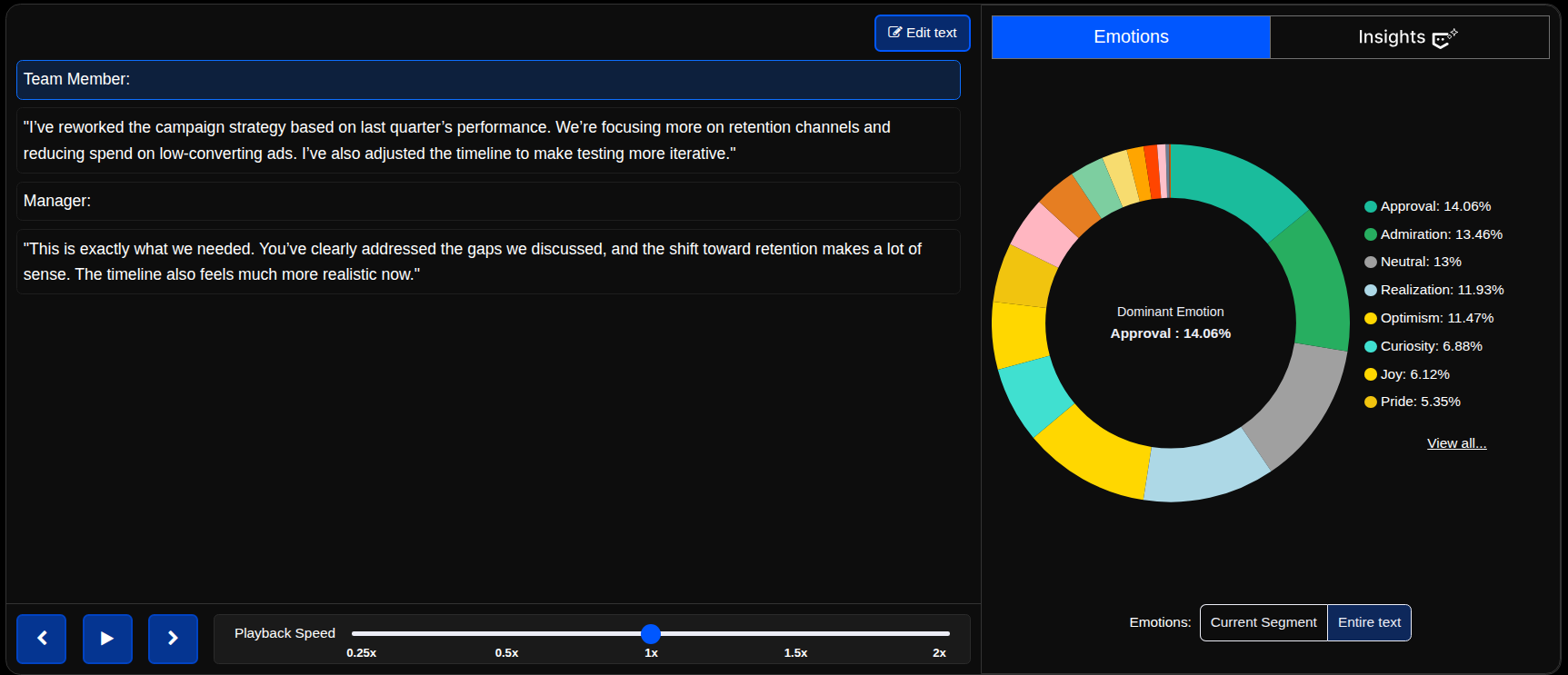
Use cases where detecting approval matters include:
Customer support
Know when customers express satisfaction versus neutral resolution, and respond accordingly.
Product feedback
Separate approving reviews from vague or hedged ones to prioritize what is actually working.
Team communication
Identify patterns of approval and engagement in async team communication tools.
Research and surveys
Go beyond rating scales to understand the emotional quality behind open-ended responses.
The ability to detect approval in text is part of a broader capability in human emotion recognition using AI. When combined with context, timing, and interaction history, approval signals become a powerful input for understanding how people feel about what they encounter.
See approval detection in action
Imentiv AI helps teams understand the emotional signals inside everyday communication. Analyze text, surface approval patterns, and make decisions backed by real emotional context.