Realization
Realization is a cognitive–emotional moment of insight — the moment when something truly makes sense. It is the sudden or gradual awareness of a truth, pattern, consequence, or meaning that was previously unclear. Unlike surprise, which is a reaction to the unexpected, realization involves understanding. It marks a shift from not knowing to knowing, from assumption to clarity.
At its core, realization is both mental and emotional. Cognitively, it reflects new information being integrated into existing beliefs. Emotionally, it often carries a tone of relief, regret, excitement, concern, motivation, or even discomfort. All these depend on what has been understood. It is the internal turning point that changes perception.
Psychological Perspective
Psychologically, realization is linked to insight learning and metacognition — the ability to think about one’s own thinking. It often occurs when:
- A contradiction becomes clear
- A hidden pattern is recognized
- A personal blind spot is acknowledged
- Cause and effect are understood
- New information reframes past experiences
Realization can feel empowering (“Now I get it”), unsettling (“I didn’t see that before”), or motivating (“This needs to change”). Because it reorganizes understanding, it often precedes behavioral change.
How Realization Appears in Communication
Although realization happens internally, it frequently shows up in observable signals across language, voice, and facial expression.
Verbal Indicators (What People Say)
Common phrases associated with realization include:
- “Oh, I see.”
- “Now that makes sense.”
- “I didn’t think about it that way.”
- “So that’s why…”
- “I just realized…”
Language often shifts from uncertainty to clarity. Sentences become more definitive. Explanations become more structured. There may also be reflective statements that connect new insight to past assumptions.
Vocal Indicators (How It Sounds)
In audio conversations, realization may include:
- A brief pause before responding
- A softer or slower tone as the meaning sinks in
- A shift in pitch, often rising slightly during the moment of insight
- A change in speech rhythm as the speaker reorganizes thoughts
Facial Indicators (What It Looks Like)
In video interactions, realization may appear as:
- Raised eyebrows or widened eyes
- A subtle nod
- A brief stillness followed by a change in expression
- A small smile when understanding is positive
- A tightening of the lips or furrowed brow when the insight is difficult
These signals are typically short-lived but meaningful. They indicate that a new understanding is forming in real time.
Realization and Emotion AI
As realization often involves subtle emotional and communicative shifts, it can be identified through multimodal analysis, especially in text and conversational data.
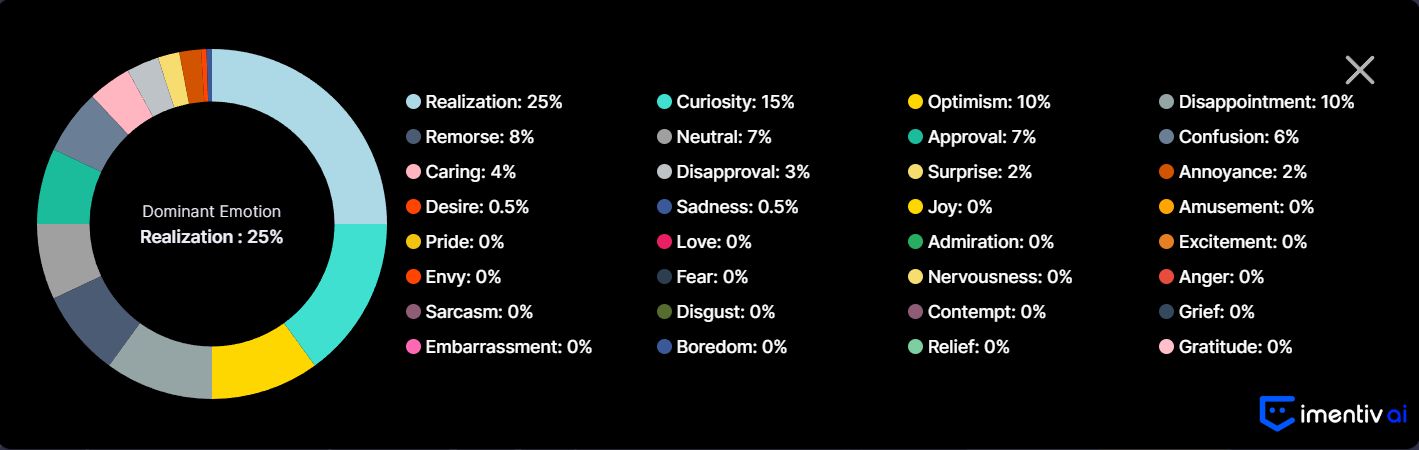
In video and audio contexts, while realization is not labeled as a standalone emotion category, insight-related emotional shifts may be inferred through:
- Micro-pauses
- Tone modulation
- Facial changes associated with understanding
- Transitions from confusion or doubt to clarity
By analyzing video, audio, and text signals together, Imentiv AI helps identify moments where perception changes — enabling teams to pinpoint when understanding truly occurs.
For organizations, this insight is powerful. It allows trainers to measure learning impact, leaders to recognize coaching breakthroughs, and sales teams to detect genuine buyer alignment rather than surface agreement.
Ethical Consideration
Realization is a deeply human cognitive–emotional experience. While AI systems can detect patterns associated with insight, they do not experience understanding themselves.
Imentiv AI is designed to complement professional judgment by highlighting potential moments of insight across text, audio, and video interactions. It supports human interpretation and decision-making — it does not replace it.