Confusion
Confusion is an emotional and cognitive state that happens when something is unclear, inconsistent, or hard to understand. It’s the feeling of “I don’t quite get this” or “something doesn’t make sense.” This can occur in conversations, learning situations, or decision-making moments—anytime the brain struggles to process information clearly.

What is the psychological meaning of confusion?
From a psychological perspective, confusion is a temporary disruption in how we think and understand information. It happens when new input doesn’t match what we already know, creating a sense of mental imbalance that the brain tries to resolve.
Some key ideas that explain this:
- Cognitive Disequilibrium (Jean Piaget – Jean Piaget’s Theory of Cognitive Development): Piaget explained that confusion occurs when new information doesn’t fit into our existing understanding (schemas). This creates a state of imbalance, pushing us to adjust and learn.
- Cognitive Overload (John Sweller – Cognitive Load Theory): Sweller’s work shows that when too much information is presented at once, the brain becomes overloaded, making it difficult to process and leading to confusion.
- Knowledge Gaps (George Loewenstein – Information Gap Theory): Loewenstein suggested that confusion can arise when we become aware of a gap between what we know and what we want or need to know.
Confusion isn’t always negative. In small amounts, it can encourage curiosity and deeper thinking. But when it lasts too long, it can lead to frustration, disengagement, and hesitation.
Behavioral and Communication Cues of Confusion
Confusion manifests through subtle but identifiable signals across communication channels.
Verbal cues:
- Clarification-seeking questions: “What does that mean?” “Can you repeat that?”
- Expressions of uncertainty: “I’m not sure I understand.”
- Attempts to rephrase or confirm understanding
Vocal cues:
- Hesitations, pauses, or filler words
- Rising intonation indicating uncertainty
- Slower or uneven speech patterns
Facial cues:
- Furrowed brows or tightened facial muscles
- Squinting or head tilting
- Brief expressions of puzzlement or disengagement
These cues are often fleeting and can be easily overlooked, especially in fast-moving or remote interactions.
What if you could see confusion the moment it happens? Discover it with Imentiv AI.
Why does confusion matter in professional contexts?
Confusion plays a bigger role in business communication than it might seem. When people don’t fully understand something, it affects how they respond, decide, and engage.
Learning and Development: Confusion can signal active cognitive engagement when learners encounter new material. However, if not addressed, it can reduce comprehension, retention, and confidence.
Customer Interactions: Customer confusion often indicates unclear messaging, poor user experience, or misaligned expectations. Left unresolved, it can lead to dissatisfaction and churn.
Sales Conversations: In sales, confusion is a hidden barrier to conversion. When prospects do not clearly understand value propositions, pricing, or differentiation, they hesitate or disengage.
Leadership Communication: Leaders communicating complex strategies or change initiatives must manage confusion carefully. Unchecked confusion can result in misalignment, reduced trust, and ineffective execution.
The challenge is that confusion is often hidden. People may not always express it directly, which makes it harder to identify and address.
How does Emotion AI detect confusion?
Emotion AI helps make confusion visible by analyzing how people communicate. Platforms like Imentiv AI look beyond just words to understand how information is being processed.
A key part of this is transcript and
text analysis
. By studying conversations and written communication, Imentiv AI can detect patterns like repeated questions, unclear phrasing, hesitation, or inconsistent responses—subtle signals that often indicate confusion.
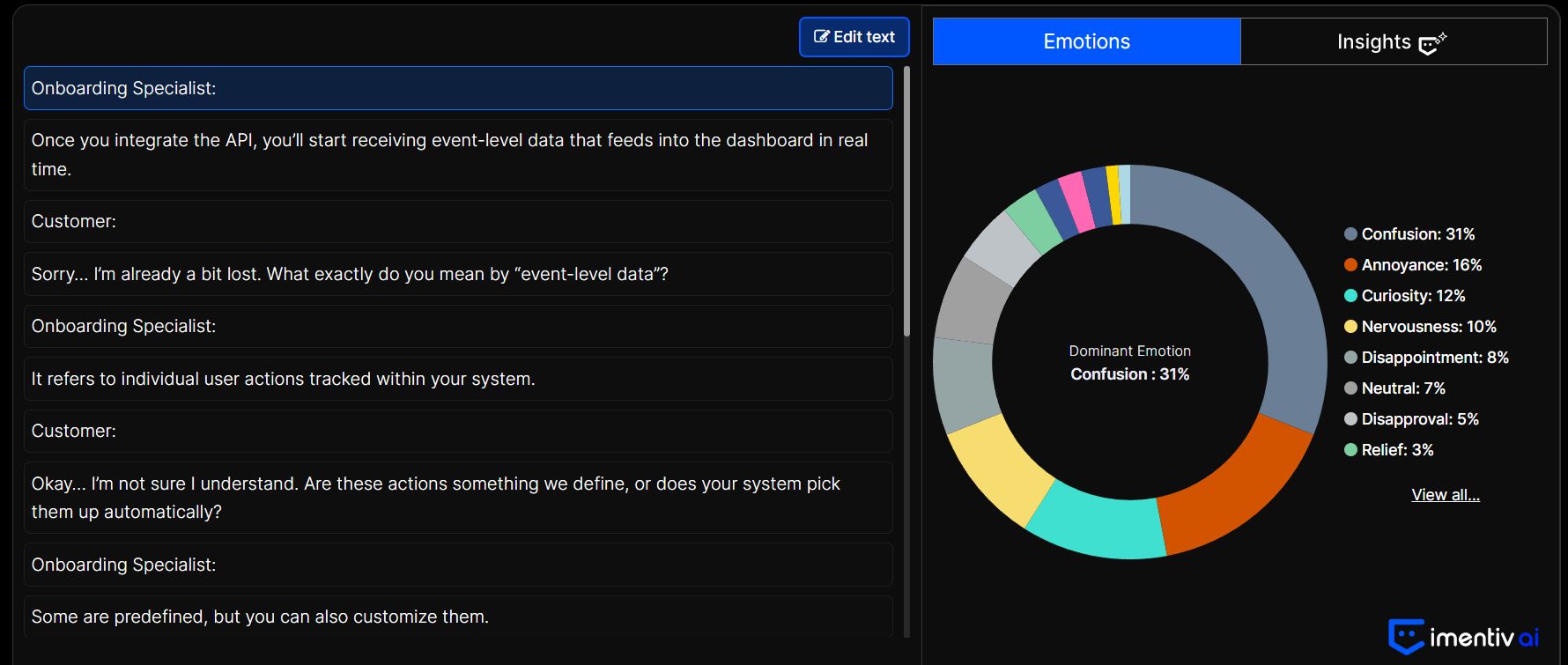
When this is combined with facial expressions and vocal tone—such as brief moments of puzzlement or uncertainty—it creates a clearer picture of where confusion is happening.
Instead of guessing, teams can see exactly where communication breaks down and why.
How can confusion be turned into clarity?
Confusion is not just a problem—it’s a signal. It shows where something needs to be clearer, simpler, or better explained.
With insights from Imentiv AI, organizations can identify these moments and improve how they communicate, teach, and engage. What was once hidden becomes something you can act on.