Disappointment
Disappointment is an emotional response that occurs when expectations are not met. It arises when reality falls short of what someone hoped for, anticipated, or believed would happen. Unlike anger, which is often intense and outwardly directed, disappointment is typically quieter and reflective. It signals a gap between expectation and outcome.
Psychological Perspective
From a psychological perspective, disappointment is closely linked to expectation and cognitive appraisal. Human beings constantly form mental predictions about future outcomes. This can be related to personal goals, professional performance, or service experiences. When those predictions are not fulfilled, the brain registers a mismatch between anticipated reward and actual result.
This expectation gap creates a sense of perceived loss. It is not necessarily of something tangible, but of something imagined. As a result, individuals may experience reduced motivation, lowered enthusiasm, or emotional withdrawal. Unlike frustration, which may push someone toward immediate action, disappointment often leads to reflection or disengagement.
Importantly, disappointment also serves an adaptive function. It helps individuals reassess expectations, refine goals, and seek clearer communication. When acknowledged constructively, it can support growth and improve alignment.
Disappointment doesn’t start loud—it starts subtle. Detect it early with Imentiv AI.
Behavioral and Communication Cues

Disappointment often appears subtly, possibly as a decrease in enthusiasm rather than an obvious expression of unhappiness.
Facial Cues (in direct interactions)
- Slight downward turn of the lips
- Reduced eye contact
- Lowered head posture
- Minimal facial animation
Vocal Cues
- Softer or flatter tone
- Slower speech pace
- Audible sighs
- Reduced vocal intensity
Verbal and Text-Based Cues
- “I expected more.”
- “This isn’t what I had in mind.”
- “I was hoping for something different.”
- Polite but restrained criticism
- Noticeable shift from earlier enthusiasm
In written communication—such as emails, chat conversations, surveys, or feedback forms—disappointment often appears through expectation-related language and subtle sentiment decline rather than explicit complaint.
Disappointment in Professional Contexts
Disappointment is particularly important in workplace and business communication because it often appears before escalation.
Customer Feedback:
Customers may express disappointment through moderate ratings, neutral-toned reviews, or language referencing unmet expectations. If ignored, this can progress into dissatisfaction or churn.
Interviews and Hiring:
Candidates may show disappointment when role clarity, growth prospects, or compensation differ from expectations. Hiring teams may also communicate disappointment in structured feedback.
Leadership Communication:
Employees may express disappointment in engagement surveys when recognition, growth, or strategy does not align with expectations. Leaders communicating disappointment must do so carefully to avoid lowering morale.
Su pport Interactions:
In chat and email support, disappointment frequently appears before frustration intensifies. Early recognition allows teams to respond empathetically and close expectation gaps.
Across contexts, disappointment acts as an early emotional signal of misalignment.
Disappointment in Imentiv AI’s Text Emotion Analysis
From an emotion AI perspective, disappointment is an emotional state associated with unmet expectations and a decline in positive sentiment. Rather than relying on a single signal, emotion AI systems analyze patterns across facial expressions, vocal tone, language, and interaction context. Indicators may include subtle facial cues such as lowered gaze or reduced facial animation, flatter or slower speech patterns, and expectation-related language that suggests something did not meet what was hoped for. By evaluating these signals together and considering shifts in tone or sentiment over time, emotion AI can identify moments where expectations and outcomes may not align.
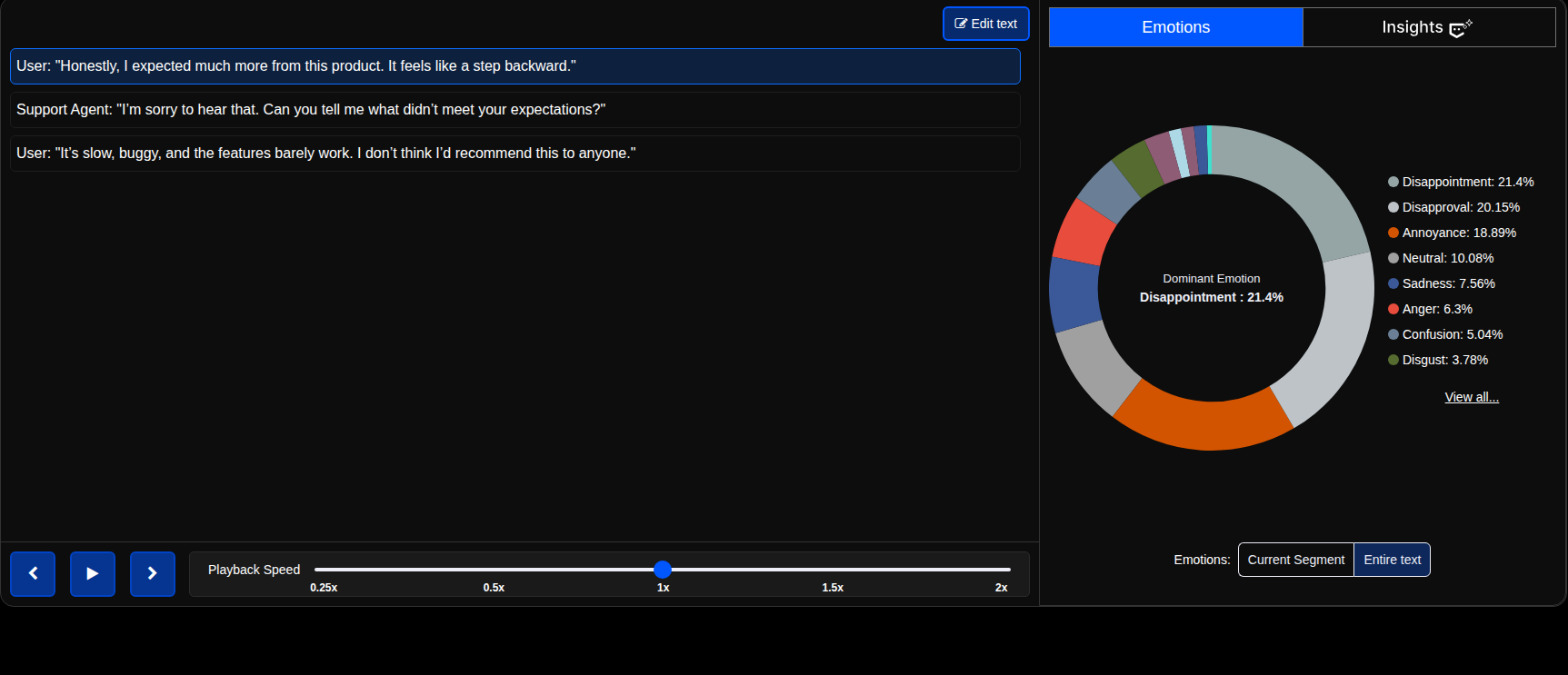
Imentiv AI detects disappointment through advanced text and transcript emotion analysis. The system uses natural language processing and contextual emotion modeling to identify patterns associated with unmet expectations. Rather than focusing on isolated keywords, it evaluates emotional meaning within the broader conversational context.
Disappointment is often reflected in expectation-gap language such as references to what was “expected,” “hoped for,” or “thought would happen.” It may also appear through subtle negative sentiment shifts, polite but restrained dissatisfaction, or a noticeable reduction in enthusiasm across responses. In many professional interactions, disappointment is expressed indirectly, making contextual interpretation essential.
For example, a phrase like “It’s fine” may indicate neutrality in one context but signal disappointment in another, depending on surrounding language, prior tone, and conversational progression. Imentiv AI analyzes these nuances across customer feedback, surveys, interviews, and support transcripts to surface patterns of unmet expectations.
By identifying disappointment signals in written communication, organizations can recognize early dissatisfaction, address expectation gaps, and improve response strategies before issues escalate.
Ethical Considerations
Disappointment is a subjective and context-dependent emotion shaped by personal expectations, communication style, past experiences, and cultural background. The same language may reflect different emotional meanings depending on context.
While emotion AI systems can identify patterns associated with unmet expectations, these insights are intended to support interpretation—not to label individuals or define intent. Emotional detection in text represents probabilistic analysis, not definitive judgment.
Imentiv AI supports professional insight and better communication, while keeping human judgment central to interpretation.