Grief
Grief is the deep emotional suffering that follows the loss of someone or something important. While most commonly associated with death, grief can also arise from experiences such as divorce, job loss, illness, miscarriage, relocation, or the loss of identity, roles, or expectations. It is a universal yet deeply personal response, often involving emotional, cognitive, behavioral, physical, and social reactions.
Common emotional responses to grief include sadness, anger, guilt, numbness, confusion, and, at times, relief or emptiness. Grief does not follow a fixed pattern, and there is no single “right” way to grieve. The intensity, expression, and duration of grief vary widely across individuals, cultures, and circumstances.
What is Grief in a Psychological Perspective?
In psychology, grief is understood as a natural and complex emotional process that supports adaptation and healing following loss. It is not considered a mental disorder in itself; however, in some cases, grief may become prolonged or complicated and overlap with clinical conditions such as Persistent Complex Bereavement Disorder or Major Depressive Disorder.
Several psychological models help explain how people experience grief:
- Kübler-Ross’s Five Stages of Grief — Denial, Anger, Bargaining, Depression, and Acceptance — which describe common emotional reactions, though not in a fixed or linear order.
- Worden’s Tasks of Mourning, which focus on accepting the reality of the loss, processing emotional pain, adjusting to life without the loss, and maintaining an enduring connection while moving forward.
- The Dual Process Model, which emphasizes oscillation between loss-oriented coping (emotional confrontation) and restoration-oriented coping (adapting to daily life and new roles).
Psychologically, grief often involves identity restructuring, meaning-making, and emotional reorganization. Therapeutic support may help individuals express emotions, work through guilt or unresolved conflict, and build new personal narratives after loss.
What does grief mean in an Emotion AI Perspective?
From an Emotion AI perspective, grief is not something that can be “detected” or diagnosed. Instead, it is approached as a compound, context-dependent emotional pattern that may manifest through observable signals over time.
Emotion AI systems may surface emotional patterns commonly associated with grief, such as:
- Facial signals, including persistent sadness, microexpressions of emotional pain, or reduced expressiveness
- Audio cues, such as softened tone, hesitation, slower speech, or prolonged silence
- Text-based indicators, including repeated references to loss, guilt, longing, anger, or emotional withdrawal in written communication or journaling
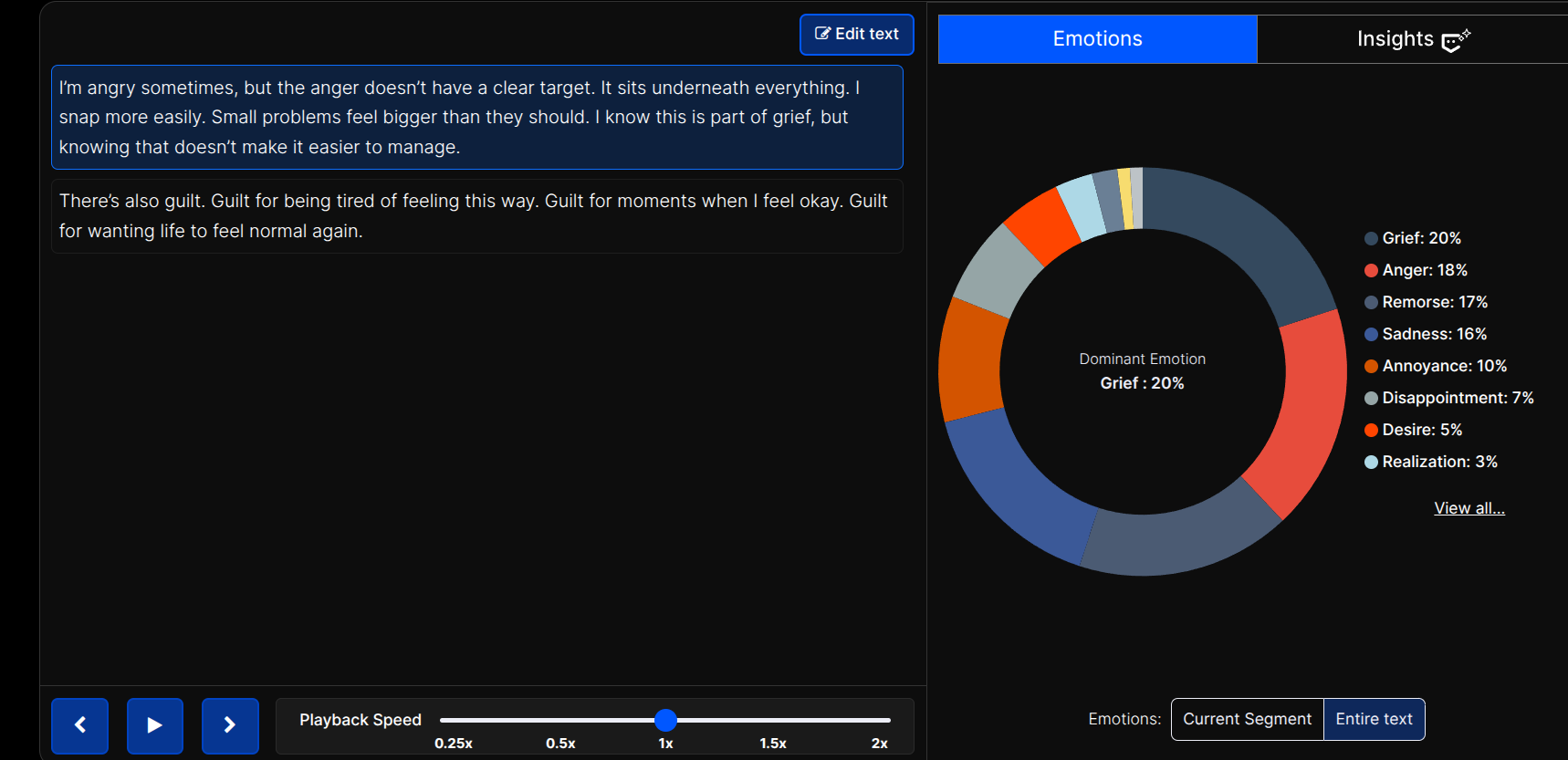
Because grief is deeply personal and shaped by cultural, situational, and temporal factors, these signals are never interpreted in isolation. Ethical Emotion AI focuses on patterns and trends rather than conclusions about an individual’s internal experience.
In therapy-supportive and research-oriented platforms such as Imentiv AI, Emotion AI can assist qualified professionals by adding structured emotional context to existing human-led processes. When used ethically and under professional oversight, Imentiv AI may support:
- Observing emotional patterns over time, helping professionals notice shifts in emotional expression across conversations or sessions, rather than relying on single observations
- Highlighting emotionally significant moments in speech or text, such as recurring themes of loss, emotional withdrawal, or expressions of guilt and longing that may benefit from deeper exploration
- Supporting reflective and meaning-centered conversations by providing emotional insights that help guide discussions around coping, identity change, or emotional processing
- Complementing qualitative assessment, by integrating emotion-related data with clinical judgment, research goals, or wellness frameworks—without diagnosing or labeling emotional states
Importantly, grief is a profoundly human experience that cannot be reduced to data or automated interpretation. Imentiv AI is designed to support emotional awareness and insight, not to diagnose, treat, or replace mental health care. Individuals experiencing grief—especially when it feels overwhelming, prolonged, or disruptive—are encouraged to seek support from licensed mental health professionals or appropriate care providers.