Replacing Hume AI’s Expression Measurement API? Here’s What Imentiv AI Offers
Hume AI's Expression Measurement API is going to sunset. If you've built a product on Hume AI's Expression Measurement API whether for UX research, recruitment, mental wellness, ad testing, or customer insight, the clock is ticking. You have until June 14, 2026 before API access is cut off and job results can no longer be downloaded.
The good news: If you're now looking for a Hume AI Expression Measurement API alternative, you don’t have to rebuild from scratch. Imentiv AI offers a production-ready, Multimodal Emotion Analysis APIs that maps to Hume AI's Expression Measurement core capabilities and, in several areas, goes further. The emotion API is live, documented, and available to start using today.
What Imentiv AI Offers
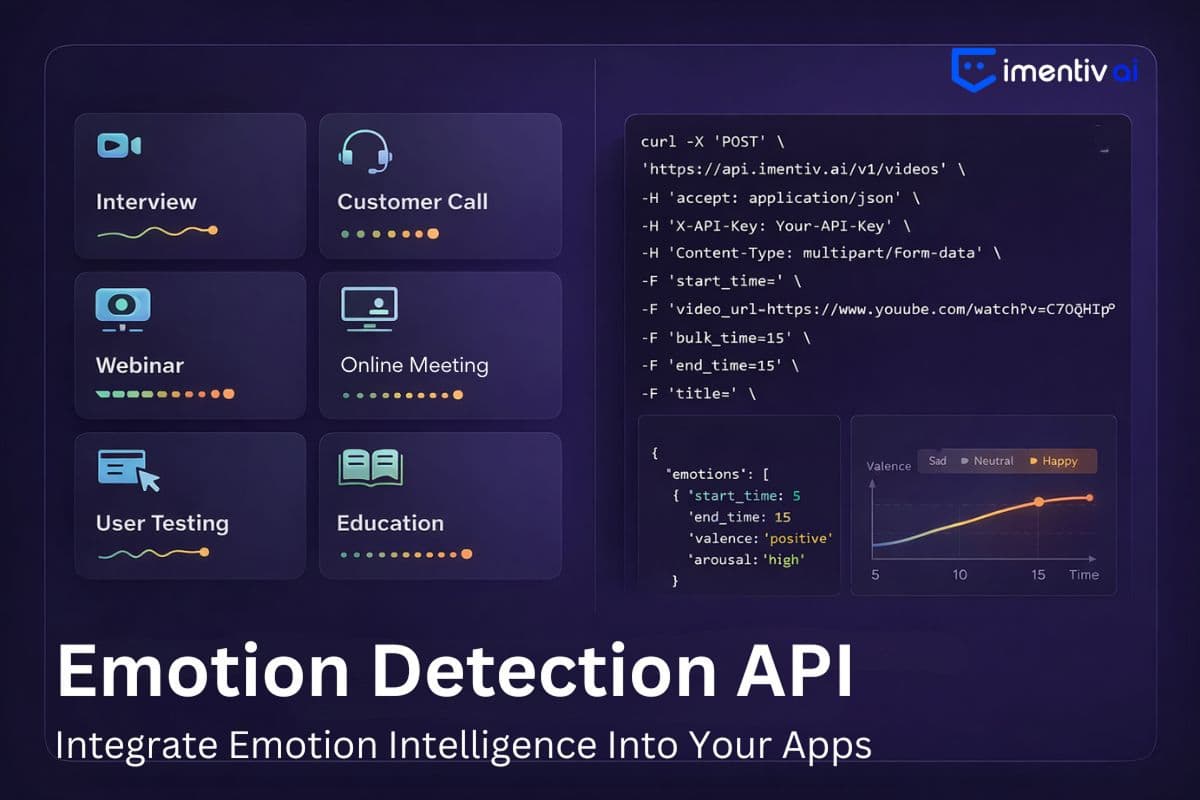
Imentiv AI is a multimodal emotion analysis platform that lets you detect and measure human emotional states from video, audio, text, and images via a clean REST APIs. It returns structured JSON with emotion scores, valence, arousal, and temporal breakdowns.
- Video Emotion API
Face-by-face, frame-by-frame emotion analysis from video files or YouTube URLs. Includes personality trait analysis via the OCEAN model.
- Audio Emotion API
Voice tone, pitch, and speech pattern analysis with speaker diarization and track each speaker's emotions separately.
- Text Emotion API
Sentence-by-sentence analysis detecting 32 distinct emotions from raw text.
- Image Emotion API
Detects facial expressions and emotional states from static images, with per-face bounding boxes.
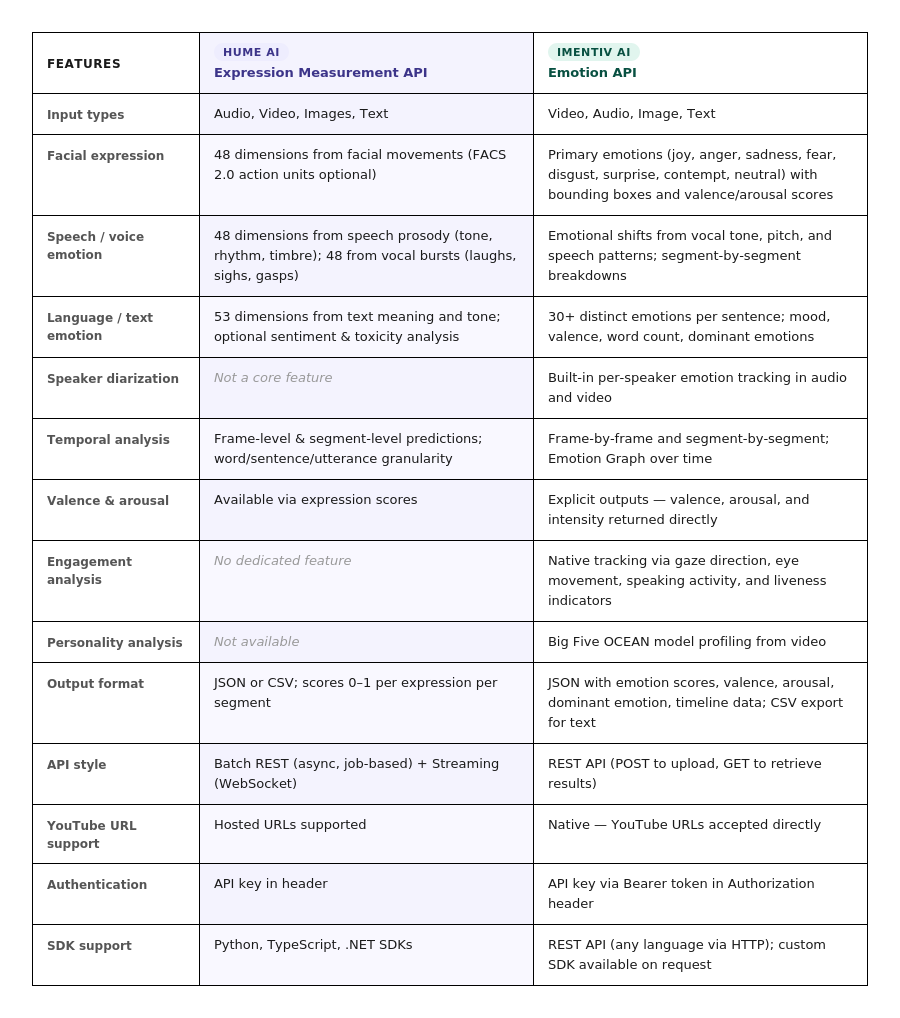
Hume AI vs Imentiv AI
A direct comparison of what each platform offers across the dimensions that matter most for a migration decision.
"Will I lose the core features I depend on?"
This is the question every migration starts with. Here's how Hume AI's core capabilities map to Imentiv AI's equivalents and where you get something extra.
Face → Face
Hume AI
Face model — Facial expressions are modeled as movement-based signals derived from facial action coding systems.
Imentiv AI
Video and Image Emotion APIs — Expressions are interpreted as primary emotions with bounding boxes, valence, arousal, and frame-level tracking.
Speech Prosody → Audio Emotion
Hume AI
Speech prosody model — Speech is analyzed through prosody and vocal bursts, capturing detailed acoustic variations.
Imentiv AI
Audio Emotion API — Emotional shifts are derived from tone, pitch, and speech patterns with speaker-level segmentation.
Language Model → Text Emotion
Hume AI
Language model — Language-based modeling captures emotional and tonal signals from text.
Imentiv AI
Text Emotion API — Sentences are mapped to clear emotional labels along with mood, valence, and dominant emotion.
Multimodal Jobs → Multimodal API
Hume AI
Run multiple models (face, prosody, language) on the same file in one batch job.
Imentiv AI
The Video Emotion API combines facial, vocal, and speech content analysis in a single call, multimodal by default.
What you gain as a bonus
Imentiv AI offers capabilities that Hume AI's Expression Measurement API did not include: Big Five OCEAN personality profiling from video content, native YouTube URL support, built-in speaker diarization for multi-speaker audio, and an Emotion Graph that visualizes emotional trajectories over time.
How to Get Started with Imentiv AI
- Create an account
Sign up at imentiv.ai. Once registered, navigate to My Account → My Profile to retrieve your API key. This key authenticates all API requests.
- Choose your endpoint
Imentiv AI provides four REST endpoints depending on your input type.
- Upload your media and call the API
Send a POST request with your file and API key. Imentiv AI returns structured JSON with emotion scores, valence, arousal, and timeline data.
- Parse and use the results
The response format is consistent across modalities. Adapt your existing data pipeline by remapping Hume's expression dimension keys to Imentiv AI's emotion labels and valence/arousal scores.
API Endpoints
POST https://api.imentiv.ai/v2/videos Video Emotion Analysis
POST https://api.imentiv.ai/v2/audios Audio Emotion Analysis
POST https://api.imentiv.ai/v2/texts Text Emotion Analysis
POST https://api.imentiv.ai/v2/images Image Emotion Analysis
Ready to migrate?
Imentiv AI is available now. Sign up, grab your API key, and make your first emotion analysis call in minutes.