How AI Journaling Apps Use Text Emotion Detection and Emotion APIs to Transform Mental Health in 2025
The Psychology Behind Journaling: Why Writing Heals the Mind
From a psychological perspective, journaling enhances:
• Emotional Processing
Writing helps shift thoughts from the limbic system (emotional brain) to the prefrontal cortex (thinking brain), gently lowering emotional intensity.
• Cognitive Restructuring
Putting thoughts into words often reveals distortions like “I always fail” or “Nobody supports me,” encouraging reframing and balanced thinking.
• Self-awareness and Insight
People often say, “I didn’t realize I felt that way until I wrote it down.” Language exposes emotions that the mind hasn’t consciously processed yet.
• Regulation and Release
The act of expressing, rather than suppressing, emotion reduces physical tension, rumination, and anxiety.
This is exactly where text emotion analysis becomes transformative.
How Text Emotion Analysis Deepens Self-Understanding
Every sentence we write carries emotional markers, valence, intensity, arousal, and tone. Even when we don’t say “I’m sad,” our writing tells the emotional story.
Humans naturally communicate emotional states through language. A sentence like “I feel stuck again” reflects low-energy, low-valence emotions associated with sadness, while “I’m terrified I’ll mess up” indicates high-arousal anxiety. Even simple statements like “I’m finally excited” reveal motivation and activation.
Text emotion detection works similarly to psychological interpretation: it reads tone, sentiment , word patterns, emotional vocabulary, ambiguity, and intensity markers . Models like the valence–arousal framework help categorize the emotional energy behind language.
This makes text-based mood analysis more than sentiment tracking; it becomes a real emotional map.
Real Journaling Examples Analyzed with Imentiv AI
Below are two journal entries, one reflecting emotional heaviness, another reflecting progress, processed through Imentiv’s Emotion Recognition API.
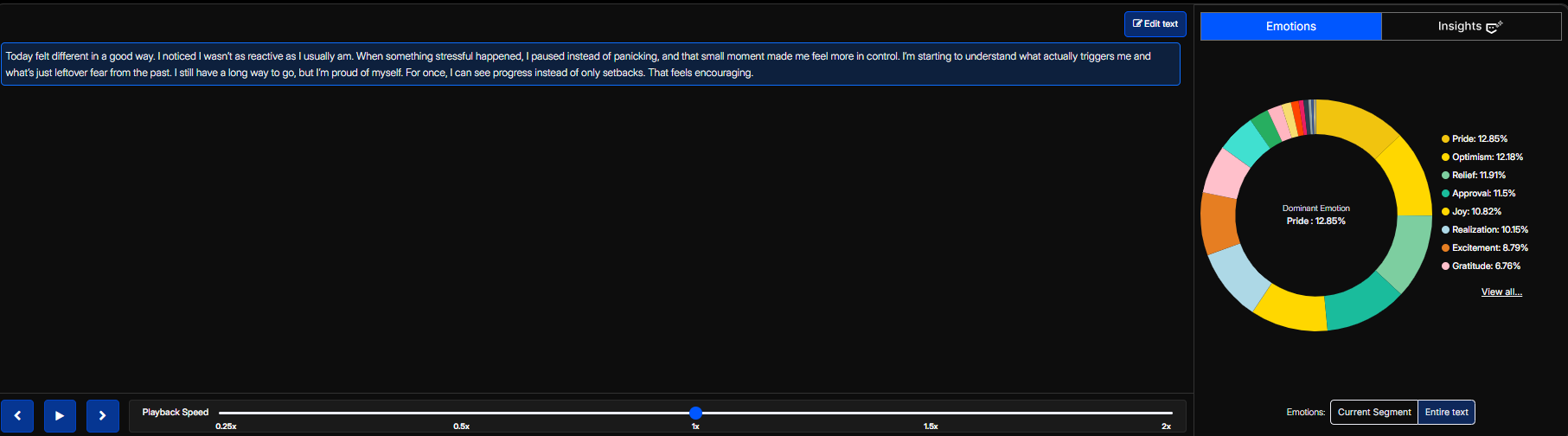
Journal Entry (Progress Focused)
“Today felt different in a good way… I paused instead of panicking… I feel proud of myself.”
Emotional Output
This entry shows dominant emotions like Pride (12.85%), Optimism (12.18%), Relief (11.91%) , and Joy (10.82%) .
These visualizations demonstrate how emotion detection from text online can highlight subtle emotional victories people often overlook.
Journal Entry (Overwhelmed / Anxious)
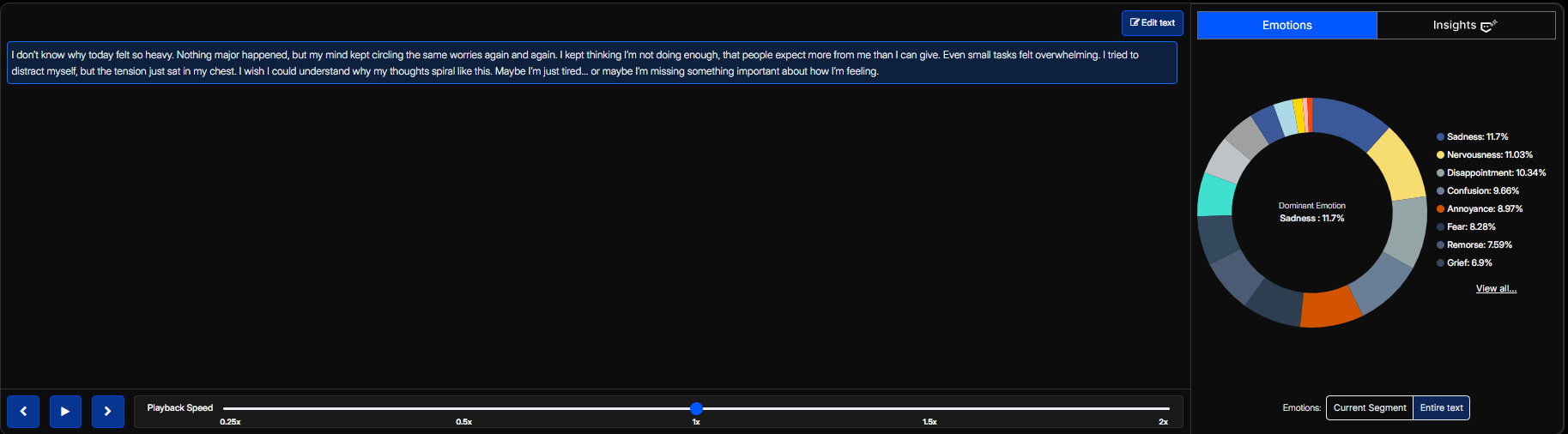
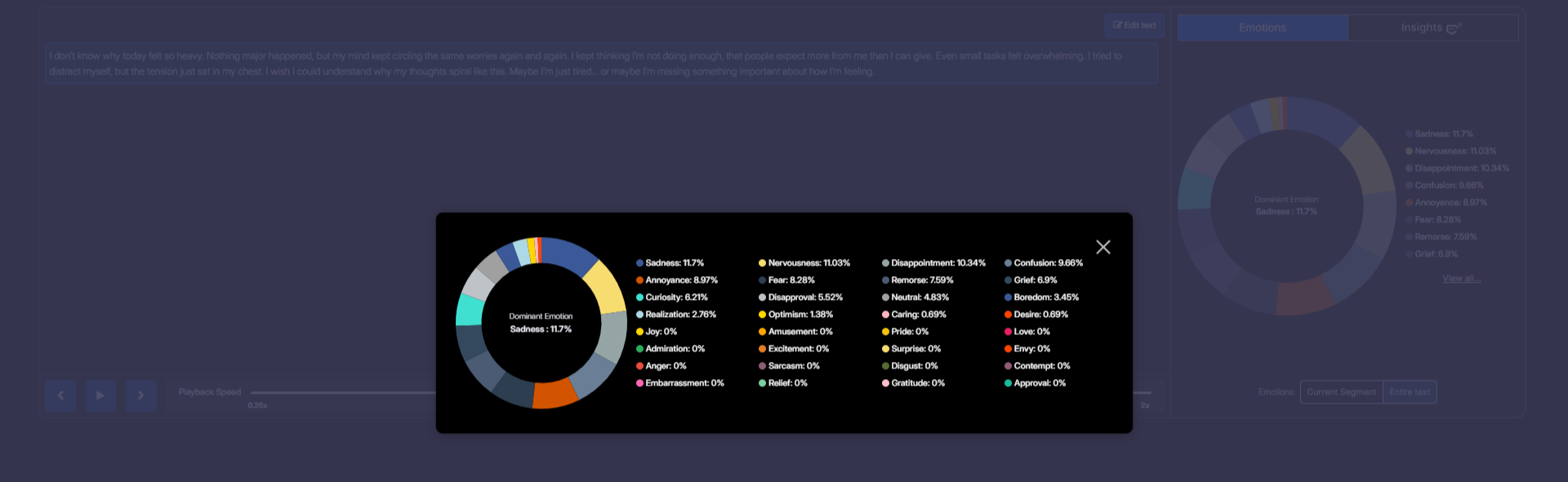
“I don’t know why today felt so heavy… My mind kept circling the same worries… I wish I could understand why my thoughts spiral like this.”
Emotional Output
A different profile emerges with Sadness (11.7%), Nervousness (11.03%), Disappointment (10.34%), Confusion (9.66%) , and Fear (8.28%) .
To reveal smaller emotion segments, Imentiv also generates expanded breakdowns:
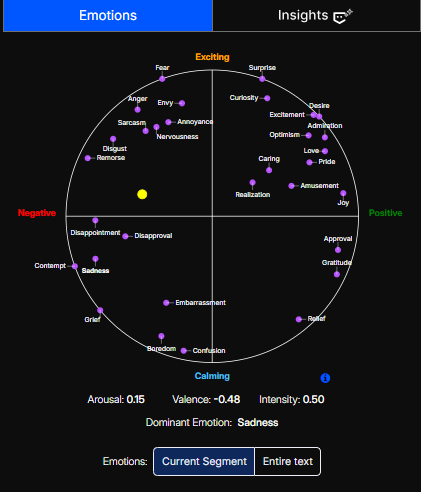
And its Valence–Arousal Emotion Map places emotions on a psychological grid:
This level of detail allows users and therapists to see emotional shifts, patterns, and triggers clearly.
How Emotion AI Supports Mental Health Through Text Journaling
By combining psychological principles with advanced Emotion analysis APIs and Sentiment analysis , Emotion AI provides:
1. Emotional Pattern Recognition
Seeing weekly or monthly emotional trends helps users understand triggers, cycles, and breakthroughs.
2. Cognitive Reflection Support
When AI highlights negativity or anxiety patterns, users recognize cognitive distortions more quickly.
3. Anxiety and Stress Monitoring
This answers one of the most searched questions today: “How do AI journaling apps help with anxiety?” They help users track worry loops, intrusive thoughts, rumination, and internal triggers over time, something the mind alone cannot do reliably.
4. Increased Self-Compassion
When users see that their emotional landscape includes both struggle and progress, self- blame reduces, and emotional balance improves.
5. Clearer Communication in Therapy
Clients come into sessions with visual emotional data, improving accuracy, reducing guesswork, and supporting deeper therapeutic discussions.
Integrating Imentiv’s Emotion API Into Wellness and Mood Tracking Apps
Wellness apps, therapy platforms, journaling apps, and corporate well-being tools can integrate the Imentiv Emotion API to offer:
• AI Mood Tracking
Apps can automatically generate mood summaries such as “Dominant emotions this week: Sadness 28%, Anxiety 22%, Relief 18%.”
• Emotion-Based Recommendations
If stress markers rise, apps can trigger breathing exercises, CBT prompts, or grounding tasks.
• Insights for Users by Wellness Apps
Example: “Your writing shows heightened mental load and self-doubt today. Consider journaling about your strengths.”
• Personalized Wellness Journeys
Using text analysis, apps can recommend journaling themes such as gratitude, boundary- setting, or emotional awareness.
• Support for Coaches and Therapists
Clients can share reports generated from journaling sessions, improving continuity of care.
• Building the Best Mood Tracking Apps of 2025
With emotion categorization, valence–arousal mapping, trend detection, and linguistic analysis, any platform can create a world-class AI mood tracking experience using Imentiv's Emotion API.
Ethical Considerations: Emotion AI as a Companion, Not a Diagnostician
Emotion AI must support, not replace, human judgment.
Imentiv follows principles of:
✔ Privacy and secure data processing
✔ Transparency in emotion inference
✔ User control over insights
✔ Non-pathologizing interpretation
As Carl Rogers beautifully said, “When someone truly hears you without judgment, you feel free.”
Emotion AI should evoke the same sense, not as a therapist, but as a compassionate tool.