The Artificial Emotion Brain
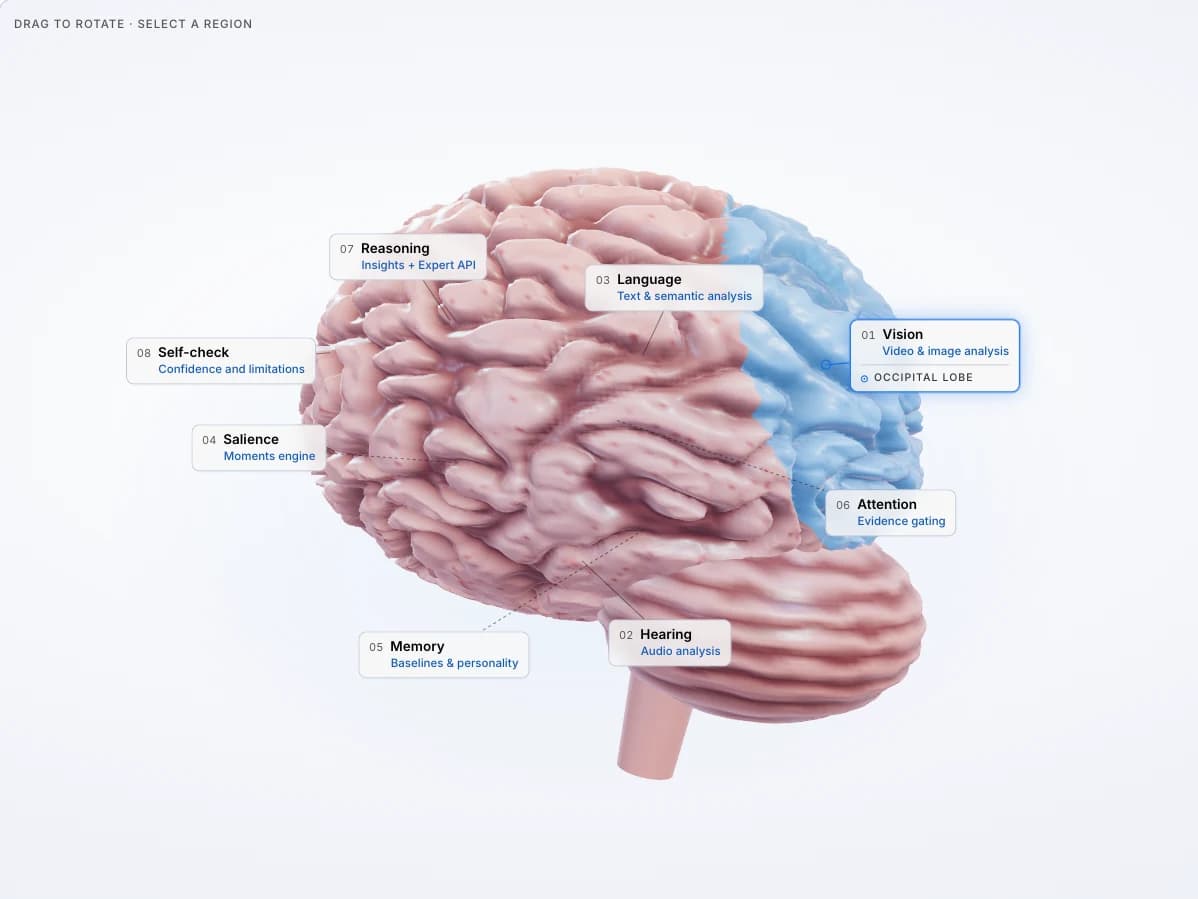
The Imentiv Artificial Emotion Brain is a system that perceives emotional signals, not one that has emotions. It connects readings from face, voice and words to moments, evidence and interpretations with confidence. It is laid out as a brain: an analogy for the flow of information, not a neuroscience claim.
One moment runs through every step: a driver asks the car to navigate home. Nothing happens; they ask again, and a third time, louder, with their eyes off the road.
Illustrative, not a recording. Choose Explore to load the interactive view.
Follow the evidence
Vision, hearing and language contribute signals. Salience, memory and attention organise the evidence; reasoning and self-check put it in context.
Read about the eight functionsVision
Reads every frame: facial expressions, gaze and head pose, and who is on screen at each moment.
Facial signals add context to the words. Reading the sequence helps distinguish a brief expression from a change that persists.
Video emotion intelligenceImage emotion intelligenceHearing
Hears how something was said: the emotion in the voice, its energy and pace, independent of the words.
Tone can differ from the transcript. Compare voice with face and words, and consider background noise before interpreting a reading.
Audio emotion intelligenceLanguage
Reads what was said: the transcript, sentiment and fine-grained text emotions, sentence by sentence.
Catches what face and voice miss, such as a stated concern or sarcasm, and attaches the topic behind each reaction.
Text emotion intelligenceSalience
Flags changes worth reviewing. Per-frame scores from the senses feed a moments engine that finds shifts relative to the person’s baseline.
A moment is useful in context: compare it with what came before, then review the face, voice and words together.
Real-time emotion analysisMemory
Keeps context within the project: what has happened so far in the session and the baseline against which a change is read.
An emotion only means something relative to a baseline. The same expression is news for one person and routine for another.
Explore the APIAttention
Selects the summaries and moments that reach reasoning, with evidence labelled by its source.
A focused set of evidence helps the reader follow an interpretation back to the signals that support it.
Explore the APIReasoning
Reasons over the evidence: summarises a session, answers questions and explains why a moment mattered with supporting references.
Interpretations need context. Linking them to moments lets a human reader review the evidence and consider other explanations.
Explore the APISelf-check
Carries confidence and signal limitations alongside a reading, so the interpretation can be considered with its uncertainty.
A score is a reading of expressed signals. Noise, lighting and missing context can limit it; review uncertain readings rather than treating them as facts about a person.
Scientific validation and limitationsWhat you get
You get moments worth reviewing, an evidence ledger that shows where a reading came from, and confidence per reading. A moment connects a change in face, voice or words to a point in the session. The ledger keeps the source visible so an interpretation can be checked against the original context.
In the voice-assistant example, a repeated request becomes useful evidence when it is considered alongside rising vocal energy and a glance away from the road. In the test-drive example, the response to acceleration and the response to parking assistance are reviewed separately. A home robot, an app walkthrough and a game playtest show the same steps outside a car: a flinch that comes with its own doubt, positive words over a flat face and voice, and a smile that fades across repeated losses. These are illustrative sequences, not measured results from a recording.
What it does not do
Imentiv reports what was expressed and what it reads as, with a confidence. It does not rule on what a person truly feels or whether their words were sincere. A face, voice or transcript can support more than one interpretation, particularly when lighting, noise or context is limited. Use the evidence to guide human review and conversation rather than making a verdict about the person.
FAQ
Contact Us for a Live Demo
Ready to see our Emotion AI in action?
- Identify use cases and business needs
- Expert hands-on demonstration of the product suite
Let’s Explore What You Need
Fill out the form & hear back within 24 hours