Multilingual Emotion Analysis: Can Emotion AI Work Across Languages?
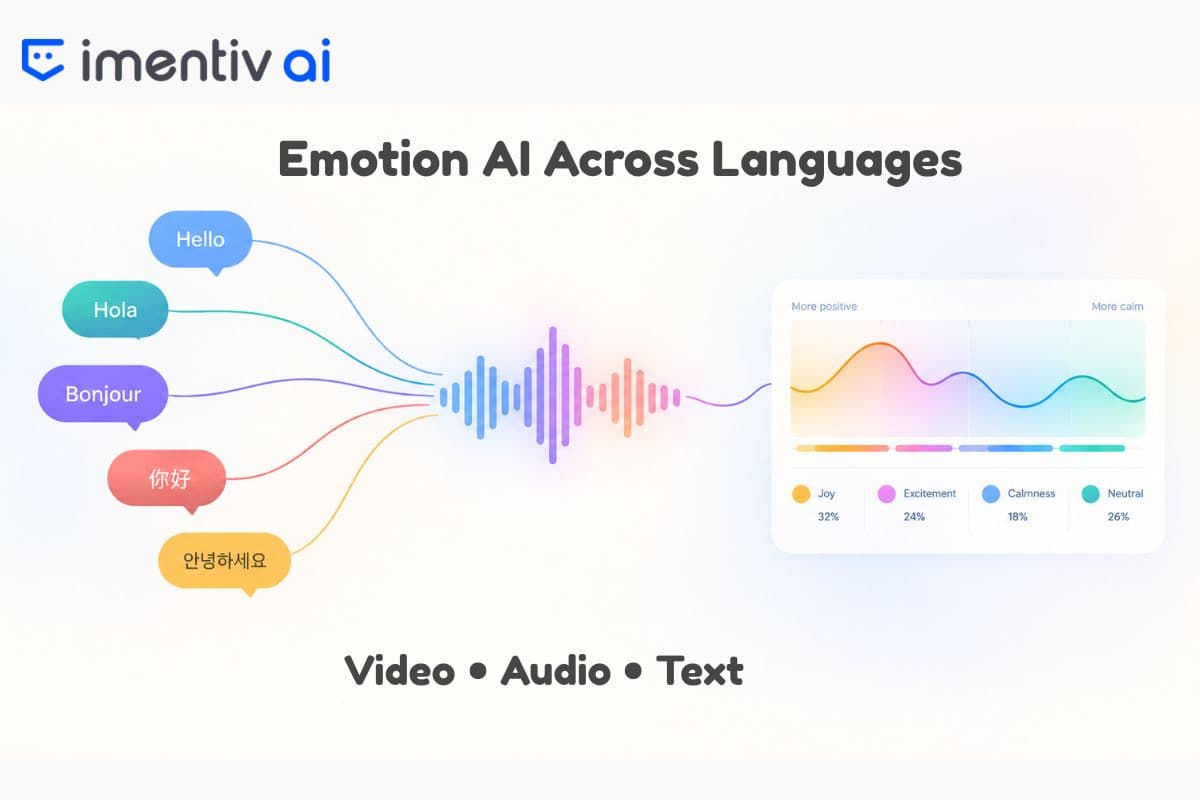
Yes. Imentiv AI offers multilingual emotion analysis across video, audio, and text.
Imagine your team has 50 customer calls in Spanish, French, and Korean and dozens of video recordings in English, French, and other languages. You want to understand not just what people said, but also the emotional and behavioral signals in those interactions.
Do you need separate tools for each language? Do you need to translate everything into English before you can analyze it?
Not with Imentiv AI.
Imentiv AI supports multilingual emotion analysis across video, audio, and text, allowing teams to analyze media in supported languages through the same platform. You can work with conversations and recordings in their original languages and examine emotional and behavioral signals as the starting point for every analysis.
For teams working across markets, this makes it easier to bring language-diverse data into existing research, customer experience, and conversation analysis workflows.
How Multilingual Emotion Analysis Works
Emotional and behavioral signals are not limited to English-language interactions. Imentiv AI supports emotion analysis across video, audio, and text in multiple languages, allowing teams to analyze content in supported languages without making English the default for every workflow.
The analysis goes beyond understanding the words spoken or written. Depending on the input, Imentiv AI can examine facial expressions, vocal characteristics, and emotional expression in text, alongside changes in emotional signals over time.
- Video Analysis: Analyze videos in supported languages for facial expressions, micro-expressions, and behavioral cues, alongside vocal and transcript-based signals where available. Valence and arousal timelines track changes in emotional signals over time, while speaker diarization helps attribute vocal cues to individual speakers. For example, a Spanish-language interview can be analyzed for both facial and vocal signals, with results available in a supported output language.
- Audio Analysis: Analyze spoken content in supported languages to understand vocal emotion, tone, intensity, and speaking patterns. Speaker diarization helps distinguish individual speakers and associate their vocal signals with the relevant speaker. This allows teams to analyze conversations such as Spanish-language customer calls without restricting their workflows to English.
- Text Analysis: Analyze written content and transcripts in supported languages for emotional expression. Teams can use this capability to examine customer feedback, survey responses, and conversations in the languages in which they were written or spoken.
This multilingual capability allows teams to apply Imentiv AI’s emotion analysis across different languages and media types, bringing emotional and behavioral context into research, customer experience, and other workflows.
Which Languages Does Imentiv AI Support?
Yes, Imentiv AI supports multilingual emotion analysis across video, audio, and text. Supported languages include English, Spanish, French, German, Portuguese, Arabic, Hindi, Chinese, Korean, and more. Audio and video are transcribed in the language spoken.
Want to know if your language can be analyzed? Try Imentiv AI on your own data , or contact our team for more language support.
Where Multilingual Emotion Analysis Can Add Context
Teams often work with people who speak different languages, whether they are conducting research, supporting customers, or reviewing sales conversations. In these situations, multilingual emotion analysis can add emotional and behavioral context to the information teams already collect.
- Research and UX: A research team conducts user interviews in Spanish and French to understand reactions to a new product. By analyzing the video, audio, and transcripts, the team can examine facial expressions, vocal cues, and emotional expression alongside participants’ feedback, adding another perspective to the findings.
- Customer Experience and Contact Centers: A company receives customer calls in English, Hindi, and Chinese. Instead of relying on transcripts alone, the team can analyze vocal emotional signals and changes over the course of each conversation to identify moments that may warrant closer review.
- Sales and Coaching: A sales team reviews conversations with prospects across different markets. Emotion analysis of supported-language audio or video can provide additional context about vocal cues, facial expressions, and changes in emotional signals during discussions, helping managers review interactions alongside their existing evaluation criteria.
Across these scenarios, multilingual emotion analysis lets teams examine emotional and behavioral signals in the languages their participants and customers use, adding context to their existing research and review processes.
Bring Multilingual Emotion Intelligence Into Existing Workflows
Imentiv AI provides emotion analysis for video, audio, and text with APIs and SDK tools for working with analyzed media. Video workflows can combine facial, vocal, and transcript-based signals, while audio and text can also be analyzed independently.
The goal is not to replace the context teams already use to evaluate people, conversations, or experiences. Emotion analysis adds another layer of observable information that can be considered alongside feedback, research findings, structured criteria, and human judgment.
For organizations working across languages, multilingual AI can provide a way to include emotional information when analyzing interactions and responses from diverse audiences.
If your data spans languages, your emotion analysis should too. Try Imentiv AI for emotion analysis.