Why Communication Style Matters More Than Credentials: Emotional Intelligence in Hiring for Customer-Facing Roles
In customer-facing roles, performance is shaped less by qualifications and more by human interaction. This is why emotional intelligence in hiring has become a defining factor for organizations building sales, support, and client-facing teams. Credentials may indicate experience, but communication style reveals how candidates handle real conversations—especially when emotions are involved.
Customers don’t experience degrees or certifications. They experience tone, patience, clarity, and emotional control. These subtle signals influence trust, satisfaction, and long-term relationships, making emotional intelligence far more predictive of success than credentials alone.
What Matters More in Customer-Facing Roles?
Resumes summarize past roles, achievements, and technical exposure, but reveal little about how a person will behave in emotionally charged situations.
Customer-facing roles are filled with uncertainty. A sales call may involve hesitation or rejection. A support interaction may involve frustration or anger. A client conversation may require careful negotiation and reassurance. In these moments, communication style becomes the real test.
Two candidates with similar qualifications can respond very differently under pressure. One may listen actively, regulate emotions, and respond clearly. Another may rush, sound defensive, or lose composure. Traditional hiring methods often struggle to surface this difference early in the process.
Communication Style Is Emotional Intelligence in Action
Communication style is not just about being articulate or confident. It reflects how well someone understands emotions—their own and those of others—and how effectively they manage them. In hiring, this is the practical expression of emotional intelligence.
Tone reveals attitude and intent before words are fully processed. Emotional regulation shows whether a candidate can pause, reflect, and respond thoughtfully rather than react impulsively. Clarity reflects structured thinking and respect for the listener. Together, these signals shape how candidates are perceived in real interactions.
This is why emotional intelligence in hiring cannot be treated as an abstract soft skill. It needs to be observed through behavior, not assumed through credentials.
Why Hiring Teams Struggle to Assess Emotional Intelligence
Although emotional intelligence is a highly valuable trait, it is also a difficult one to assess. Hiring managers frequently have to fall back on instinct or impressions. This becomes even harder in remote and high-volume recruitment, especially if emotional intelligence is subtle and easy to overlook.
As hiring increasingly takes place over video and voice-based formats, the need for better tools to assess emotional signals has grown. Organizations need ways to understand communication patterns without removing human judgment from the process.
Bringing Emotional Intelligence Into Focus With Imentiv AI
This is where Imentiv AI becomes central to modern customer-facing hiring. Rather than replacing recruiters, Imentiv AI supports them by making emotional intelligence visible and comparable.
Imentiv AI uses a multimodal approach to analyze video, voice, speech, and behavioral signals together. This allows hiring teams to see how candidates communicate across moments, not just how they perform in a single answer.
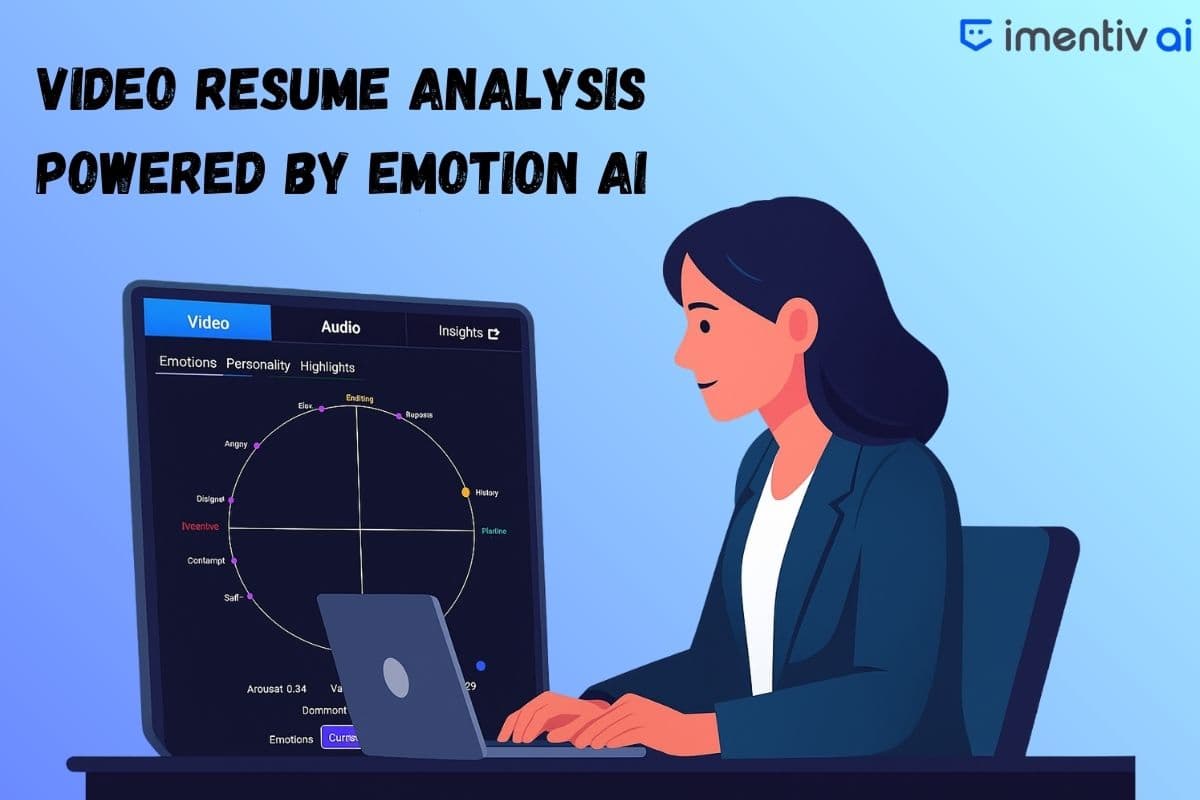
One of the platform’s key capabilities is the use of emotion graphs . These visual timelines show how a candidate’s emotional state changes throughout an interaction. For customer-facing roles, this helps recruiters understand emotional regulation—how candidates respond to pressure, recover from challenging questions, or maintain composure over time.
Imentiv AI also offers personality trait analysis based on the Big 5 OCEAN models. When combined with emotional signals, these traits add context to communication style, highlighting tendencies related to empathy, assertiveness, adaptability, and collaboration.
To make emotional data easier to interpret, Imentiv AI offers AI insights as an interactive layer within the hiring process. Recruiters can ask questions and receive context-specific answers based on a candidate’s emotional patterns, communication behavior, and responses, helping them understand why certain signals appeared and how they may translate to real customer-facing situations—without relying solely on instinct.
Importantly, Imentiv AI supports psychologist review, adding expert interpretation to AI-generated insights. This approach supports ethical use of emotional data in hiring.
Emotion AI in the Recruitment Workflow
When embedded into the emotion AI in recruitment workflow, Imentiv AI supports hiring decisions at multiple stages. During early screening, video resume emotion analysis helps identify candidates whose communication style aligns with role expectations. In scenario-based assessments it provides deeper visibility into emotional responses under pressure.
Rather than treating emotional intelligence as an afterthought, this approach integrates it into the core of recruitment. It brings structure to evaluations while preserving the recruiter’s role in final decision-making.
Curious how emotional intelligence can be assessed during hiring? Explore Imentiv AI.