Stop Reading Emotion Charts. Start Asking Questions: Introducing Imentiv ai Insights Feature
Emotion data has a presentation problem.
Most platforms that analyze emotion give you a graph, a percentage, a color-coded label. You see that 'positive' spiked at minute three, that 'anger' appeared briefly at minute seven, that the overall sentiment was 'neutral.' And then you sit there wondering: what does that actually mean? What happened at minute three? Why did anger appear? Did it resolve, or did it simmer under the surface for the rest of the recording?
The numbers tell you something happened. They rarely tell you what, or why, or what to do about it.
That gap between raw emotional data and genuine emotional understanding is exactly what Imentiv AI Insights was built to close.
What Are Insights?
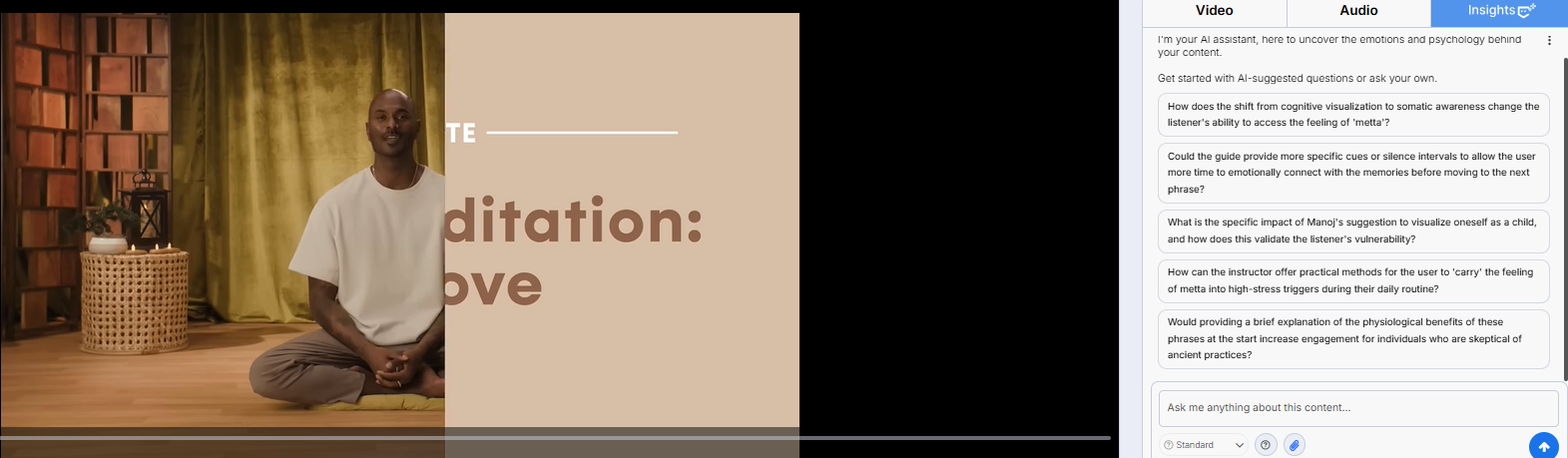
Insight is Imentiv's intelligent layer that sits on top of the emotional analysis your content generates. After you upload a video, audio clip, image, or piece of text and the platform processes its emotional signals, AI Insights lets you go further by asking questions about what you're seeing.
Not preset filter questions. Not toggle switches between categories. Natural language questions, typed directly into the platform, answered with narrative explanations that reference the actual content you uploaded.
Ask something like: 'Do specific topics consistently trigger distress or calm?' and the system doesn't just point you at a bar chart. It analyzes the content across all the available signal channels: what was said, how it was said, what expressions accompanied it, and tells you, in plain language, what the emotional data shows. With timestamps. With context. With the kind of answer that actually helps you move forward.
It works across all four modalities Imentiv AI supports:
video, audio, text, and image.
Wherever emotion data exists, AI Insights can be applied to it.
Key Takeaway: AI Insights turns your emotional data from a static report into an interactive analysis that you can interrogate, explore, and extract genuine understanding from.
Why Emotional Labels Are Not Enough
Tagging a moment as 'happy' or 'angry' or 'neutral' is a starting point. For most real-world applications, it's not a finishing point.
Human emotion is not a fixed state. It shifts. It intensifies and fades. It plays out differently in tone of voice than in word choice. It looks one way on a face and sounds another way in speech. Two people in the same conversation can be experiencing entirely different emotional arcs at the same moment. A single person can shift from guarded to open to tense within a two-minute segment.
Standard sentiment tools flatten all of that into a label. They tell you what emotion was detected, not how it developed, what triggered it, how long it lasted, or whether it resolved.
Imentiv's multi-modal approach captures emotion across multiple signal channels simultaneously: facial expression, vocal pitch and intensity, speech cadence, word choice, contextual cues. AI Insights then makes that layered data legible by letting you ask about the patterns.
The result is the difference between knowing that frustration appeared and understanding how it built, what it responded to, and when it shifted.
Key Takeaway: Emotion is a process, not a label. AI Insights is designed to surface that process so the analysis you get reflects how emotion actually works.
AI Insights Across Every Modality
In Video
Video is where emotional signals are richest and most complex. A speaker's words, their tone of voice, their facial expressions, and their body language can all tell different stories at once. AI Insights for video synthesizes all of these cues to answer questions that a single-channel analysis would miss entirely.
You can ask questions like:
- 'Highlight moments of stress, tension, or disengagement with timestamps.'
- 'Which segments produced the strongest emotional response?'
- 'When did the emotional tone of this video shift, and what was happening at that point?'
The response isn't a clip highlight reel. It's a coherent explanation of the emotional arc, identifying the moments that mattered and telling you why the data points there.
In Audio
Audio analysis surfaces what voice alone can reveal: changes in pitch, pace, intensity, and tone that carry emotional meaning independently of the words being spoken. With speaker diarization, Imentiv AI can track each participant in a conversation separately.
AI Insights for audio makes this genuinely useful. In a customer service call analysis, for example, you can ask:
- 'Show how emotions shifted before and after problem resolution.'
- 'Compare the emotional trajectories of the two speakers across this call.'
- 'Were there moments where one speaker's tone changed in response to the other?'
What comes back is an analysis of emotional dynamics, not just individual states, but how those states developed in relation to each other over the course of the interaction.
In Text
Text emotion analysis goes well beyond sentiment scoring. AI Insights for text allows you to explore the emotional journey of a document, how tone develops, where it shifts, and what themes carry particular emotional weight.
For written content, research transcripts, customer feedback, or campaign copy, you can ask:
- 'Does the text feel positive, negative, or neutral overall, and where does it shift?'
- 'Which parts of this feedback carry the strongest emotional signal?'
- 'Compare emotional tone across different sections of this document.'
The platform identifies not just what emotion is present, but the texture of how it flows through the writing making it possible to pinpoint exactly where audience reaction is likely to intensify or drop off.
In Image
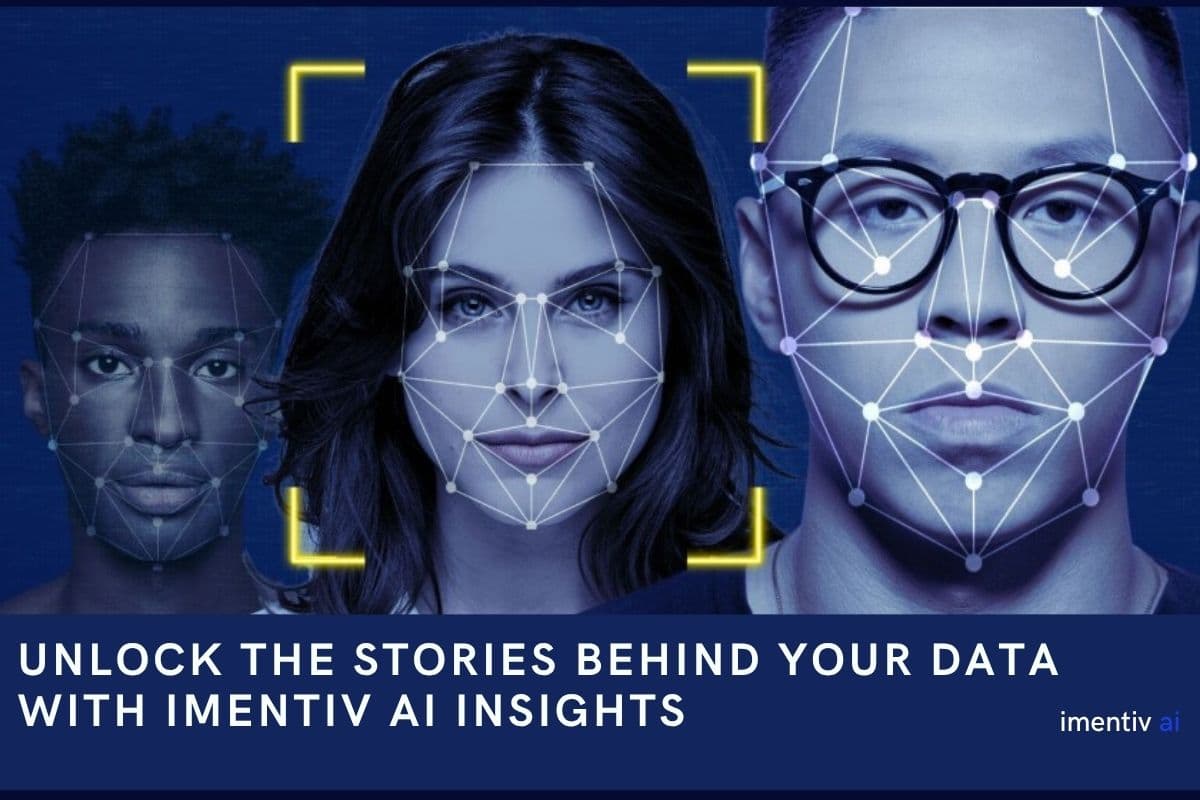
Image analysis reads facial expressions and contextual emotional cues across still visuals. AI Insights extends this into territory that goes well beyond 'this person looks happy.'
For campaign images, team photos, event documentation, or research stimuli, you can ask:
- 'Which emotions dominate in this image, and are they consistent with the intended message?'
- 'Are the majority of faces showing engagement, fatigue, or distraction?'
- 'How consistent are emotional expressions across multiple images from the same session?'
An image becomes a source of interpretable emotional information, not just a visual record.
Key Takeaway: Across every modality, AI Insights converts the same question 'what is the emotion data telling me?' into answers that are specific, contextual, and actionable.
Who Uses AI Insights and What They're Looking For
The questions AI Insights can answer span a wide range of professional contexts. Some examples of how different users approach the feature:
- ask about engagement and stress patterns in recorded sessions to understand team dynamics at a level that surveys can't reach. HR & People Teams
- analyze support call recordings to understand the emotional arc of interactions not just whether calls ended positively, but how they got there. Customer Experience Teams
- identify the exact moments in training videos where learner attention or emotional engagement drops off, enabling more targeted content improvements. Educators & L&D Professionals
- query emotional patterns across large bodies of recorded or written material without the bottleneck of manual coding passes. Researchers
- test whether campaign content produces the emotional response it was designed for and find out specifically where it does or doesn't land
The through-line across all of these is the same: these professionals already have emotional data. What they need is a way to ask real questions. AI Insights is built for exactly that.
Pre-Built Questions: A Head Start on the Analysis
Not everyone comes to an emotion dataset knowing exactly what to ask. The platform includes pre-built question suggestions tailored to common use cases, so you can begin exploring immediately, even before you've identified the specific question you're trying to answer.
These aren't generic prompts. They're designed around the kinds of questions that consistently surface in each professional context: what changed, when it changed, what preceded it, and how different participants compared. They serve as starting points that users can build on or depart from entirely as their analysis develops.
Key Takeaway: AI Insights meets users wherever they are in their analysis with open-ended questioning for those who know exactly what they're looking for, and structured starting points for those who are still finding their footing.
From Data to Understanding
The goal of AI Insights has always been straightforward: to close the gap between having emotional data and actually understanding what it means.
Emotion analysis platforms generate a lot of output. Graphs, percentages, tags, timelines. All of that output represents something real about human experience. But without a way to interrogate it to ask what it means, to find the patterns inside the noise, to connect specific moments to specific questions, it stays at the level of data. Interesting, but inert.
AI Insights makes that data active. It makes it answerable. And in doing so, it turns emotional analysis from something you observe into something you can actually use.
Ready to ask your first question?
Explore AI Insights across video, audio, text, and image at imentiv.ai.