Personality Trait
A
personality trait is a relatively stable and enduring characteristic that influences an individual's thoughts, feelings, and behaviors across various situations. Personality traits are most widely conceptualized within the Five-Factor Model, also known as the Big Five or OCEAN, which includes Openness, Conscientiousness, Extraversion, Agreeableness, and Neuroticism. These dimensions capture the core psychological patterns that shape how people perceive the world and interact with others. Imentiv AI's Personality Traits Analysis feature maps these dimensions using multimodal Emotion AI, transforming emotional signals from faces, voices, and words into meaningful psychological insights.
The Big Five Personality Traits
The Five-Factor Model remains the most widely used and empirically supported framework for describing human personality across cultures, contexts, and research disciplines.
Openness
Openness reflects creativity, imagination, and intellectual curiosity. Individuals high in openness tend to seek out novel experiences, think in abstract terms, and engage with ideas across diverse domains. In video content, it may manifest as curiosity, emotionally engaged expressions, and exploratory communication styles.
Conscientiousness
Conscientiousness captures organization, reliability, and self-discipline. Highly conscientious individuals tend to be goal-directed, methodical, and consistent in their behavior. In communicative contexts, it often appears as structured delivery, steady confidence, and deliberate language use.
Extraversion
Extraversion reflects sociability, enthusiasm, and outward energy. Extraverted individuals draw energy from social interaction and tend to be expressive, assertive, and engaging. This trait frequently surfaces through animated facial expressions, dynamic vocal tone, and high communicative energy.
Agreeableness
Agreeableness encompasses empathy, cooperation, and warmth. Individuals high in agreeableness prioritize harmonious relationships and tend to respond to others with kindness and understanding. In group or conversational settings, it is often visible through cooperative exchanges, warm affect, and emotionally supportive language.
Neuroticism
Neuroticism reflects emotional sensitivity, stress reactivity, and a tendency toward negative affect. Individuals high in neuroticism may experience more frequent emotional fluctuations and perceive situations as more threatening. Signs of tension, defensiveness, or emotional instability can indicate elevated neuroticism in observed behavior.
Psychological Significance
Personality traits have been extensively studied as predictors of behavior, well-being, and life outcomes across domains including mental health, occupational performance, and interpersonal relationships. Unlike temporary emotional states, traits are consistent across time and situations, making them a foundational construct in psychological assessment and behavioral research. Understanding personality traits enables clinicians, researchers, and communicators to anticipate behavioral tendencies, tailor interventions, and design more effective and empathetic interactions. The Big Five framework in particular offers a structured, empirically validated lens through which personality can be observed, measured, and meaningfully interpreted.
Understanding Personality Traits Through Emotion AI
Personality is revealed through patterns, not single moments. Imentiv AI's Personality Traits Analysis examines emotional behavior across three modalities to build a comprehensive personality profile:
- Facial expressions such as joy, anger, fear, or surprise that reflect underlying emotional tone
- Vocal qualities including pitch, intensity, and rhythm that signal energy, confidence, or emotional reactivity
- Language patterns where word choice and phrasing reveal mood, intent, and psychological orientation
Beyond detecting individual emotions, Imentiv AI examines how emotional signals behave over time, looking at consistency to determine whether emotions remain stable or fluctuate, synchrony to understand whether participants mirror or diverge from each other, and duration to assess whether expressions are fleeting or sustained. Together, these dynamics form the foundation for translating raw emotional data into Big Five personality trait profiles.
Personality Traits Analysis in the Context of Imentiv AI
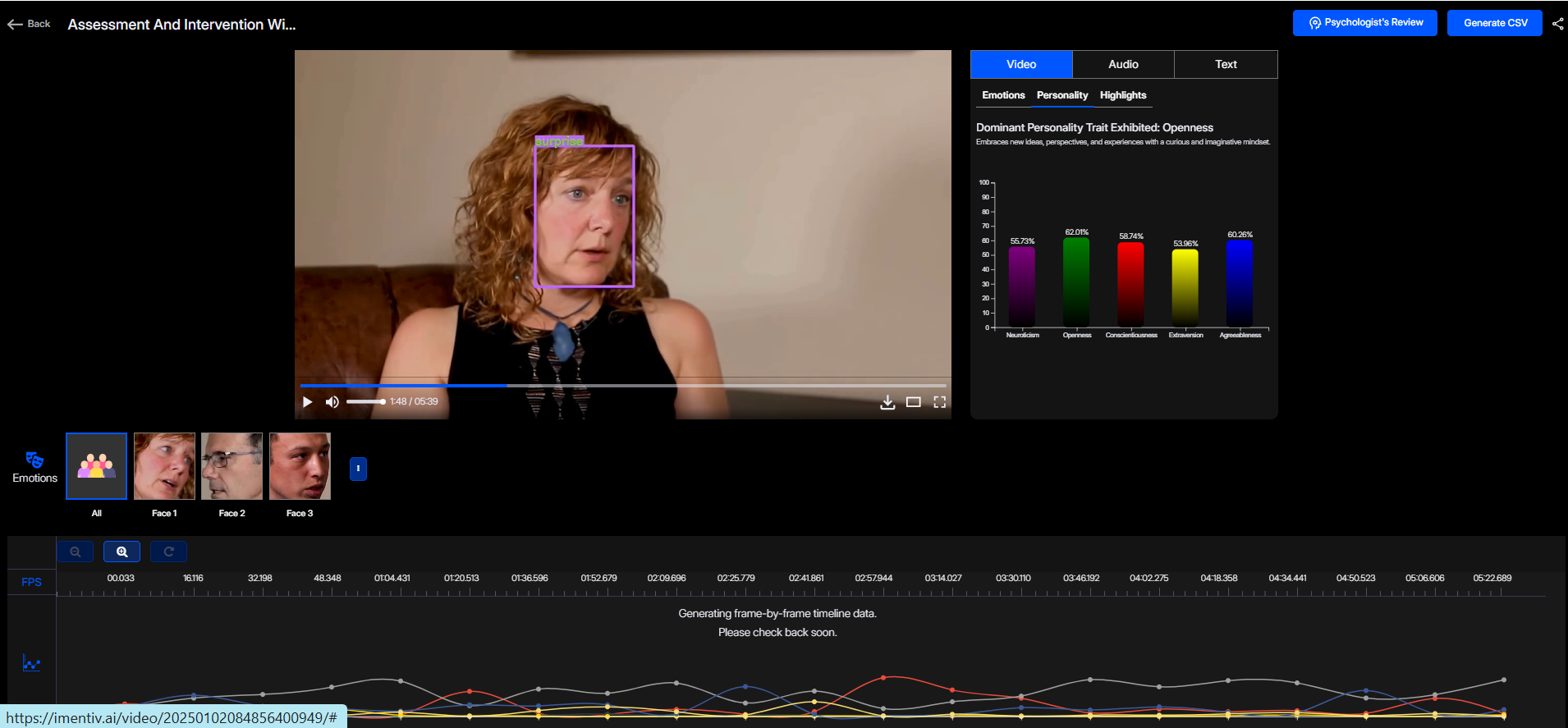
Within Imentiv AI, Personality Traits Analysis focuses on the psychological climate of video content as a whole rather than labeling individuals. Results are presented through a color-coded bar chart where each bar represents one of the Big Five traits, making it easy to compare personality tones across multiple videos, track how traits shift over time, and align content with audience preferences or brand identity. This feature helps communicators understand whether their content conveys confidence, empathy, creativity, or authority, and how closely it reflects their intended psychological tone.
Why Personality Traits Matter
Personality traits remain one of the most powerful frameworks for understanding human behavior, communication, and psychological well-being. Recognizing and interpreting these traits in context allows for more empathetic research, more effective communication, and stronger audience connection. When paired with Emotion AI, personality trait analysis moves beyond self-report questionnaires into observable, real-time behavioral insight, offering new possibilities for psychological research, content strategy, and human-centered design.
To dive deeper into the fascinating world of emotion recognition AI and its applications, read more here.