Guilt Cycle
The guilt cycle has drawn significant attention in psychology and psychotherapy because of its impact on emotional regulation and self-perception. It is often rooted in perfectionism, moral rigidity, or unresolved trauma , where individuals hold themselves to excessively high standards or internalize responsibility for others’ emotions. While healthy guilt motivates ethical behavior and empathy, maladaptive guilt becomes self-punitive—driven by distorted beliefs such as “I’m not good enough” or “I should have done more.” This cycle can lead to chronic self-criticism, avoidance, or emotional withdrawal.
Therapeutically, breaking the guilt cycle involves addressing cognitive distortions and nurturing self-compassion . Approaches such as Cognitive Behavioral Therapy (CBT) , Mindfulness , and Compassion-Focused Therapy (CFT) encourage individuals to challenge internalized blame, differentiate guilt from shame, and replace punitive self-talk with empathy and forgiveness. These interventions help rebuild emotional balance and reduce the compulsive need for self-punishment.
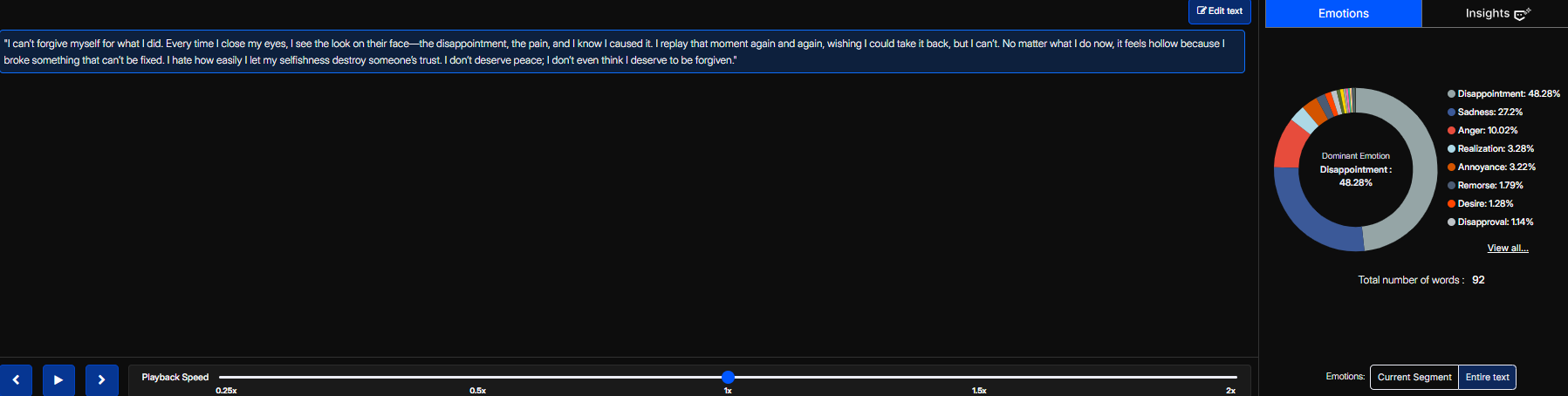
- Guilt Cycle and Emotion AI: Mapping Emotional Repetition Through Multimodal Cues Emotion AI offers a new dimension in recognizing patterns of guilt by analyzing emotional signals across facial, vocal, and textual modalities . Using Imentiv’s Emotion AI, subtle emotional variations that accompany guilt, such as lowered tone, avoidance gaze, micro-expressions of distress, or language marked by over-apology, can be identified and tracked over time. This allows for early recognition of emotional stagnation, over-responsibility, or unaddressed remorse in individuals who might not consciously express guilt.
Imentiv’s multimodal Emotion AI system captures:
- Facial cues like downcast eyes, tightened lips, or furrowed brows suggesting self-blame or regret.
- Vocal emotion patterns such as reduced pitch, prolonged pauses, or voice tremors indicating internal conflict.
- Textual emotion markers reflecting repetitive apologies or self-critical language in digital communication.
Clinical Ethics and Use
Since guilt is a deeply personal emotion often tied to trauma or moral distress, ethical AI use is essential. Imentiv AI functions purely as a supportive tool , not a diagnostic system. It offers assistive insights for professionals while maintaining privacy and transparency. Ethical guidelines include:- No automated interpretation or empathy simulation.
- Strict data confidentiality and opt-in consent.
- Designed to enhance, not replace, therapist judgment.

Research and Future Directions
Imentiv’s Emotion AI contributes to emerging research exploring how guilt interacts with emotional regulation, resilience, and moral cognition. With timestamped multimodal data , researchers can study:- Emotional shifts before and after guilt-inducing triggers.
- The relationship between guilt and anxiety or burnout.
- Longitudinal changes in self-blame and emotional tone.
- Intervention effectiveness in breaking cyclical emotional patterns.
This integration of psychology and technology deepens the understanding of how guilt functions emotionally and behaviorally, transforming it from a hidden burden into an insight-driven opportunity for emotional healing.