How to Understand User Behavior Across Every Digital Touchpoint
Your users completed the tasks. They answered your questions. A few said it was "pretty straightforward." And yet there's still that one screen with a drop-off you can't explain, and a synthesis doc full of quotes that don't quite add up to a clear answer.
Here's the thing. That's not a ‘you’ problem. That's a ‘tools’ problem.
Traditional user testing is good at capturing what users do and what they say. It's not built to capture what they actually feel in the moment. And that missing layer, the emotional one, is usually where the real answer lives.
That's the gap Imentiv AI is built to close. Imentiv AI helps you analyze facial expressions, voice tone, textual data, and behavioral cues across your session recordings so you stop reading between the lines and start seeing the full picture.
The Data Looks Fine. So, Why Can't You Explain the Drop-off?
You've done everything right. Recruited the right participants. Designed clean task flows. Recorded every session. Asked thoughtful follow-up questions about what users liked, disliked, and where they struggled.
And you've probably gathered useful answers. They might have shared feedback on the overall experience, but there is always a blind spot. 84% of UX and product teams run usability testing regularly , and most of them hit the same wall even when the methods are solid. Because the one thing that actually drives user behavior, ’ emotion,’ is difficult to measure directly with traditional research methods.
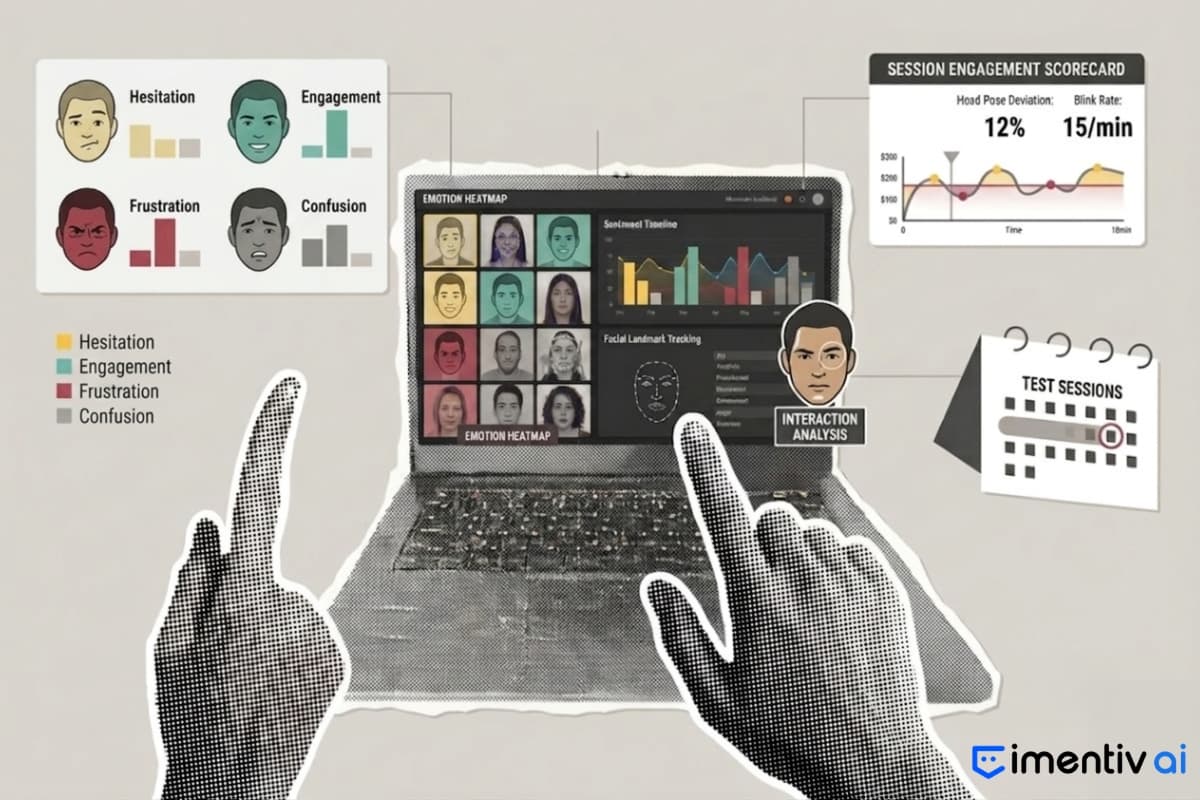
Now, what if, alongside those insights, you could also see how users emotionally responded throughout the session? Imentiv AI provides emotional and behavioral insights that add context to moments of hesitation, engagement, frustration, and confusion. Instead of relying solely on what users say after the fact, teams can understand how users reacted as the experience unfolded. The result is a richer, more complete understanding of the user experience.
For UX researchers and product teams, Imentiv AI acts as an assistive behavioral analytics layer, helping you see the emotional patterns, engagement shifts, and moments of friction across user testing sessions.
The Real Problem: Users Can't Tell You What They Felt
Here's the uncomfortable truth sitting at the center of most user testing setups. Post-session interviews and surveys assume users can accurately recall and describe what they felt during the test.
But they really can't.
What users say doesn't always match their actual behavior. A participant might describe a flow as "a bit confusing" when their face showed sustained frustration for a solid 40 seconds. Someone else says they "figured it out fine," while their voice was carrying real stress the whole time. They're not lying to you. This is just how memory and self-reporting work.
Emotions move faster than language. By the time a user is answering your post-task questions, that moment of genuine frustration or confusion is already fading. And so is the most honest signal you could've captured.
Real analysis of user testing sessions with emotion AI backs this up. Participants who looked calm throughout their sessions still showed underlying confusion and frustration in their emotional data, signals that never showed up in the post-session survey. And those hidden signals pointed directly to the exact usability issues causing drop-offs.
The gap isn't in your methodology. It's in what your tools can actually see.
What You're Actually Losing Without Emotional Data
When an emotional signal is missing from your sessions, a few things quietly go wrong:
Friction gets misattributed. A user pauses for eight seconds on a screen. You can see it in the recording. But without emotion data, you don't know if that pause was confusion, careful consideration, or quiet frustration before they pushed through. Those are three different problems with three different fixes.
Prioritization turns into guesswork. You can't fix everything at once. But without knowing which moments triggered real frustration versus mild annoyance, teams end up ranking issues on gut feel. That's a rough place to be when you're making the case for a design sprint.
Stakeholder conversations hit a wall. "Users seemed a bit confused here" doesn't move things forward. A timestamped frustration spike that shows up in the same spot across six sessions? That's a conversation starter.
How Imentiv AI Fills the Gap
Imentiv AI adds a multimodal emotional layer on top of your existing user testing workflow. You don't need to redesign how you run sessions. You just start seeing a dimension of what's happening that you couldn't see before.
Here's what that actually looks like:
Analyze users' facial expressions frame by frame throughout the session. With imentiv AI, spot moments of confusion when someone reaches a navigation menu, surprise when a feature behaves differently than expected, and subtle signs of disengagement before they abandon a form. These emotional signals help reveal how users are truly experiencing your product, beyond what they say in feedback.
Voice carries emotion, too, and we read that as well. Audio emotion analysis picks up on tone, pace, and vocal stress, separate from the actual words. A participant saying "okay, I think I get it" can sound genuinely confident or quietly defeated. That difference completely changes how you interpret that moment.
Words tell part of the story as well. Imentiv AI analyzes the emotional tone of the transcript alongside facial expressions and vocal cues, helping teams understand whether a user’s comments reflect confidence, uncertainty, frustration, or satisfaction. Together, these signals provide a more complete picture of the user experience.
An emotional timeline for every session. No more scrubbing through recordings trying to figure out where things went sideways. With Emotion Graphs, Engagement analytics, and personality analysis of each individual, you get a clear view of how your users' emotional state evolves throughout the session. Frustration spikes at minute two. Engagement drops before the exit. A moment of confusion appears during onboarding. You know exactly where to look, what happened, and why it matters.
And it’s not just user testing. Teams using Imentiv AI for product testing, ad analysis, and broader experience research get the same emotional depth across every interaction, helping you see the moments where emotions influence decisions, engagement, and outcomes.
‘Insights’ That Actually Change How You Think About Your Product
Imentiv AI's Insights is a feature that helps researchers turn session recordings into actionable findings faster. Once you upload a recording, you can ask direct questions such as "when did the user seem most frustrated?" or "what part of the session caused confusion?" Instead of manually reviewing hours of footage, Insights identifies relevant moments using emotional and behavioral data collected throughout the session.
So instead of reporting that users seemed frustrated during checkout, you can pinpoint exactly when frustration peaked, what triggered it, and whether the same pattern appeared across multiple sessions. That level of specificity makes it easier to identify usability issues, prioritize fixes, and communicate findings to stakeholders.
Beyond emotion analysis, Imentiv AI’s Insights feature helps product and UX teams uncover findings faster and with less manual effort. Instead of spending hours reviewing recordings and piecing together observations, teams can quickly identify patterns, validate assumptions, and understand what is driving user behavior. This accelerates decision-making, shortens the path from research to action, and helps organizations improve products with greater confidence.
And if you have a backlog of recordings, you don't have to start from scratch. Imentiv AI supports bulk uploads, allowing teams to analyze entire libraries of user testing sessions and uncover patterns that may have been missed the first time around.
The Sessions You're Running Deserve Better Data
You're already putting in the work. Recruiting. Moderating. Watching hours of recordings. Writing up synthesis docs that take longer than anyone expects.
That effort deserves better than "users seemed to struggle a bit in the middle section."
Every $1 invested in UX yields up to $100 in return. But that return only appears when the research identifies the right problems. Emotional data is what gets you there.
Try Imentiv AI on your next user testing session. Upload your recordings, get a full emotional breakdown, and finally see what your users were actually feeling, not just what they remembered to mention afterward.
Your sessions are already happening. It's time they told you everything.