How Are Emotion, Affect, Mood, and Feelings Different — And Why Does It Matter for Emotion AI?
“Between stimulus and response there is a space. In that space is our power.” — Viktor Frankl
Before we say I feel angry , the body has already shifted. Before we recognize we are in a bad mood, our perception has already narrowed. Before we consciously report joy, facial muscles have already contracted in measurable patterns. Human emotional life unfolds in layers, biological, cognitive, expressive, and narrative. To understand Emotion AI scientifically, we must first understand these layers with precision.
The terms emotion , affect , feeling , and mood are not interchangeable. They represent distinct processes operating at different levels of awareness and duration. Their differentiation is foundational in affective neuroscience, clinical psychology, and increasingly, computational modeling of emotion.
Emotion: A Time-Limited, Coordinated Adaptive Episode
An emotion is a short-lived, stimulus-bound, multicomponent response that prepares the organism for adaptive action. In neuroscience, emotions involve coordinated activation across the amygdala, ventromedial prefrontal cortex, anterior insula, anterior cingulate cortex, and autonomic nervous system.
When a stimulus is appraised as relevant, threatening, rewarding, unjust, or affiliative, the brain initiates a rapid evaluation. This appraisal is often pre-conscious and shaped by memory, beliefs, and goals. Within milliseconds, the sympathetic nervous system may activate, altering heart rate, respiration, muscle tone, and endocrine activity.
Emotion is not just a feeling. It includes:
- Physiological activation
- Cognitive appraisal
- Expressive motor output (facial, vocal, postural)
- Action readiness
- Subjective awareness
Take anger as an example. It involves narrowed attention, increased cardiovascular activation, lowered brow muscles (Action Unit 4 in FACS), tightened lips, vocal intensity, and readiness to confront. These changes are measurable. Emotion is an organized biological event designed to optimize survival and social functioning.
Importantly, emotions are episodic. They arise in response to identifiable triggers and typically last seconds to minutes. They are intense but transient.
Emotion is the surge.
Affect: The Continuous Neurophysiological Tone
Beneath discrete emotions lies affect , the more fundamental and continuous core of emotional life. Affect refers to a neurophysiological state defined along two principal dimensions: valence (pleasant–unpleasant) and arousal (activated–deactivated). This dimensional model, widely supported in affective science, suggests that all emotional experiences emerge from these underlying coordinates.
Unlike emotion, affect does not require a clear trigger. It fluctuates continuously and may operate outside conscious awareness. A person may carry low-valence affect throughout the day without labeling it as sadness. The affective system is always active, constantly evaluating stimuli for relevance and safety.
Affect is observable indirectly through:
- Subtle facial muscle micro-activations
- Vocal tone variations
- Autonomic indicators
- Behavioral engagement patterns
In essence, affect is the baseline energy state upon which discrete emotions are constructed. If emotion is a wave, affect is the ocean’s depth and temperature.
Feeling: The Conscious Construction of Emotion
A feeling is the conscious awareness and mental representation of an emotional process. Neuroscientist António Damásio proposed that emotions are body-based reactions, while feelings are the mind’s perception of those reactions. Feelings require cortical processing, language, and self-reflection.
Two individuals may experience similar physiological arousal, elevated heart rate, and muscle tension, but interpret it differently. One labels it excitement; another labels it anxiety. The difference lies in cognitive appraisal, prior learning, and emotional vocabulary.
Feelings are shaped by cultural norms, identity, and belief systems. They are reportable, narratable, and influenced by bias. This is why self-report measures of emotion are not always reliable indicators of underlying affect.
Feeling is the story the mind tells about the body.
Mood: The Enduring Affective Context
While emotions are brief episodes, mood represents a more sustained affective condition. A mood is diffuse, longer-lasting, and often lacks a specific triggering stimulus. It may persist for hours, days, or longer, subtly shaping perception, attention, and memory.
Mood does not typically generate the same intensity as emotion, but it biases emotional thresholds. A person in a negative mood interprets ambiguous events more negatively, a phenomenon known as mood-congruent processing. Cognitive research shows that mood influences recall, decision-making, and risk perception.
If emotion is a thunderstorm, mood is the prevailing climate pattern. It does not erupt suddenly; it settles and influences everything that follows.
Why These Distinctions Matter for Emotion AI
In human interaction, these processes blur together. In computational modeling, they must be differentiated.
Emotion AI does not access subjective feelings directly. It measures observable signals correlated with affective processes. Confusing mood with emotion or affect with feeling can lead to flawed interpretations and ethical risks.
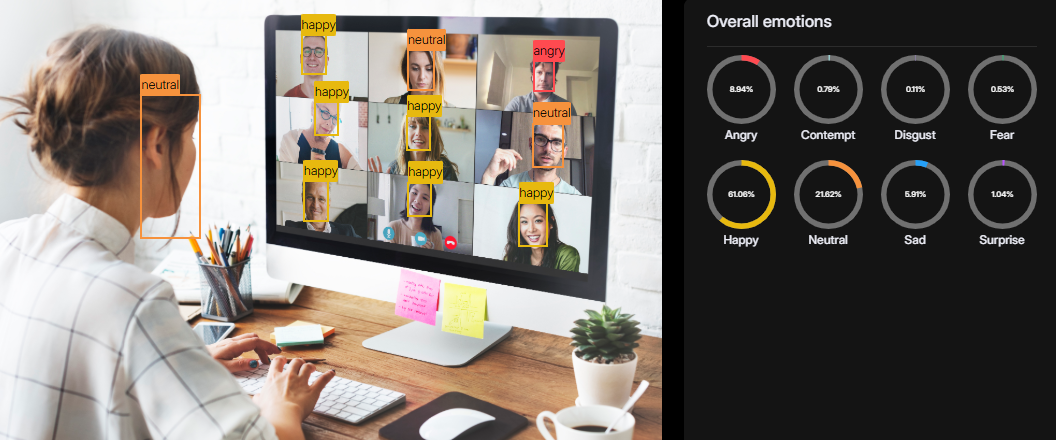
Advanced systems rely on multimodal analysis to approximate emotional states by integrating facial, vocal, textual, and behavioral cues.
Translating Affective Science into Measurable Data
Facial emotion recognition models are rooted in the Facial Action Coding System (FACS) , which maps muscle activations to probabilistic emotional states. A raised inner brow, tightened eyelids, and lip corner pull each correspond to specific action units. These measurable muscular contractions reflect expressed emotion, not necessarily internal feeling.
Audio emotion analysis captures prosodic features, pitch variability, tempo, intensity, and spectral qualities that correlate with arousal and valence. Sustained monotony may indicate low affect; sharp fluctuations may indicate high arousal emotions.
Text-based analysis uses natural language processing to identify sentiment polarity. Text reveals conscious feeling reports and interpretative framing rather than raw affect.
Image emotion detection captures momentary affective display from still visuals, but cannot infer longitudinal mood without repeated sampling.
Single snapshots reveal emotion. Patterns across time reveal mood.
Multimodal Integration in Imentiv AI
Imentiv AI integrates video emotion analysis, audio affect detection, text sentiment mapping, and image-based emotion recognition into a unified multimodal framework. By triangulating across channels, it reduces overreliance on any single modality.
For instance, if facial data indicates positive valence but vocal tone reflects tension and text expresses dissatisfaction, the system can detect incongruence, potential emotional masking. Repeated low-valence patterns across sessions may suggest mood trends rather than isolated emotional reactions.
The platform further incorporates video-based personality analysis, examining expressive consistency, emotional reactivity, regulation tendencies, and behavioral stability. These patterns contribute to identity-level insights rather than single emotional events. Importantly, psychologist review adds contextual validation, ensuring interpretations remain ethically grounded and scientifically aligned.
The Deeper Truth
Emotion is the rapid adaptive surge. Affect is the continuous neurophysiological tone. Feeling is a conscious interpretation. Mood is an enduring emotional climate.
Emotion AI, when grounded in scientific differentiation, does not claim to read minds. It models observable correlates of affective systems. Here, Imentiv AI demonstrates how multimodal integration, video, audio, text, image, and psychologist-informed interpretation can approximate the layered architecture of human emotional life with increasing precision.
Ready to move beyond guesswork and truly understand emotional patterns?
Explore Imentiv AI and experience emotion intelligence in action.