Envy
Envy is an emotion that arises when a person desires something that someone else has—such as success, status, recognition, relationships, or material possessions- and feels discomfort, resentment, or dissatisfaction because of that comparison. It is a common human experience and often emerges in social contexts where people measure themselves against others.
Envy can range from mild feelings of longing or frustration to more intense emotions involving bitterness or self-criticism. For example, someone may feel envy when a colleague receives a promotion they wanted, or when a peer appears happier or more successful. While often viewed negatively, envy can also signal unmet needs, values, or goals.
Envy From a Psychological Perspective
In psychology, envy is understood as a social comparison emotion. It arises when individuals perceive themselves as lacking something important that another person possesses. Researchers often distinguish between:
- Benign envy, which can motivate self-improvement and goal pursuit
- Malicious envy, which may involve resentment or a desire to see the other person lose their advantage
Psychologically, envy is linked to self-esteem, identity, perceived fairness, and social status. It can influence behavior in both constructive and destructive ways—either encouraging growth and effort or contributing to withdrawal, hostility, or reduced well-being if left unexamined.
How Is Envy Different From Jealousy?
Although envy and jealousy are often used interchangeably in everyday language, psychology treats them as distinct emotions.
- Envy occurs when a person wants something that someone else has, such as success, recognition, status, or relationships. It is rooted in comparison and perceived lack.
- Jealousy involves the fear of losing something one already has, typically a valued relationship or position, to a third party. It is rooted in threat and insecurity, rather than comparison alone.
In simple terms:
- Envy = “I want what they have.”
- Jealousy = “I’m afraid of losing what I have.”
Understanding this distinction is important because the two emotions lead to different behavioral responses. Envy may motivate self-improvement or withdrawal, while jealousy often triggers protective, defensive, or monitoring behaviors.
Envy From an Emotion AI Perspective
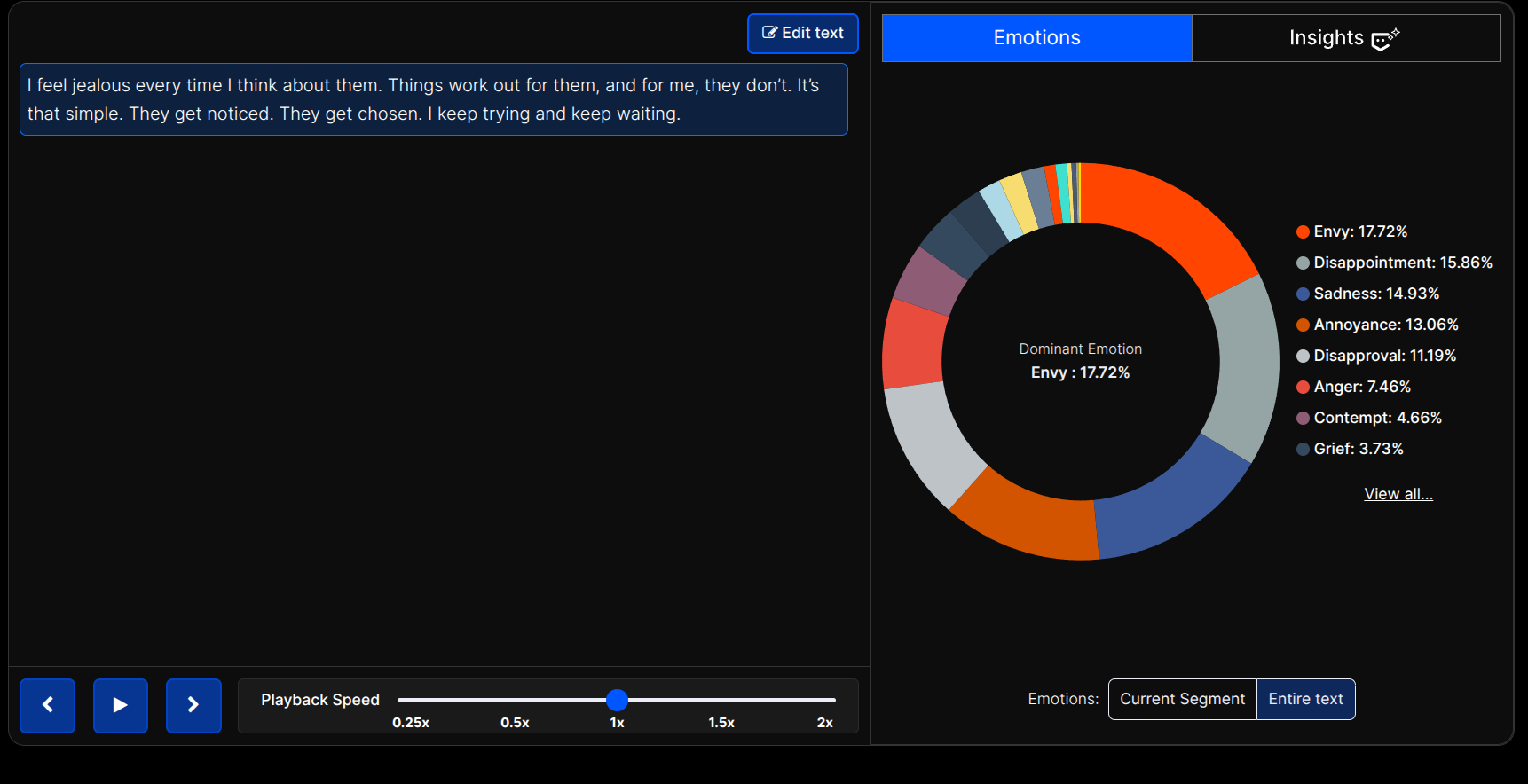
From an Emotion AI perspective, envy is not treated as a single, directly observable emotion. Instead, it is understood as a compound emotional pattern that may involve elements of sadness, frustration, resentment, lowered self-worth, or social tension.
Emotion AI systems focus on detecting patterns over time, such as:
- Shifts in emotional tone during social comparison moments
- Language that reflects self-doubt, comparison, or dissatisfaction
- Changes in engagement or affect following exposure to others’ success
Because envy is highly context-dependent, it cannot be reliably inferred from isolated facial expressions or words alone.
In platforms such as Imentiv AI, envy may be surfaced through text-based emotion analysis, particularly in written communication or transcribed conversations where comparison, evaluation, or competition is present. By identifying linguistic patterns associated with dissatisfaction, self-comparison, resentment, or status sensitivity, Imentiv AI highlights potential comparison-driven emotional shifts over time.
These insights can support research, coaching, workplace analysis, or mental wellness applications by helping professionals better understand how comparison-related emotions influence behavior, motivation, and interaction dynamics over time.
Ethical Considerations
Envy is a subjective and situational emotion shaped by personal history, culture, and context. While Emotion AI systems can identify patterns associated with comparison-related emotional states, these insights are intended to support analysis, not to label individuals or define character. Interpretation should always involve human judgment and contextual understanding. Imentiv AI is designed to complement professional insight, not replace it.