Annoyance
Annoyance is a low- to moderate-intensity emotional state that arises in response to minor irritations, disruptions, or unmet expectations. It is often short-lived, but if the triggering stimulus persists or accumulates over time, it can escalate into stronger emotions such as frustration or anger. It refers to situations, behaviors, sounds, or interactions that repeatedly disrupt attention, expectations, or personal comfort. Unlike intense emotions such as anger or rage, annoyance is typically lower in intensity but can build over time if the source persists.
For example, a repetitive noise, constant interruptions during work, or someone speaking over others in a meeting may be described as annoying. The reaction is often subtle at first, such as eye-rolling, sighing, and reduced patience, but can escalate if the stimulus continues.
Annoyance is highly subjective. What one person finds mildly irritating, another may barely notice. Context, mood, stress levels, and cultural expectations all influence how something is perceived.

Is Annoyance Different From Frustration or Anger?
Although related, these emotions differ in intensity and focus:
- Annoyance is mild irritation triggered by minor disruptions.
- Frustration arises when a goal is blocked or progress is prevented.
- Anger is a higher-intensity response often tied to perceived injustice or threat.
In simple terms:
- Annoyance = “This is irritating.”
- Frustration = “This is stopping me.”
- Anger = “This is wrong.”
Annoyance can escalate into frustration or anger if the source remains unresolved.
Annoyance From a Psychological Perspective
From a psychological standpoint, annoyance is both an emotional and cognitive response. It involves an appraisal of a situation as mildly unpleasant, unjustified, repetitive, or obstructive without posing a serious threat. Psychologically, annoyance often signals a boundary violation, inefficiency, or disruption, prompting a person either to resolve the issue or mentally distance themselves from it.
Unlike intense anger, annoyance typically stems from small, recurring stressors, such as background noise, slow responses, repeated interruptions, minor mistakes, perceived incompetence and inefficiency, or delay. It reflects a mismatch between expectations and experience. Over time, repeated minor irritations can accumulate, increasing emotional intensity.
Individual differences also matter. Personality traits, stress levels, tolerance thresholds, and emotional regulation capacity influence how frequently someone experiences annoyance and how strongly they express it.
While annoyance is generally mild, chronic or unaddressed annoyance can reduce concentration, affect mood, strain interpersonal relationships, and can escalate into conflicts. At the same time, annoyance can serve a functional role by signaling that something in the environment requires adjustment.
Annoyance in Interpersonal and Organizational Contexts
In interpersonal communication, frequent expressions of annoyance, through tone shifts, sarcasm, sighing, dismissive responses, or withdrawal, can gradually reduce social cohesion.
If unaddressed, minor irritation may escalate into frustration or open conflict.
In organizational, classroom, or customer experience settings, recognizing early signs of annoyance allows for timely intervention. Addressing irritation early can improve collaboration, satisfaction, engagement, and overall interaction quality.
How Emotion AI perceives Annoyance
In Emotion AI and affective computing, annoyance is not treated as a single isolated signal but as a pattern of subtle cues across modalities.
Annoyance may be detected through:
Facial indicators
- Eye rolling
- Lip pressing
- Micro-frowns
- Tightened jaw
- Irritated tone
- Clipped or shortened speech
- Audible sighing
- Changes in pitch or pacing
Textual indicators
- Impatience in phrasing
- Repetitive complaints
- Passive-aggressive language
- Abrupt or dismissive responses
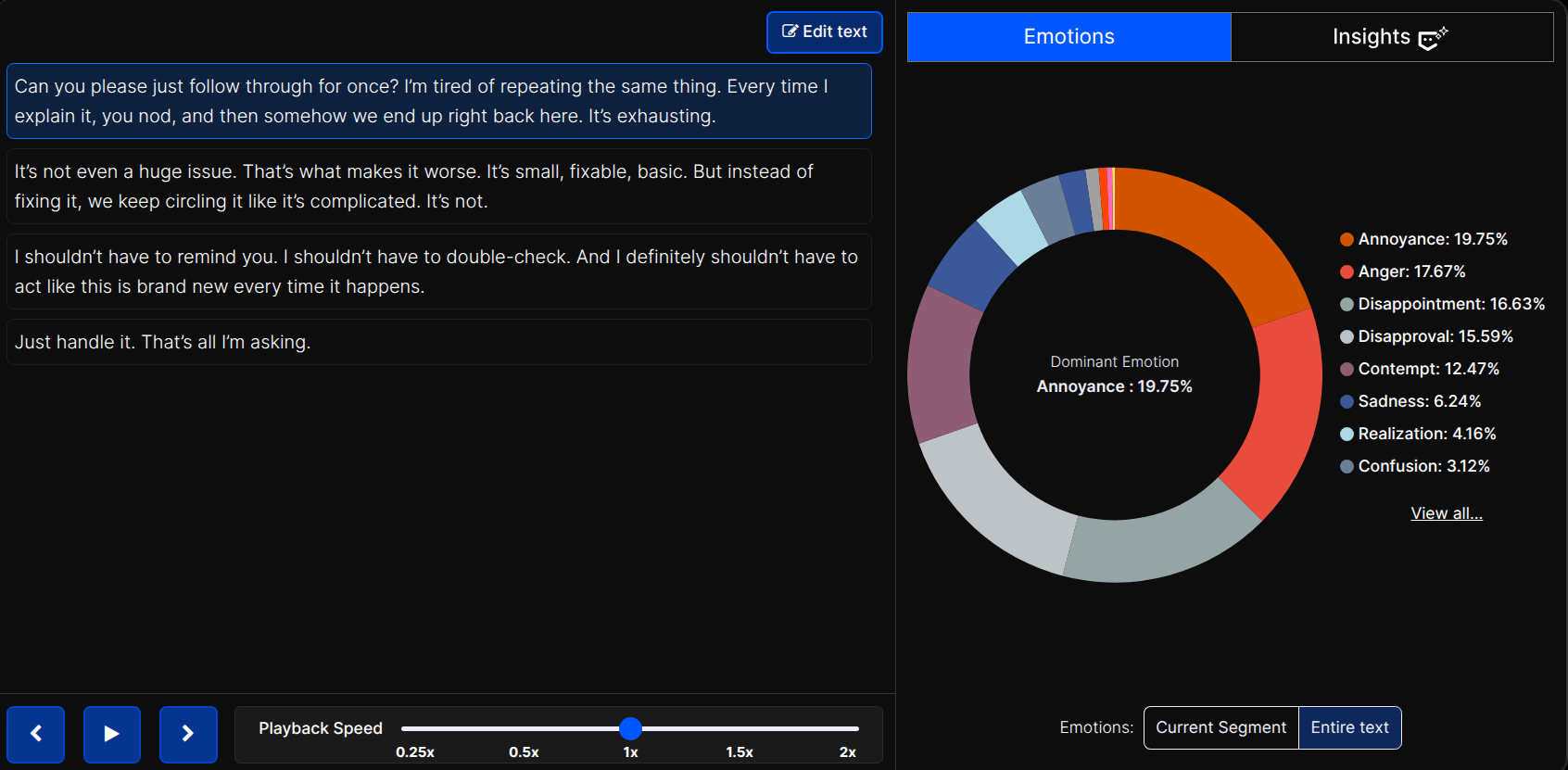
Because annoyance is subtle and context-dependent, reliable identification depends on detecting patterns over time rather than single instances.
Recognizing annoyance in real time enables adaptive systems, such as virtual assistants, customer service platforms, and learning tools, to adjust tone, pacing, or response style to improve interaction flow.
In platforms such as Imentiv AI, annoyance may be surfaced through text emotion analysis in written communication or transcribed conversations. The system identifies linguistic cues and recurring patterns that suggest irritation, reduced patience, or mounting frustration.
These insights can support professionals in research, workplace communication analysis, learning environments, or customer experience review by highlighting moments where interaction quality may be declining. The goal is not to assign blame, but to surface patterns that may influence collaboration, engagement, or performance.