When Journaling Watches Back: How AI Video Journaling Is Redefining Emotional Awareness in 2026
Journaling has long been a way to slow down, reflect, and make sense of internal experiences. People write to organize thoughts, speak to release emotional weight, and revisit memories with more clarity. In today's world, however, journaling is evolving beyond words and voice. With the emergence of AI-powered video journaling , emotional expression is no longer limited to what we consciously articulate. It now includes facial expressions, vocal tone, pauses, spoken language, and behavioural cues , offering a more realistic picture of how emotions are actually experienced.
Unlike traditional journaling, video captures what often escapes awareness. A neutral sentence delivered with tired eyes, slowed speech, or emotional restraint can carry far more meaning than the words themselves. When analyzed using Video Emotion Analysis, Audio Emotion Detection, Transcript Emotion Interpretation, and Personality Insights, video journaling becomes a powerful tool for emotional self-understanding rather than simple self-expression.
Human emotions are inherently
multimodal
. Affective neuroscience consistently shows that emotional meaning is distributed across the face, voice, body, and language, not just words. This is why people frequently struggle to understand how they truly feel through text alone. Language tends to simplify, rationalize, or even minimize emotion.
Video journaling introduces
self-observation
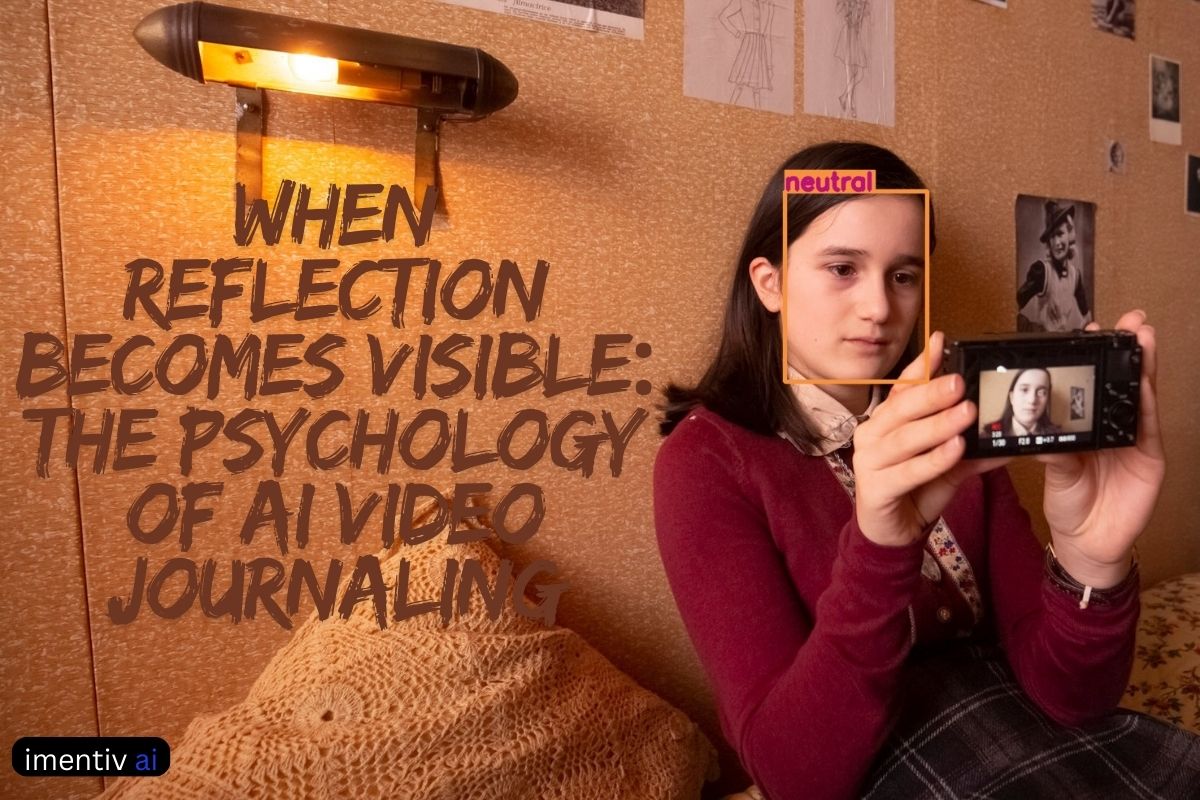
, a psychologically powerful process. When individuals watch themselves speak, they often notice emotional truths they were unaware of while recording. People realize they appear more fatigued than expected, more guarded when discussing certain topics, or more emotionally activated when recalling specific memories.
Imentiv AI’s
Video Emotion Recognition Platform
relies on
multimodal emotion analysis
, interpreting emotion through multiple channels simultaneously. This approach closely mirrors how humans perceive emotion in real life.
Facial emotion recognition analyzes micro-expressions, muscle activation, and changes in intensity to detect emotions such as sadness, anxiety, relief, or emotional suppression.
Audio emotion analysis
captures tone, pitch variability, speech rhythm, energy levels, and pauses, often revealing stress, fatigue, or emotional tension even when language sounds neutral.
Spoken content is converted into transcripts and analyzed for emotional themes, cognitive patterns, emotional valence, rumination, and self-talk style. Across repeated video entries,
personality insights
begin to emerge, highlighting tendencies such as emotional openness, self-criticism, resilience, or avoidance.
Together, these layers do not simply answer
“How do I feel today?”
They reveal
how emotions are processed, regulated, and carried forward over time
.
Emotion rarely appears in clear, dramatic expressions, especially during periods of recovery, sleep deprivation, or psychological transition. Video journaling captures this emotional complexity with remarkable precision.
Video processed through imentiv ai
In this first entry, recorded shortly after hospital discharge, the speaker introduces himself and explains why he has chosen a video journal over writing. The tone is subdued, reflective, and marked by disrupted sleep.
Psychologically, the near balance between neutrality and sadness is significant. Neutrality in this context does not indicate emotional stability; it often reflects
emotional depletion or numbness
, commonly observed after medical stress or prolonged exhaustion. Sadness is present but restrained, expressed quietly rather than dramatically.
Transcript analysis reveals uncertainty, low expectations, and subtle bids for connection, such as
“if anyone’s watching, if anyone cares.”
The emotional meaning lies in tone, pacing, and hesitation, elements that would be difficult to capture through text alone.
Video processed through Imentiv AI”
The second entry, recorded the following evening, shows a noticeable emotional shift. While physical exhaustion remains, emotional depth increases through a detailed dream narrative, something the speaker notes has been absent for a long time.
Here, sadness becomes dominant, accompanied by subtle fear and emotional activation. The dream contains symbolic imagery associated with helplessness, observation without control, and confrontation with the self. Although the speaker verbally minimizes the experience, describing it as “not really a nightmare”, emotional data reveals increased emotional intensity.
This discrepancy between language and emotion is psychologically meaningful and is surfaced clearly through
Imentiv AI’s multimodal emotion analysis
.
What truly distinguishes AI video journaling is how
Insights
and
Psychologist Review work
together
to transform emotional data into meaningful reflection. The Insights feature synthesizes facial emotion patterns, vocal shifts, transcript themes, and personality tendencies to address questions users often struggle to articulate: why certain topics consistently drain energy, why emotional expression feels muted, or why emotional intensity surfaces through storytelling rather than direct disclosure.
The
Psychologist Review feature within Imentiv AI
adds essential human context to these insights. Trained psychologists interpret emotional outputs alongside narrative content, distinguishing emotional numbness from regulation, fatigue from disengagement, and emerging emotional processing from avoidance. This ensures that emotion analysis remains supportive, ethical, and psychologically grounded, reflective rather than reductive.
AI-powered video journaling is gaining attention across
mental health, therapy
,
coaching, and wellness platforms
because it offers something traditional journaling cannot:
objective emotional visibility over time
.
Repeated video entries reveal emotional patterns, triggers, and recovery trajectories that are often missed by memory alone. Subtle changes in facial affect or vocal energy can signal emotional strain before burnout becomes consciously recognized. In therapeutic settings, this reduces recall bias and supports deeper, more accurate conversations.
Perhaps most importantly, video journaling helps normalize emotional fluctuation. Users see that their emotional landscape includes both struggle and progress, reducing self-blame and supporting emotional regulation.
Wellness apps, journaling tools, therapy platforms, and corporate well-being systems can integrate
Imentiv AI’s Video Emotion Recognition APIs
to create emotionally intelligent experiences. By combining
video, audio, transcript analysis, personality insights, AI-generated reflections, and psychologist review
, platforms move beyond surface-level mood tracking into
genuine emotional understanding
.
This is not about monitoring emotion.
It is about
supporting awareness, reflection, and emotional growth
.
Ethical use of Emotion AI is essential. Responsible platforms prioritize informed consent, data privacy, transparency, and non-pathologizing interpretation. Emotion AI should never
replace human care or clinical judgment.
As Carl Rogers once said,
“When someone truly hears you without judgment, you feel free.”
AI-powered video journaling should offer that same experience, a respectful mirror that helps people understand themselves more clearly.
Explore how AI-powered video journaling can deepen emotional awareness and mental well-being.
Build the next generation of emotionally intelligent wellness platforms with Imentiv AI.
Why Video Journaling Feels More Honest Than Writing or Audio Alone
From a psychological perspective, video journaling supports emotional processing in several ways:
How AI Video Emotion Analysis Understands Emotional Expression
Real Video Journaling Examples: Emotion in Its Natural State
The following examples are analyzed using
Imentiv AI’s Video Emotion Recognition Platform
, combining
facial emotion analysis, audio emotion detection, transcript interpretation, and AI-generated insights
.
Video Journal #1
.png?alt=media&token=200ac585-c6b6-44fe-8e71-bf790a388c0a)
.png?alt=media&token=e041df13-ba43-4477-91da-b4c50fab4d54)
Video Journal #2 – Dreaming
.png?alt=media&token=4a1cba4f-07d6-4687-82fd-c943c42413dc)
Insights and Psychologist Review: Turning Emotion Data into Understanding
.png?alt=media&token=885312f6-d5be-48ea-a0b8-d09b3756bfd1)
.png?alt=media&token=789aab24-d25c-4a86-bee4-aa4729bea5c6)
Why AI Video Journaling Matters for Mental Health
Building Emotionally Intelligent Platforms with Imentiv AI
Emotion AI as a Reflective Companion