%20(100%20x%2073%20px)%20(1200%20x%20800%20px)%201.jpg?alt=media&token=de6da4f1-7ceb-4b6b-8d15-bb640cc24c00?w=3840&q=75)
What If Emotion AI Could Map the Emotional Engine of Virality?
“Emotions drive people to action. They make us laugh, shout, and cry, and they make us talk, share, and buy. So rather than quoting statistics or providing information, we need to focus on feelings.”
Jonah Berger
You finish reading an article.
Your heart rate shifts slightly. You feel charged, maybe inspired? outraged?
Then, without thinking too much, you share it.
Why?
Have you ever wondered why you share certain articles, videos, and content?
Well, in the third chapter of Contagious: Why Things Catch On , a book by Jonah Berger that explores the science behind why ideas and content go viral, Berger makes a sharp observation that quietly reframes how we think about virality. Content doesn’t spread simply because it is positive. It spreads because it activates us . High-arousal emotions drive behavior, whether positive or negative.
Activation Over Positivity
Awe spreads. Anger spreads
Anxiety spreads. Excitement spreads.
But calm… rarely does.

Now digging deep, we believed that the hidden axis behind viral content was to make it positive, make it relatable, and make it emotional, and then it will travel. We optimized for warmth. We optimized for inspiration. We optimized for likability. But virality has never been powered by positivity alone. Emotion is not a label. It’s a coordinate.
When you reduce emotion to categories such as happy, sad, and angry, you flatten its structure. You ignore the intensity. You ignore the activation. You ignore the very mechanism that converts feeling into behavior.
Something can feel good, but very calm, and calm rarely pushes people to act. On the other hand, something can feel intense, exciting, surprising, or even frustrating, and that intensity is what drives sharing.
So the real hidden factor behind viral content isn’t just positivity. It’s activation. When people feel emotionally energized, they’re far more likely to pass something along.
Arousal as the Engine of Viral Marketing
Now imagine if that activation could be seen.
Behind every piece of writing or video is an invisible emotional journey. A reader or viewer begins in neutrality. A headline or opening scene sparks curiosity. The narrative builds tension. A key moment triggers awe, excitement, or even outrage. The ending either restores hope or heightens urgency.
What feels like a smooth, engaging experience on the surface is actually a steady movement across emotional states. Your audience isn’t just consuming information; they’re traveling through shifts in feeling, intensity, and energy from beginning to end.
Two Dimensions of Feeling
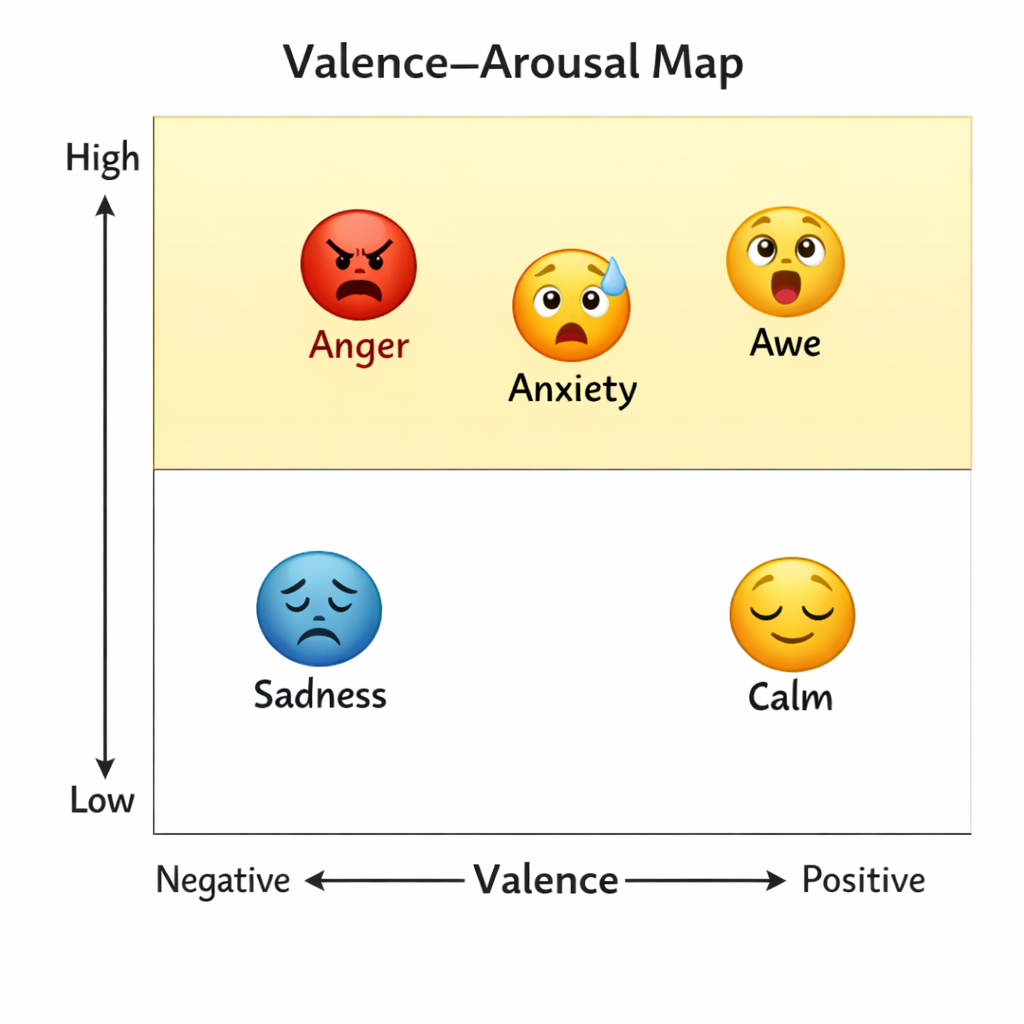
This is where the valence-arousal model framework becomes powerful. Instead of treating emotion as a simple label, happy, sad, or angry, it plots experience along two continuous axes. Valence measures whether the emotion feels positive or negative. Arousal measures the intensity of activation in the nervous system. High arousal sits at the top of the graph; low arousal rests at the bottom. The content that drives behavior almost always rises to the surface.
Berger’s argument does more than tell us that emotion is important. More specifically, Berger isolates arousal as a primary transmission factor. In high-arousal states, the bodies are physiologically activated, heart rate increases, attention is heightened, and energy is mobilized. That activation does not like to be still. It requires release, and sharing is the most natural thing to do.
This explains why anger-fueled posts also circulate rapidly. It explains why awe-inspiring videos travel across platforms within hours. It explains why anxiety-provoking headlines trigger immediate clicks and reposts. The valence-positive or negative shapes the flavor of the response, but arousal determines whether the response turns into action.
From a marketing standpoint, this is profound. Campaigns do not fail because they lack information; they fail because they lack activation. A technically sound message that evokes low arousal remains static. A message that activates, even controversially, moves. Viral marketing is less about broad positivity and more about calibrated stimulation. The most effective campaigns elevate arousal deliberately, then guide it toward a desired behavior.
If Berger explains why high arousal spreads, the valence–arousal model shows where it lives.
And this is precisely where Imentiv AI becomes transformative for creators.
Consider a writer crafting an article meant to inspire change. The introduction establishes context, but the emotional activation remains low. The middle section introduces tension, data that challenge assumptions, and stories that unsettle comfort. Arousal rises. Then comes a pivotal insight framed in a way that evokes possibility rather than despair. High arousal meets positive valence. That combination, energized optimism, is fertile ground for transmission.
From Theory to Measurement
.jpg?alt=media&token=13ad2d91-8c93-436e-8594-24fe04de2cdf)
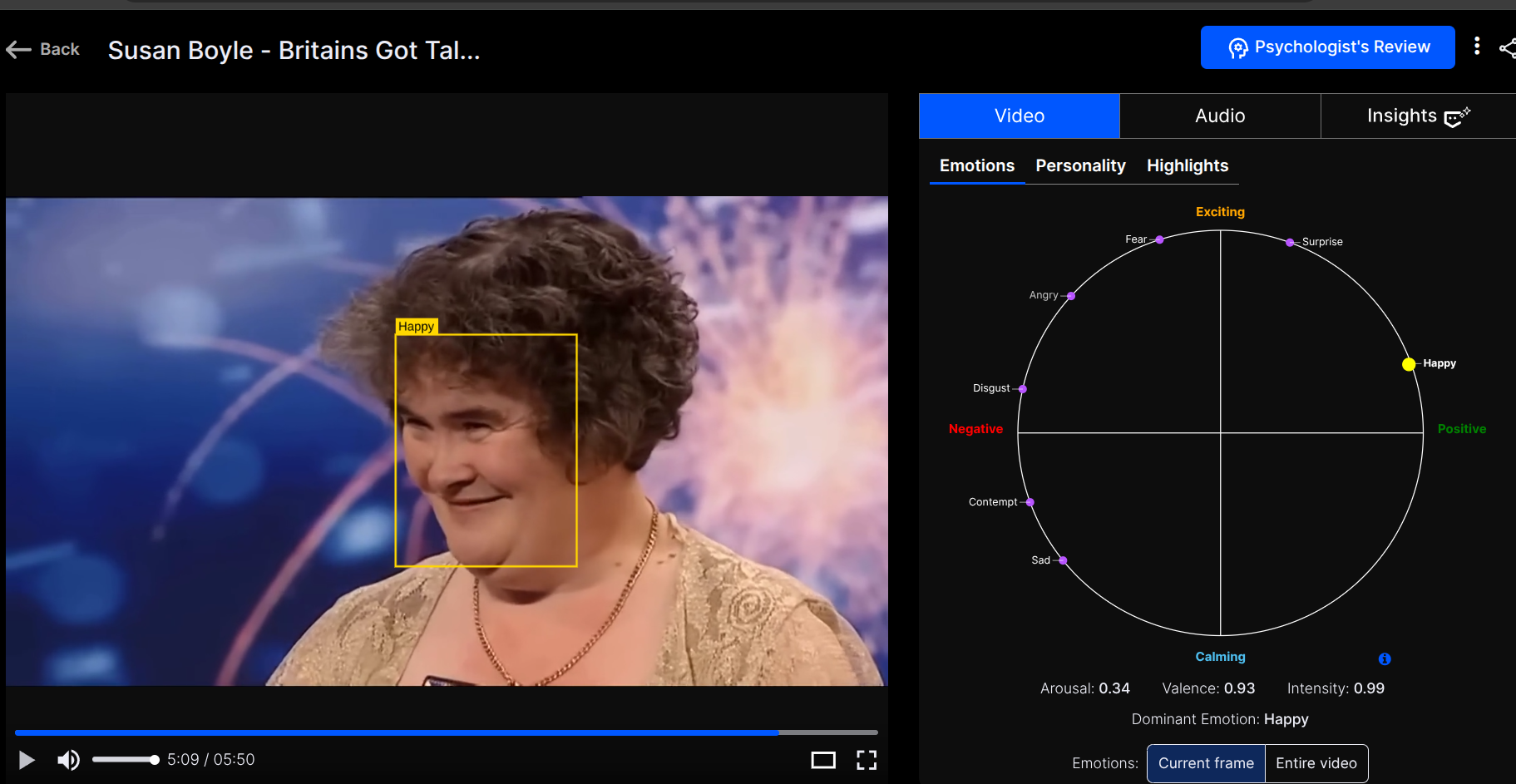
Without measurement, this arc is an intention. With Imentiv AI, it becomes observable. We provide real-time valence–arousal mapping of your content, grounded in James A. Russell’s (1980) Circumplex Model of Affect. By plotting emotional responses across the dimensions of valence (pleasant–unpleasant) and arousal (activation–deactivation), creators can see whether the audience’s emotional trajectory followed the intended climb.
If tension generates anxiety but never resolves into empowered hope, the visualization will show sustained high negative arousal. If the narrative failed to activate at all, the marker will remain near the neutral centre or in low-arousal territory. Instead of inferring impact, you can diagnose it—frame by frame, beat by beat.
While the valence–arousal graph reveals the emotional trajectory of content, Imentiv AI also analyzes emotional signals across video, audio, text, and images. By combining facial cues, vocal tone, language patterns, and visual context, it offers a deeper understanding of how audiences emotionally experience content.
Understanding, Not Manipulation
This is not about manipulating audiences; it is about understanding them. Emotion plays a central role in cognition. When arousal increases, attention sharpens, memory encoding strengthens, and motivation rises. As Jonah Berger explains in Contagious: Why Things Catch On, physiologically activated emotions are more likely to translate into action—people share, discuss, and respond because the feeling demands release.
For marketers, this insight is critical. Campaigns often fail not because they lack clarity or polish, but because they fail to elevate emotional activation. They inform without stimulating and persuade without energizing. Viral performance rarely comes from positivity alone; it comes from calibrated stimulation that channels emotional energy toward a goal—whether that is conversation, advocacy, or conversion.
Traditional metrics like click-through rates or shares only show outcomes. Tools like Imentiv AI make the underlying emotional dynamics visible by mapping audience responses across valence and arousal, revealing how content actually moves people.
Measuring Activation
For marketers, this changes how creative work is evaluated. Instead of relying only on impressions or shares, teams can examine whether a campaign moment truly generated high arousal or simply mild interest. The difference between calm approval and activated enthusiasm matters because behavior tends to follow emotional activation.
This approach does not replace creativity; it sharpens it. Marketers still craft stories, shape positioning, and define voice, but those decisions can now be evaluated through the lens of emotional activation. Rather than asking only whether a campaign feels compelling, teams can analyze its activation curve. Does arousal rise at key moments? Does it sustain enough energy to drive action?
The valence–arousal framework explains where emotions sit, while insights from Jonah Berger highlight why activation drives sharing. Platforms such as Imentiv AI make these emotional dynamics measurable, helping marketers design content that channels activation into meaningful audience response.
Stop hoping your content moves people, and start measuring what actually does with Imentiv AI.