%20(100%20x%2073%20px)%20(1200%20x%20800%20px)%20(3)%201.jpg?alt=media&token=14c56b78-a792-4245-aa02-1d294277fb49&w=3840&q=75)
Using Emotion AI to Decode the Emotional Drivers Behind High-Performing Ads
What makes someone stop scrolling? What makes them click, share, or better yet buy?
It's rarely the offer. It's rarely even the product.
It's how the ad makes them feel.
The most successful advertising campaigns in history, from Nike's "Just Do It" to Apple's "1984," weren't built on rational arguments. They were built on emotional ones. They made audiences feel something powerful enough to act on. And yet, for decades, marketers have relied on surveys, click-through rates, and A/B tests to measure what's working, tools that capture behavior but consistently miss the emotion driving it.
That's the gap Emotion AI for advertising and ad analysis was built to close. And it's precisely what Imentiv AI is designed to do.
Upload your ad and see how it performs emotionally →
What Emotion AI Actually Does
Emotion AI is a branch of artificial intelligence that analyzes human emotional signals — facial expressions, vocal tone, and language — and converts them into structured, measurable data.
Think of it as giving your analytics team the ability to read the room.
Imentiv AI's multimodal engine does this across three channels simultaneously — video, audio, and text — building what it calls an emotional fingerprint of your content. Rather than asking audiences "Did you like this ad?" a question that produces socially filtered, often unreliable answers, Imentiv AI observes genuine, emotional responses. It identifies not just whether someone felt something, but what they felt, when they felt it, and how intensely.
For advertising teams, this changes everything.
The Problem With Conventional Ad Testing
Here's a scenario most marketing teams know well.
An ad performs beautifully in concept testing. Audiences rate it highly. Sentiment scores look positive. It goes live — and underperforms.
Why? Because conventional testing methods capture what people think about an ad after they've processed it, but they often miss the emotional appeal in advertising that actually drives decisions. They don't capture the split-second emotional reactions that actually drive purchase decisions, brand recall, and sharing behavior.
Neuroscience research consistently shows that emotional responses precede rational ones. By the time a viewer is consciously forming an opinion about your ad, their emotional response has already determined the outcome. Conventional metrics arrive too late to the story.
Emotion AI Across Digital Touchpoints
This is where things get genuinely exciting for modern marketing teams.
Applying emotion AI for customer sentiment analysis across digital touchpoints means you're no longer measuring emotional response in a single controlled environment — you're tracking how emotional signals shift, and ads’ emotional appeal evolve as audiences encounter your brand across video ads, social media content, digital pre-rolls, landing pages, and beyond.
Every touchpoint tells part of the emotional story. A viewer might feel curiosity during a YouTube pre-roll, trust during a brand explainer, and finally urgency during a retargeted social ad. Understanding that full emotional arc and not just individual moments- is what separates campaigns that convert from those that simply reach.
Imentiv AI maps this entire journey. Using Valence–Arousal Mapping, it visualizes emotional peaks, dips, and sustained activation across the ad timeline — giving creative and strategy teams a precise, frame-by-frame picture of how emotional energy builds and shifts across every touchpoint in the campaign.
What High-Performing Ads Have in Common
They create an early emotional hook. The first five seconds carry disproportionate weight. Ads that generate strong emotional activation in the opening moments — curiosity, warmth, mild surprise — hold attention significantly longer than those that build slowly.
They manage emotional pacing deliberately. High-performing campaigns succeed not just because of messaging, but because of how effectively they build and sustain emotional appeal in advertising across key moments such as introducing tension, building connection, and resolving with a feeling that the brand owns: confidence, relief, joy, and belonging.
They align emotional tone with brand identity. The emotion an ad generates at its peak moment should feel inseparable from the brand itself. When there's a mismatch — an ad that generates excitement but sells a product people associate with calm trust — emotional resonance breaks down even if production quality is high.
They work at the level of individual moments. The difference between a good ad and a great one is often a single scene, a line of dialogue, or a visual cut. Imentiv AI identifies precisely which moments are generating the strongest emotional responses — and which are quietly losing the audience — with timestamped precision.
Why Imentiv Emotion AI is the Future of Ad Analysis
Imentiv AI brings Emotion AI for advertising into a practical, usable workflow—helping teams move from raw data to clear creative decisions.
At its core, the platform performs advanced ad analysis by combining facial expressions, voice tone, and language to capture real emotional reactions. This allows teams to understand the true emotional appeal in advertising, not just surface-level engagement metrics.
What makes this especially powerful is the combination of the Valence–Arousal Graph and the AI Insights feature. Instead of manually interpreting complex data, teams can both visualize and interact with emotional patterns in their content.
Two Key Features for Effective Ad Analysis
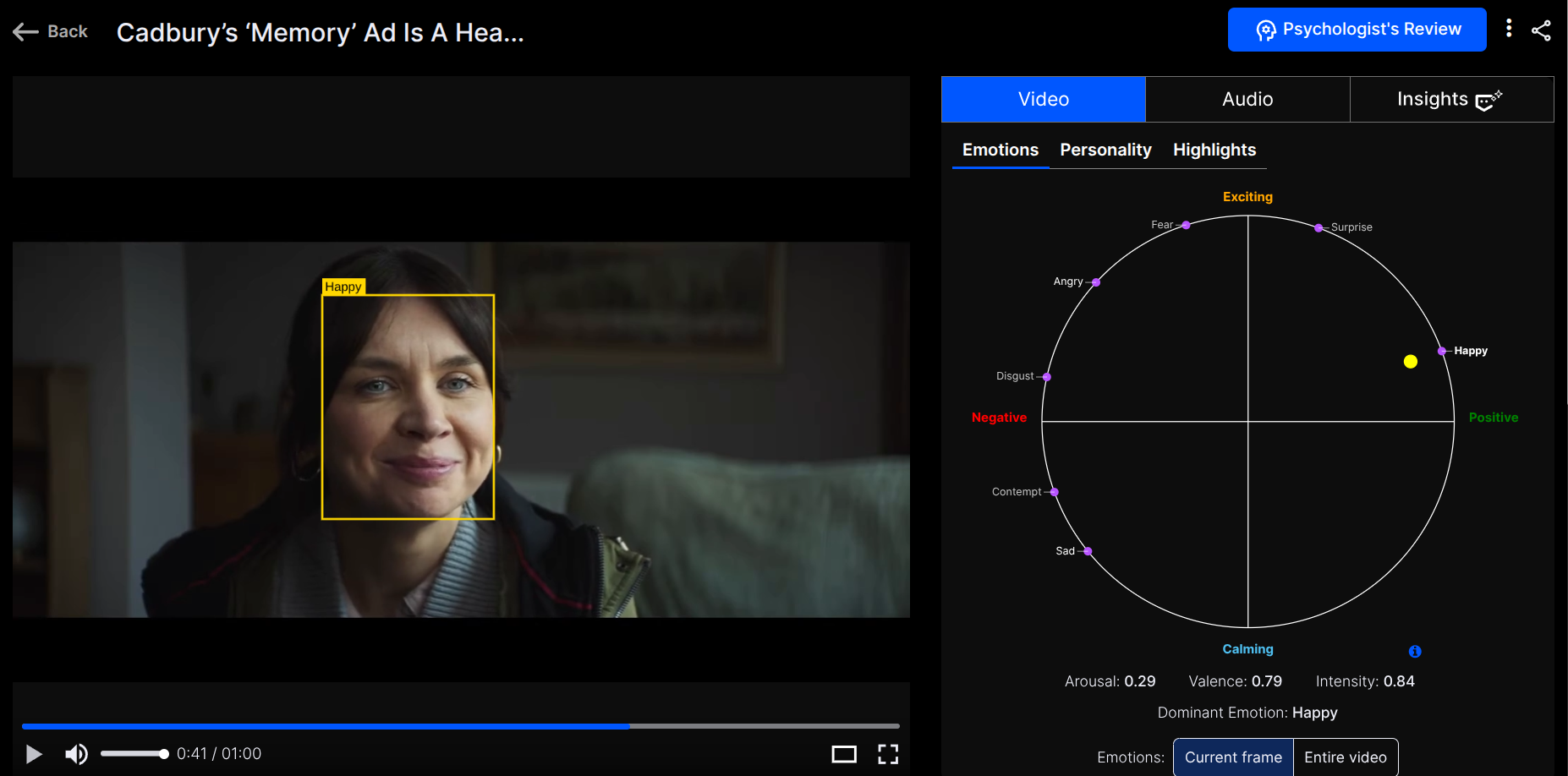
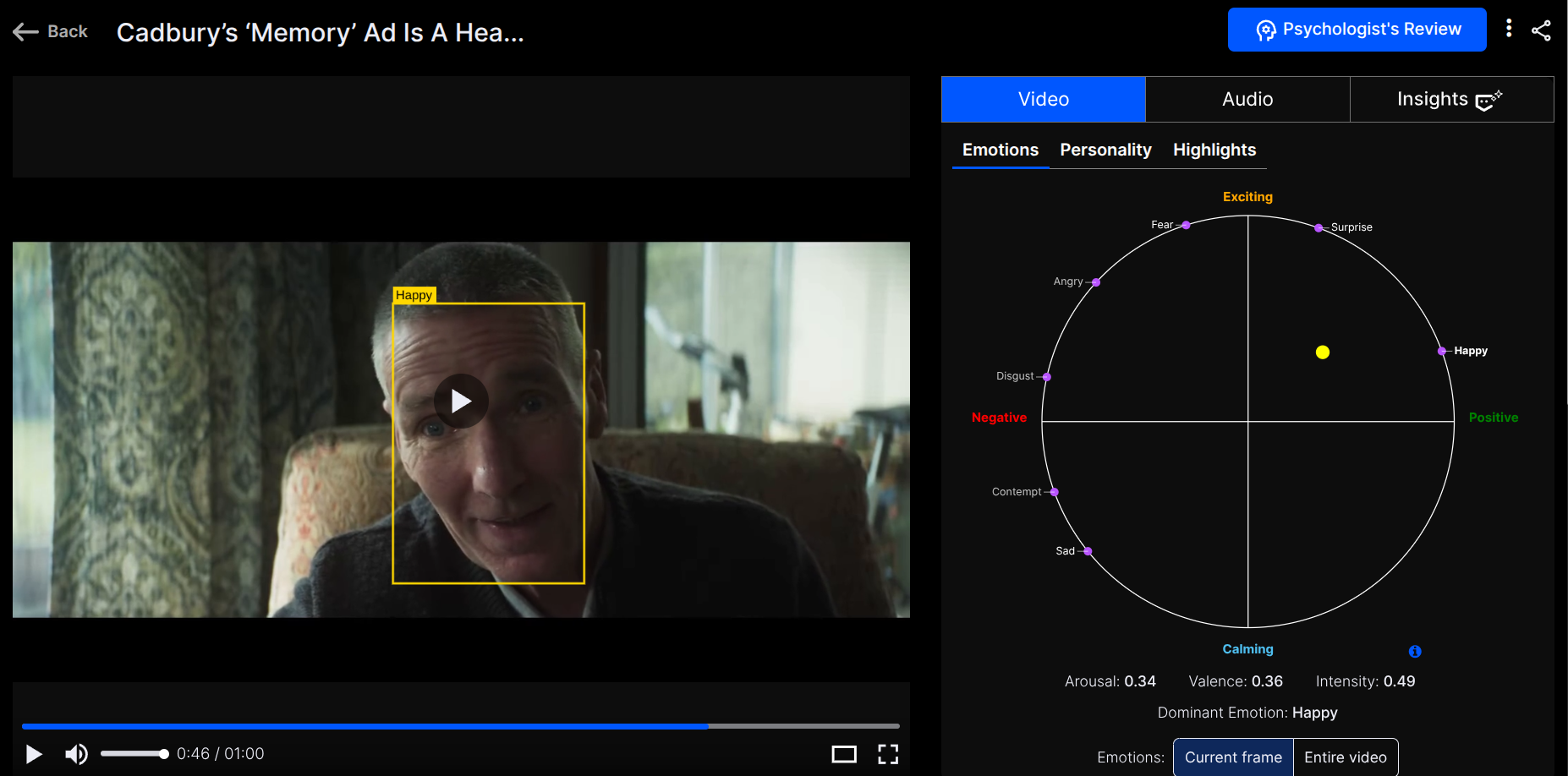
The Valence–Arousal Graph maps emotional responses across two critical dimensions—how positive or negative an emotion is (valence) and how intense or activated it is (arousal). Instead of static metrics, this creates a continuous emotional timeline of your ad, showing exactly where attention builds, drops, or shifts.
For ad analysis, this becomes highly actionable:
- Identify drop-off moments where viewers lose interest
- Pinpoint high-impact scenes that drive emotional engagement
- Compare emotional pacing across different ad versions or cuts
- Detect mismatches (e.g., high arousal but negative valence → confusion or stress)
This helps creative teams refine story structure, pacing, and messaging, rather than relying only on surface-level metrics like views or CTR.
On top of this, the AI Insights feature turns emotion data into direct answers. Instead of manually interpreting graphs, teams can ask questions like:
- Which part of the ad lost engagement?
- Where did emotional intensity peak?
- What emotional signals are driving viewer response?
- “Engagement dropped after the pricing reveal due to increased concern signals.”
- “Peak positive response occurred during the product demonstration.”
For ad analysis, this enables:
- Faster creative iteration cycles
- Clear justification for edits and decisions
- Better alignment between marketing, creative, and strategy teams
Together, these features shift ad analysis from “what happened” to “why it happened.” And beyond these, Imentiv AI includes additional capabilities across emotion detection, personality insights, and multimodal analysis—giving teams a more complete understanding of audience response from a single platform.
Cadbury’s ‘Memory’ Ad analysed
Cadbury’s ‘Memory’ Ad analysed
Improve Ad Performance with Smarter Emotion AI Decisions
For marketing teams, creative agencies, and brand strategists, Imentiv AI isn't a replacement for creative instinct; it's the intelligence layer that sharpens it.
When you can see, with timestamped precision, that your narrative loses emotional engagement at the 18-second mark, you don't need to guess what to fix. When you can map how the same ad lands emotionally across different digital touchpoints — and see that it resonates differently on social versus connected TV — you can optimize with a confidence that gut instinct alone never allows.
The brands winning attention in today's oversaturated digital landscape aren't necessarily the ones with the biggest budgets. They're the ones who understand emotion at a structural level — and Imentiv AI gives every team the tools to do exactly that.
Emotion has always driven advertising performance. Imentiv AI simply makes it measurable through advanced AI for advertising and ad analysis.