Desire
Desire is a motivating emotion characterized by a strong feeling of longing, wanting, or craving directed toward a person, object, experience, or outcome. It is an approach-oriented emotion that drives goal-directed behavior and sustained attention. Desire can range from mild preference to intense yearning, and is often accompanied by anticipation, hope, and heightened focus. Unlike passive emotions, desire actively orients an individual toward something perceived as rewarding or fulfilling.
What is Desire in Psychology?
In psychology, desire is understood as a core motivational state that influences thought, behavior, and decision-making. It is closely linked to reward processing, intrinsic motivation, and the anticipation of pleasure or satisfaction. Desire differs from mere preference in that it carries emotional intensity and a felt sense of lack or incompleteness that motivates action. It plays a central role in areas such as attachment theory, consumer behavior, self-determination theory, and the study of emotion regulation. When desire is fulfilled, it often transitions into satisfaction or joy; when unmet, it may give rise to frustration, longing, or sadness
Desire plays a central role in reinforcement learning, habit formation, and goal pursuit. Neurocognitively, desire is associated with dopaminergic pathways involved in reward anticipation rather than reward consumption itself. In other words, desire is often strongest in the “wanting” phase, before fulfillment occurs.
Desire can manifest in multiple domains:
- Physical desire: hunger, thirst, sexual attraction, or sensory cravings.
- Emotional desire : longing for connection, belonging, validation, or intimacy.
- Aspirational desire : ambition, achievement, recognition, mastery, or growth.
- Material desire : wanting possessions, status symbols, or financial security.
Where Does Desire Fit in Plutchik's Model of Emotions?
Within Plutchik's Wheel of Emotions, desire is not classified as a primary emotion but is considered a secondary or blended emotion. It is commonly understood as a combination of anticipation and joy — where anticipation reflects a forward-oriented focus on a future state, and joy represents the positive valence associated with the imagined reward. This blend explains why desire carries both a sense of excitement and emotional investment, making it more complex and context-dependent than basic emotions.
How Is Desire Viewed from an Emotion AI Perspective?
From an Emotion AI perspective, desire is treated as a compound emotional state rather than a single, easily identifiable signal. It typically surfaces through a constellation of behavioral and expressive cues, such as sustained attention, positive anticipatory affect, heightened engagement, subtle facial expressions like raised brows or parted lips, and forward-leaning body language. Because desire is deeply tied to individual context, values, and goals, it cannot be reliably inferred from a single isolated signal.
Emotion AI systems approach this complexity by analyzing emotional patterns across multiple modalities — including facial expressions, voice tone, speech dynamics, and text — over time. By observing how emotional signals evolve within an interaction or narrative, Emotion AI can help surface indicators of longing, intent, and motivated engagement. Ethical Emotion AI systems do not assign judgment about the nature or appropriateness of desire; instead, they provide probabilistic insights that support informed human interpretation.
How Does Imentiv AI Identify Desire Through Transcription Analysis?
From the Imentiv AI perspective, desire is identified through transcription and language-based signals. When analyzing transcribed speech or text, Imentiv AI examines linguistic markers commonly associated with desire, such as expressions of wanting, aspirational language, future-oriented phrasing, emotionally charged word choices, and references to goals or longed-for outcomes. These language cues are analyzed alongside vocal tone and emotional patterns to detect shifts toward anticipation, motivation, or emotional investment.
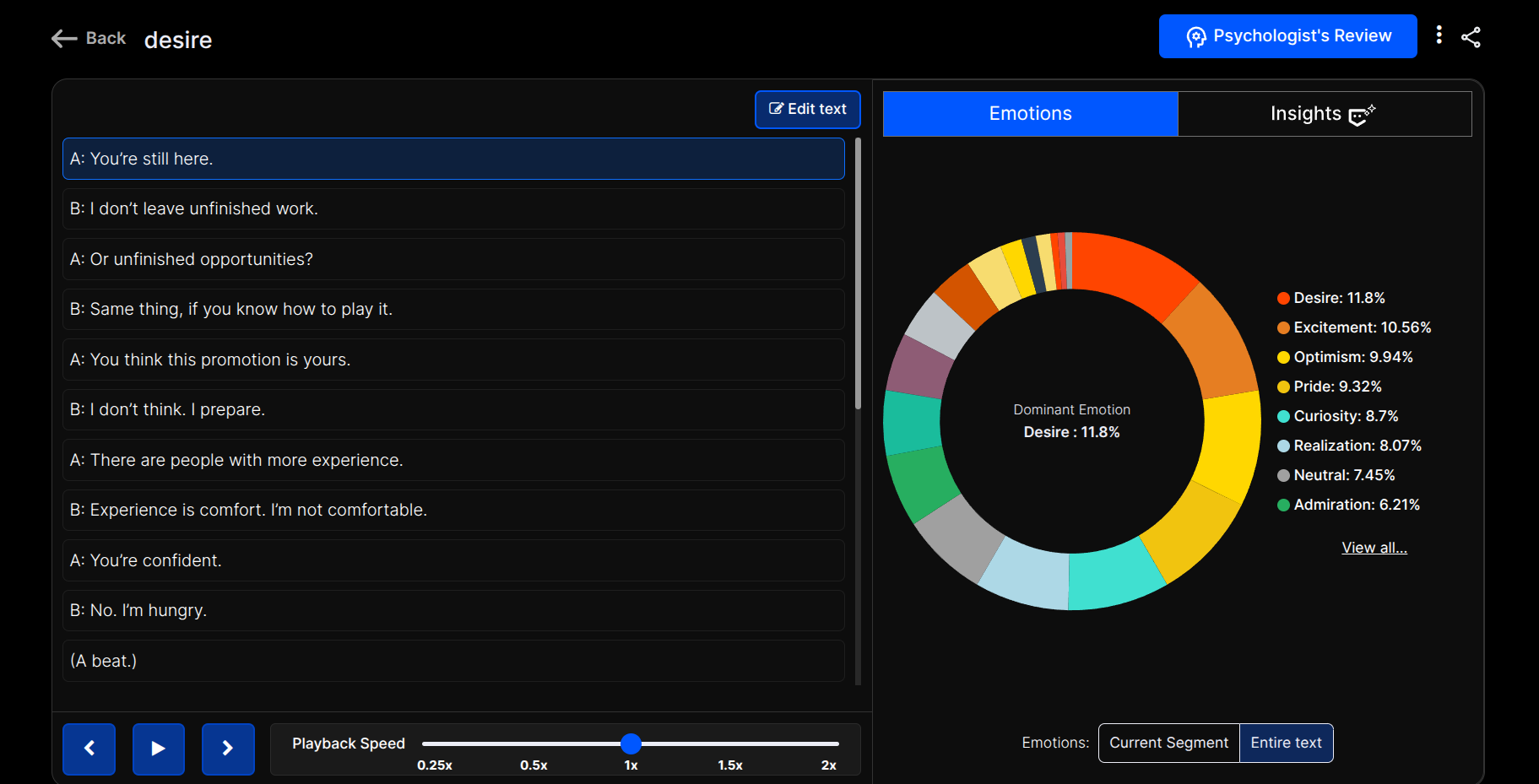
Rather than labeling desire as a definitive emotional state, Imentiv AI offers emotional context that may help interpret moments of longing, intent, or engagement within communication. When used ethically and with human oversight, this approach supports applications in research, coaching, consumer insights, and mental wellness by enabling a more empathetic, context-aware understanding of emotional behavior — while respecting the complexity and sensitivity of human emotions.
Why Is Ethical Interpretation Important When Analyzing Desire?
Because desire is deeply personal and shaped by individual context, values, and circumstance, ethical interpretation is essential. Imentiv AI is designed to support emotional awareness rather than assign intent or judgment. By focusing on emotional patterns instead of labels, it enables a more empathetic, human-centered understanding of emotional behavior, particularly in sensitive domains such as mental wellness, research, and behavioral analysis.
Explore how Emotion AI can support a deeper understanding of complex emotions like desire.