Contempt
Contempt is a complex social emotion characterized by feelings of superiority, disdain, or disrespect toward another person or group. It arises when someone evaluates another as inferior, incompetent, immoral, or unworthy of consideration. Unlike momentary irritation, contempt involves a more stable negative judgment about a person’s character or value. It is often expressed through subtle cues such as eye-rolling, smirking, dismissive language, or a tone of moral superiority.
For example, someone might feel contempt toward a coworker they believe acts unfairly or dishonestly, or toward a person whose behavior they see as far below what is acceptable. Contempt is more than simple disagreement; it means looking down on the person and seeing them as less worthy of respect.
Contempt in Basic Emotion Theory
From the perspective of basic emotion research, contempt has been studied extensively by psychologist Paul Ekman, who identified it as one of the universal facial expressions observed across cultures. Ekman’s cross-cultural research found that contempt is uniquely associated with a unilateral lip raise, often appearing as a slight smirk on one side of the mouth. Unlike symmetrical expressions such as happiness or anger, contempt is marked by asymmetry, reinforcing its signaling function of superiority and social judgment.
Ekman described contempt as a moral emotion that communicates social hierarchy. While anger signals that a boundary has been crossed and often motivates confrontation or correction, contempt signals dismissal. It communicates not “You did something wrong,” but rather, “You are beneath my concern.” This distinction is central to understanding its relational impact.

Contempt also differs from disgust , although the two are sometimes confused. Disgust is primarily a response to contamination or revulsion and is evolutionarily linked to disease avoidance. It typically manifests through expressions such as nose wrinkling or upper lip retraction and is directed at something perceived as physically or morally repulsive. Contempt, by contrast, involves evaluation of status or character rather than contamination. Disgust says, “That is revolting.” Anger says, “That is unfair.” Contempt says, “You are inferior.”
Contempt From a Psychological Perspective
In psychology , contempt is considered a moral and relational emotion. It typically involves: Perceived violation of values or norms, A sense of moral superiority, social distancing or withdrawal, and reduced empathy toward the target.
Research in interpersonal psychology has shown that sustained contempt, especially in close relationships, can erode trust, respect, and emotional safety. It is associated with chronic conflict, relational breakdown, and reduced cooperation in both personal and professional settings. At the same time, contempt may function as a boundary-setting signal when individuals perceive serious value violations. However, when persistent, it can contribute to polarization, exclusion, and social fragmentation.
Contempt From an Emotion AI Perspective
From an Emotion AI and affective computing standpoint, contempt is treated as a complex evaluative emotion that may be reflected in subtle expressive and linguistic cues.
%20(100%20x%2073%20px)%20(Instagram%20Post%20(45))%20(1).png?alt=media&token=88b206b8-cf40-46dc-8864-47bf2e46375b)
Potential indicators may include:
Facial cues such as: Unilateral lip raise (a classic contempt expression), Smirking, Eye rolling, and subtle asymmetrical expressions.
Vocal markers : Sarcastic tone, Dismissive or condescending inflection, Slowed or exaggerated speech patterns.
Textual indicators: Derogatory or belittling language, Repeated negative character judgments, Mockery or sarcasm, Dehumanizing phrasing.
Because contempt involves judgment and context, reliable identification requires pattern recognition across interactions rather than isolated words or expressions.
In platforms such as Imentiv AI, contempt may be surfaced through emotion analysis in communication data, including both text and video. In textual communication, the system may identify patterns of dismissal, superiority signaling, or repeated devaluing language over time. In video-based interactions, potential indicators may also emerge through facial expressions and micro-expressions associated with contempt, such as subtle smirks or unilateral lip raises, when these patterns appear consistently within context.
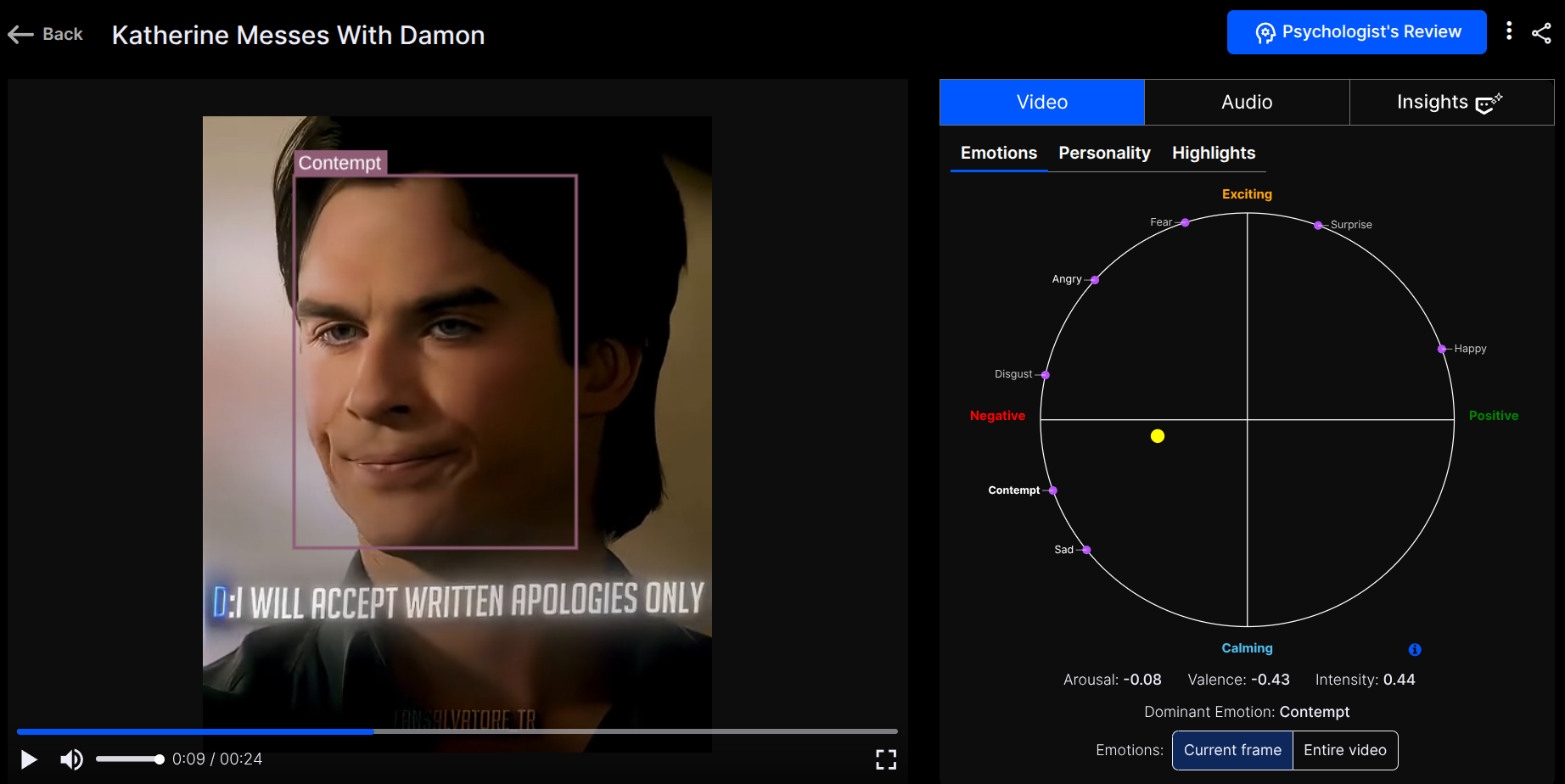
In addition, Imentiv AI applies a multimodal approach to emotional analysis, combining signals from facial expression, voice, text, and behavioral cues to help identify complex emotions like contempt more reliably. By analyzing how language is used, how something is said, and how patterns evolve across interactions, the system can highlight subtle indicators that may not be obvious in isolated messages.
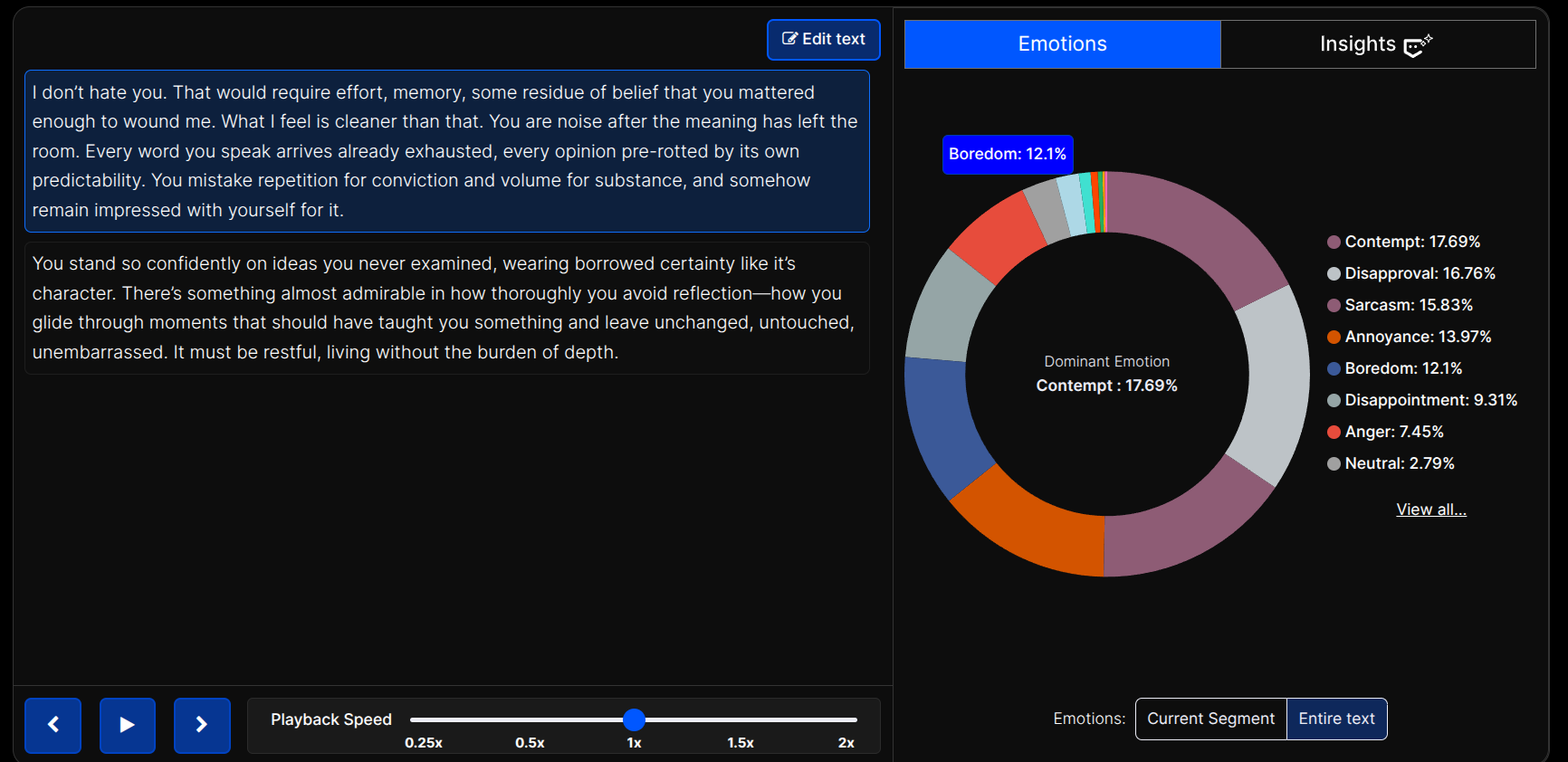
By highlighting potential signals of relational strain, these insights can support research, workplace communication analysis, education, and customer experience evaluation. The aim is not to assign moral judgment, but to surface patterns that may affect collaboration, trust, and interaction quality.
Ethical Considerations
Contempt is highly context-dependent and influenced by culture, power dynamics, and relational history. While Emotion AI systems may detect patterns associated with dismissive or devaluing communication, such signals are intended to support analysis—not to define intent, character, or moral standing. Interpretation should always involve contextual awareness and human judgment. Emotion analysis tools are designed to complement professional insight, not replace it.