Boredom
In conventional usage, boredom, sometimes referred to as ennui or tedium, is an emotional state marked by a lack of interest, engagement, or stimulation in one’s surroundings. It often arises when activities or environments feel repetitive, unchallenging, or lacking in meaning. Although boredom is widely experienced, there is no universally accepted definition. Researchers describe it as a distinct and unpleasant mental state characterized by low stimulation and a strong desire for relief, rather than simply another form of depression or apathy.
Boredom may be accompanied by restlessness, fatigue, or difficulty concentrating, and can lead to disengagement or distraction. For example, a person may experience boredom during a long meeting or lecture that offers little mental challenge or personal relevance. While boredom is a common and universal experience, how it is expressed and tolerated varies across individuals, cultures, and situations.

Research links prolonged boredom to a range of behavioral, social, and health-related consequences, including reduced well-being and motivation. At the same time, boredom has a paradoxical role in human functioning. Creating mental space for reflection, it can encourage creativity, problem-solving, and the exploration of new ideas. This dual nature makes boredom both potentially disruptive and, at times, developmentally valuable, serving as a signal that attention, motivation, or purpose may be misaligned with the current context.
What is Boredom in a Psychological Perspective
From a psychological standpoint, boredom is considered a motivational and attentional state rather than a simple emotion. It reflects a mismatch between an individual’s need for stimulation and the environment available to them. Psychological research links boredom to reduced cognitive engagement, lowered arousal, and a desire for change or novelty.
Boredom may manifest in different forms, such as situational boredom (temporary, context-specific) or trait boredom (a more stable tendency to feel bored across situations). Prolonged or frequent boredom has been associated with decreased well-being, reduced performance, and, in some cases, maladaptive coping behaviors. At the same time, boredom can prompt creativity, exploration, and goal re-evaluation when responded to constructively.
Boredom in an Emotion AI Perspective
From an Emotion AI perspective, boredom is understood as a low-arousal emotional state that often emerges through patterns rather than distinct signals. It may be reflected in reduced facial expressiveness, slower or monotone speech, diminished variation in language, frequent disengagement cues, or shifts in posture and attention.
Because boredom is closely tied to context and task relevance, it cannot be reliably identified from isolated cues alone. Emotion AI systems, therefore, focus on detecting trends over time, such as sustained low engagement or declining emotional variability—rather than momentary indicators.
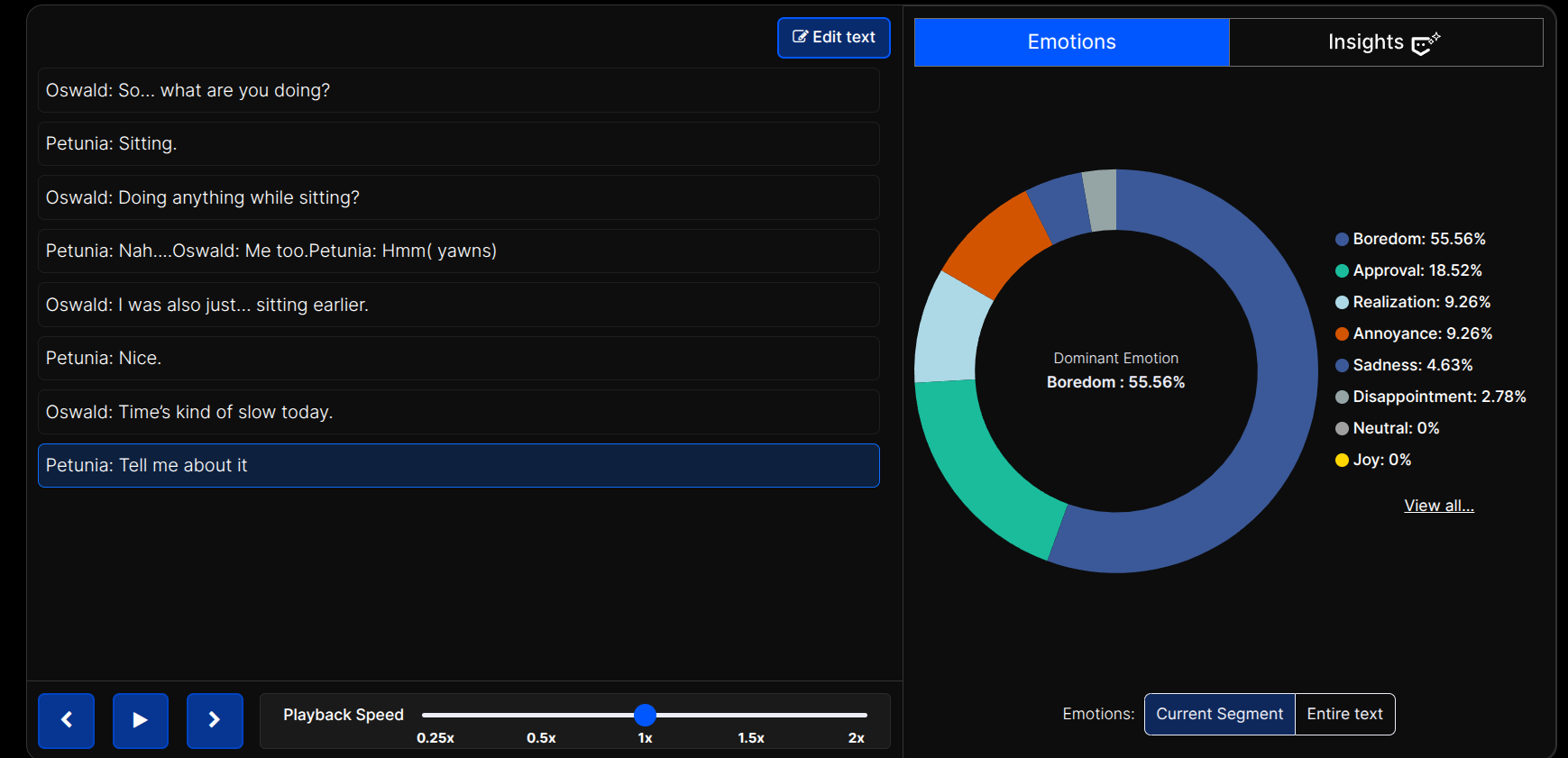
In platforms such as Imentiv AI, boredom can be identified and labeled through multimodal emotion analysis, including facial signals, vocal tone, speech dynamics, and text-based emotion analysis. In transcribed conversations or written communication, Imentiv AI may detect language patterns associated with disengagement, low interest, or reduced emotional activation.
These insights can support professionals in settings such as research, learning and development, customer experience analysis, or workplace engagement assessment by highlighting moments or periods of low engagement. By surfacing boredom-related emotional patterns, Imentiv AI enables more informed human interpretation of attention, motivation, and interaction quality across time.
Ethical Considerations
Boredom is a subjective and context-dependent experience. While Imentiv AI can label boredom based on observable emotional and linguistic patterns, these labels are intended to support analysis, not to define individual intent, attitude, or capability. Interpretation should always consider situational context, cultural factors, and human judgment. Imentiv AI is designed to complement professional insight, not replace it.