.jpg?alt=media&token=92dacc07-ee78-4b58-a0de-acba748fbe77&w=3840&q=75)
What Your Facial Expressions Reveal About Stress and Mood
Our faces are powerful indicators of what we’re feeling inside. From a fleeting smile to a furrowed brow, facial expressions silently communicate stress levels, moods, and emotional states—even when we don’t say a word. Today, with face emotion analysis software and AI facial emotion recognition, these subtle signals can be decoded with new clarity. Advances in artificial intelligence, like Imentiv AI, are transforming how we decode these subtle cues, offering new ways to understand and manage our mental well-being.
With modern facial expression recognition and image emotion recognition technology, we can capture our daily interactions and facial cues. These silent signals can now be analyzed to uncover deeper insights into mood, behavior, and communication patterns. Let’s break down how facial expressions reflect stress and mood, why they matter, and how technology like Imentiv AI helps decode these signals.
The Science Behind Facial Expressions and Emotions
Human faces are powerful emotional storytellers. With over 40 facial muscles, we create thousands of tiny expressions—often in just fractions of a second—that reflect what we’re truly feeling, even when we try to hide it. These subtle movements can signal alertness or fatigue, tension or relaxation, excitement, confusion, frustration, and even whether a smile is genuine or forced.
When stress appears, the face reacts almost instantly. Even if someone tries to remain neutral, small changes in muscle tension around the eyes, forehead, or jaw can quietly reveal their emotional state. This is why facial expressions are often called universal signals—they bridge what we feel inside with what the world sees outside.
For years, researchers have studied how facial movements are connected to emotions like happiness, anger, sadness, calm, and anxiety. Tightened features often suggest stress or discomfort, while more relaxed expressions usually point to ease or contentment. However, reading these micro-expressions accurately is difficult because they happen so quickly and often without conscious control. This is where AI facial expression recognition and facial recognition emotion detection bring real value, by helping capture and interpret these subtle emotional signals.
How Stress Shows Up on Your Face
Stress affects the body, and the face is often the first place it shows. Here’s how:
1. Tightened Jaw or Clenched Teeth
When stressed, your jaw muscles contract automatically. This creates stiffness around the mouth and can even affect how you speak or smile.
2. Furrowed Brows
One of the strongest signs of cognitive overload or pressure. Your eyebrows pull together when you’re thinking hard, anxious, or trying to solve a problem quickly.
3. Forced or Fading Smiles
Under stress, smiles become short-lived or uneven. The eyes stop “smiling,” even if the mouth still does.
4. Rapid Eye Blinking or Avoidance
Blinking speeds up when you’re experiencing discomfort or anxiety. Avoiding eye contact can indicate overwhelm or lack of confidence.
5. Subtle Micro-Expressions
These appear for fractions of a second — a flash of fear, frustration, or sadness — often unnoticed by others but picked up by AI.
Understanding Facial Action Coding System (FACS)
To truly understand how facial expressions reveal stress and mood, it’s important to look at the science behind how expressions are measured. This is where the Facial Action Coding System , or FACS, comes into play.
FACS is a scientifically accepted system developed by psychologists to map every visible facial movement to specific muscle actions. Instead of labeling expressions as “happy” or “sad” right away, FACS breaks them down into small components called Action Units (AUs). Each Action Unit represents the movement of a specific facial muscle or muscle group. For example, tightening of the eyelids, raising of the eyebrows, pulling down the lip corners, or clenching the jaw are all mapped as individual Action Units.
These Action Units do not work in isolation. Emotions like stress, happiness, fear, or frustration appear as combinations of different Action Units occurring together. Stress, for instance, may show up as lowered eyebrows, tightened eyelids, stretched lips, or a clenched jaw. Mood, which is more long-lasting than a single emotion, is reflected in repeated facial patterns over time.
This is exactly how Imentiv AI understands human emotions.
How Imentiv AI Detects Stress and Mood From Facial Expressions
Imentiv AI uses advanced computer vision and deep learning trained on FACS principles to detect facial movements. By simply analyzing static images, our system also tracks continuous facial activity across video frames. This allows it to pick up even the smallest micro-expressions that appear and disappear within fractions of a second.
Here’s how the process works in simple terms:
- Imentiv AI detects key points on the face, such as the eyes, eyebrows, nose, lips, and jawline.
- It tracks how these points move over time to identify specific Action Units.
- It analyzes patterns of these Action Units to determine emotional states like stress, calmness, engagement, fatigue, happiness, or discomfort.
- It converts this data into clear emotional insights that can be used for analysis, reporting, or feedback.
What makes Imentiv AI powerful is its ability to go beyond surface-level expressions. People often try to hide stress behind polite smiles or neutral faces. But micro-expressions still appear briefly and involuntarily. Imentiv AI is designed to capture these hidden emotional signals.
What is an example of Facial Emotion Recognition?
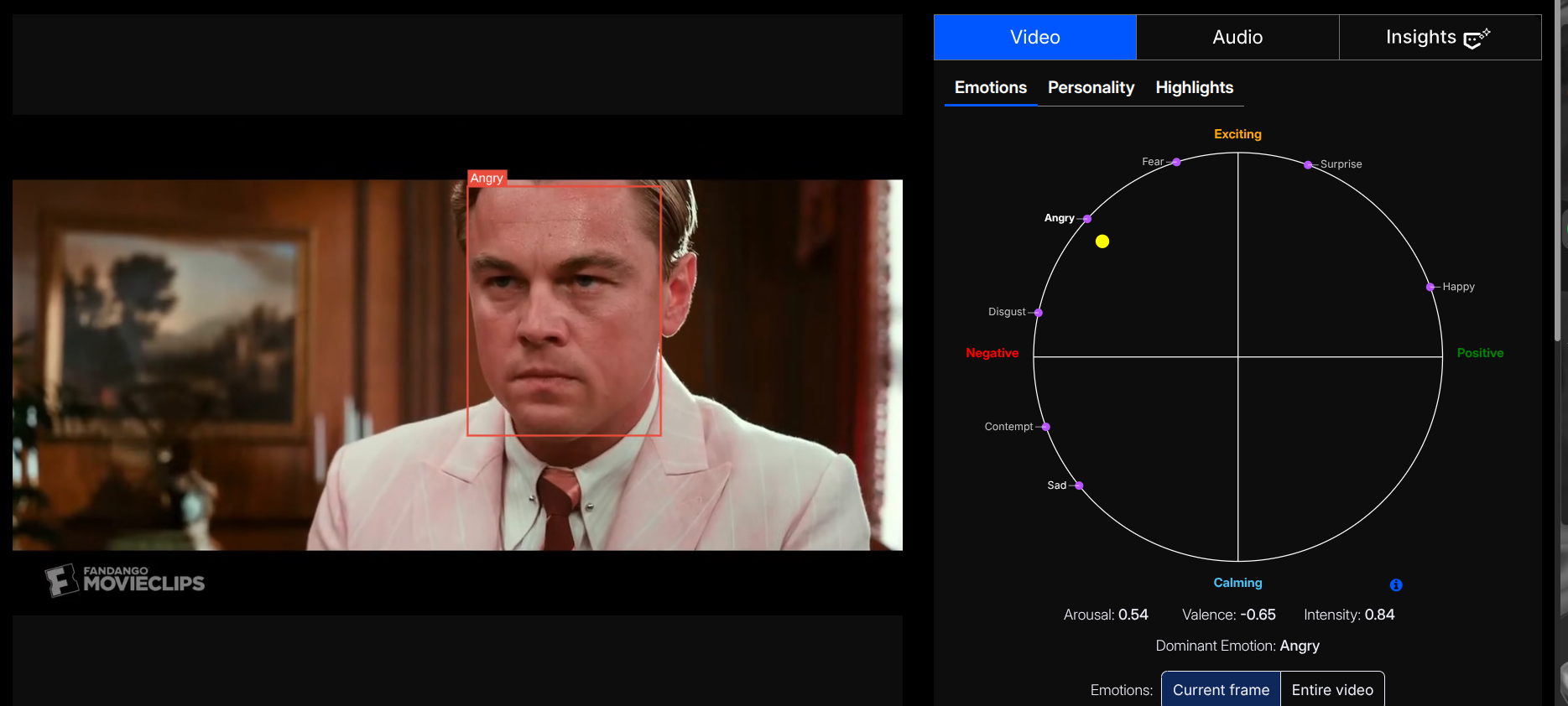
Why This Matters for Mental Well-Being and Communication
By decoding facial expressions through Action Units, Imentiv AI provides an objective view of emotional states. This has a real-world impact across mental health support, workplace well-being, customer interactions, learning environments, and clinical research.
- For individuals, it means greater self-awareness of stress and mood patterns.
- For organizations, it means a better understanding of human behavior, engagement, fatigue, and emotional well-being.
- For researchers and clinicians, it means access to unbiased emotional data that supports better decisions and outcomes.
In a world where emotions are often hidden behind screens and filters, Imentiv AI offers a way to truly understand how people feel—through the science of the face.
Our Expertise Goes Beyond
Imentiv AI goes beyond basic expression detection. By combining video, voice, and text analysis, the platform provides a complete emotional understanding.
It helps you:
- Identify stress signals during interviews, meetings, or presentations
- Track emotional patterns over time
- Understand how your tone and expressions affect others
- Improve leadership, empathy, and team communication
- Make coaching sessions more data-driven and personal
Whether you're a leader, HR professional, coach, or trainer, facial insights can transform how you connect and communicate.
Your face is a window into your emotional world. It reflects stress, mood, and intentions — often more honestly than words. With tools like Imentiv AI , these cues can be understood with clarity and used to build stronger, healthier, and more emotionally intelligent workplaces.
Want to explore how facial emotion insights can enhance communication and leadership?
Visit Imentiv AI and request a demo today.