Image Emotion Recognition: Decode Human Emotions From Any Image
Every image captures more than what meets the eye—it captures emotion. A subtle eyebrow raise, an uncertain smile, a burst of genuine joy, or a moment of disengagement. These micro-cues often reveal more than spoken words ever could. Yet, without the right tools, this emotional layer stays invisible.
Image emotion recognition changes that. By using AI to analyze facial expressions and map emotional signals, it helps organizations understand how people truly feel in real situations—whether during a leadership workshop, a product usability test, a recruitment interview, or a customer reaction study.
With Imentiv AI, this emotional understanding becomes contextual and actionable, empowering teams to make decisions based on real emotional signals rather than assumptions.
What Is Image Emotion Recognition?
Image emotion recognition is the process of using artificial intelligence to detect human emotions from visual inputs—typically faces. The system identifies facial features, maps micro-expressions, and interprets emotional states such as happiness, sadness, anger, fear, and more subtle affective signals.
It goes beyond simple image analysis. Instead of identifying what is in an image, it helps you understand how people feel in that moment.
Common applications include:
- Advertising and creative evaluation
- UX and product testing
- Customer sentiment analysis
- HR tech and recruitment
- Leadership development and coaching
- Academic and behavioral research
- Healthcare and wellbeing monitoring
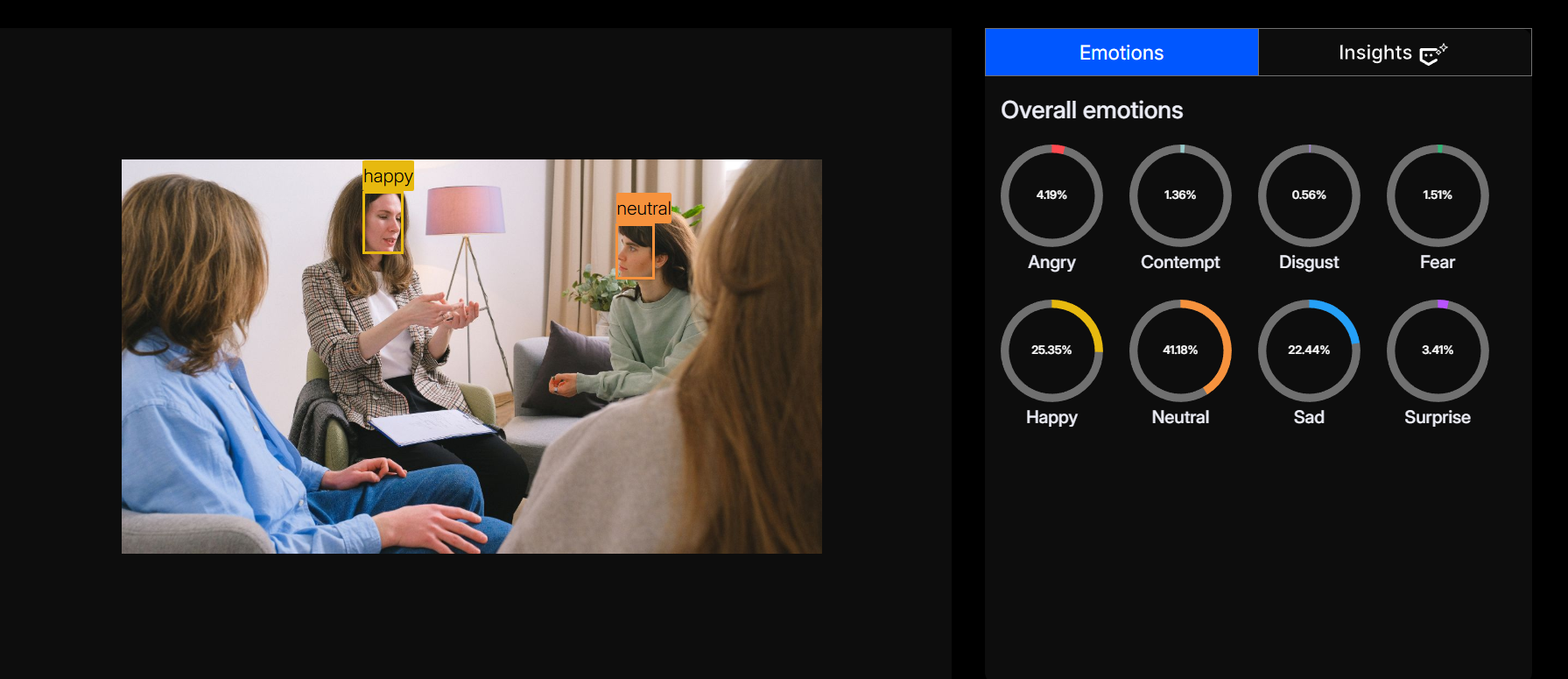
How Image Emotion Recognition Works
Modern systems use a combination of deep learning, face detection, and expression modeling. Here’s how the process typically unfolds:
1. Face Detection and Landmark Mapping
The AI first identifies faces in the image, even in complex or multi-person scenes. It then maps facial landmarks—eyes, brows, mouth, and key muscle regions—to detect subtle movements.
2. Micro-Expression and Feature Analysis
These facial movements are compared against established frameworks like FACS (Facial Action Coding System), which links specific muscle activations to emotional states.
3. Emotion Classification
Using trained neural networks, the system classifies expressions into emotional categories such as happy, sad, disgust, surprise, neutral, anger, contempt, fear, etc.
4. Insight Generation
Finally, the system organizes the emotion data into a downloadable CSV file. This makes it easy to review and use across tools and workflows.
How Imentiv AI Enhances Image Emotion Recognition
Here’s what sets Imentiv AI apart:
Face-by-Face Emotion Insights
Imentiv AI provides a detailed analysis for each detected face, instead of a single mood score. This is ideal for team assessments, UX studies, and research.
Psychologist-Backed Review
In-house psychologist validate complex or ambiguous samples to ensure the quality of insights , making Imentiv AI suitable for leadership and organizational use cases.
AI Insights
Imentiv’s AI doesn’t stop at detecting emotions—it helps you understand them. You can ask questions about the feelings or patterns in the image, and the system responds with clear, context-aware explanations that make the results easy to interpret.
API Integration for Scalable Emotion Analysis
Imentiv AI also offers seamless
API integration, allowing businesses to plug emotion recognition directly into their existing products, workflows, and analytics systems. This makes it easy to automate image analysis at scale without building infrastructure from scratch.
Why Image Emotion Recognition Matters
Emotion drives decision-making. It shapes behavior, reactions, and experiences. Whether you work in leadership coaching, customer research, UX, HR, or creative testing, understanding emotion adds clarity you can’t get from surveys or transcripts alone.
Image emotion recognition gives you:
- More honest reactions
- Richer behavioral insights
- Better decisions based on emotional data
Imentiv AI analyzes not just images but video, audio, and text signals. This creates a richer and better understanding of human emotion. By combining facial expressions, vocal tone, and language cues, it delivers emotional intelligence that goes far beyond traditional single-mode image analysis.
See Emotional Insights in Your Images. Try Image Emotion Recognition with Imentiv AI!